At the 2025 PDF Solutions Users Conference, CEO John Kibarian delivered a wide-ranging keynote that positioned the semiconductor industry at a pivotal inflection point, one driven by explosive AI demand but constrained by unprecedented manufacturing complexity. His central message: the path to a trillion-dollar semiconductor industry by 2030 requires fundamentally rethinking how manufacturers collaborate, leverage data, and deploy AI-driven automation.
The AI-fueled growth imperative
Kibarian opened with striking growth projections that have evolved from ambitious to achievable. The semiconductor industry is on track for approximately 10% annual growth through 2030, with AI serving as the primary catalyst. This isn’t just about data centers; by 2030, roughly two-thirds of semiconductor demand will be AI-influenced, from edge devices to MCUs embedded in everyday products.
The scale of this transformation is staggering: global data center capacity could more than triple by 2030 with a compound annual growth rate near 22%, while edge AI already accounts for over half the semiconductor AI market. Perhaps most tellingly, leading-edge nodes below 2 nanometers will dominate foundry revenue, accounting for 40% by 2030 and 60% by 2035—a clear refutation of persistent “end of Moore’s Law” predictions.
Three fundamental challenges
Kibarian framed the industry’s evolution around three interconnected challenges that PDF Solutions is contributing to address its through its platform and solutions:
The 3D Revolution: Manufacturing has evolved from simple scaling complexity to what Aart de Geus calls “systemic complexity.” This encompasses both chiplet-based system packaging and increasingly three-dimensional wafer processing. Modern products routinely feature 17-18 metal layers with billions of vias to test, while technologies like wafer bonding (once considered exotic for image sensors) have become standard for flash memory and backside power delivery. The infrared sensor in a phone is now a multi-chip system in a package, and even chips used in test equipment are multi-chip modules.
Supply Chain Fragmentation: The traditional semiconductor paradigm of concentrating manufacturing capacity for economies of scale is being upended. As Kibarian noted, the industry is attempting something it has never done before: achieving economic efficiency in disaggregated, globally distributed manufacturing operations. Customers expect competitive pricing regardless of where wafers are manufactured, yet geopolitical realities, talent distribution, and market access requirements are driving capacity expansion across multiple continents simultaneously.
The complexity compounds at the product level. Advanced packages now involve 20+ test insertions, integration of 20+ high-bandwidth memory dies with logic, and emerging technologies like co-packaged optics. Every fabless company has effectively become a manufacturer, responsible for orchestrating complex multi-party supply chains rather than simply receiving finished wafers.
Operational Efficiency Through AI: As 80% of U.S. graduates with semiconductor engineering master’s degrees leave the country and 90% of APAC companies cite talent acquisition as a top priority, the skills shortage is acute. Meanwhile, the industry analyzes only 5-10% of manufacturing data using conventional methods, with data scientists spending 80% of their time on data alignment and preparation rather than actual analysis. This calls for a radically different approach where AI will enable analysts to use all of the available data to make decisions much faster, delivering the increased operational efficiency the industry needs.
Strategic response
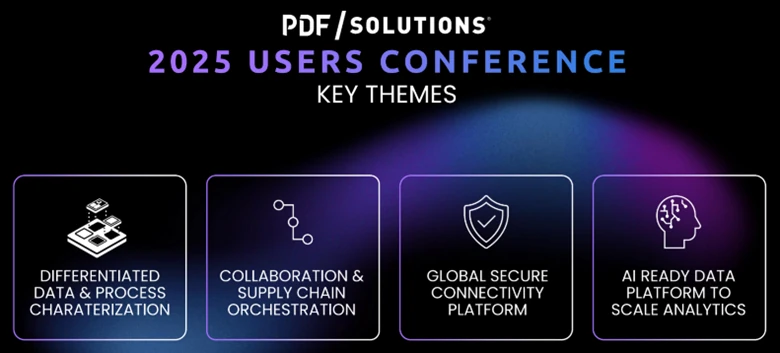
Kibarian outlined how PDF Solutions has evolved its portfolio to address these challenges through four integrated pillars:
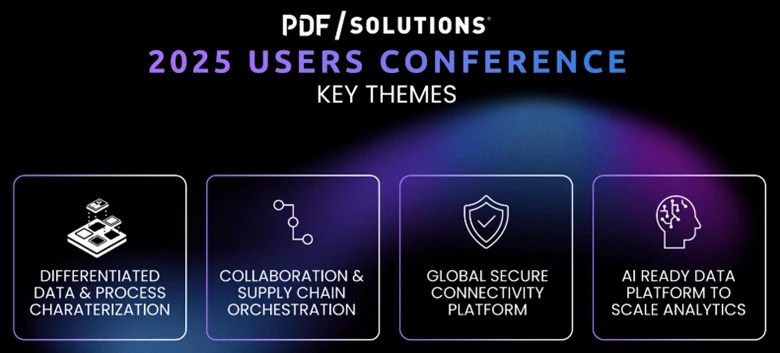
Differentiated Data & Process Characterization: The company’s DirectScan e-beam inline inspection combines voltage contrast inspection with design layout analysis to identify systematic failures before they occur. PDF Solutions’ eProbe technology performs inline inspection capable of testing over 60 trillion vias per year per machine, critical for catching defects in increasingly three-dimensional structures. Advanced test vehicles with tens of thousands of experiments and billions of measurements per wafer are being made more accessible through agentic AI that can interpret complex datasets and generate insights on demand.
AI-Ready Data Platform: Recognizing that current analytics architectures hit fundamental limits around 20,000 parameters, while modern RF and chiplet products routinely generate millions, PDF Solutions unveiled a completely reimagined analytics platform. The new architecture introduces a scalable, parallel, interactive analytics layer between traditional business intelligence tools and data storage, delivering 25x improvements in analytics loading and 42x improvements for critical analyses like test structure release (TSR). Critically, engineers can now work interactively with datasets containing a million test items, an order of magnitude beyond previous capabilities.
Collaboration and Supply Chain Orchestration: PDF Solutions is tackling the orchestration challenge at two levels. Internal orchestrations through Sapience Manufacturing Hub enable seamless integration across MES, ERP, PLM, and EDA tools thus eliminating the data wrangling that consumes most of data scientists’ time. External orchestrations through Supply Chain Hub automate quality assurance, enable real-time work-in-progress tracking, and facilitate data feed-forward applications that allow test parameters from one insertion to optimize subsequent operations.
The philosophy centers on “human governance with AI execution,” establishing rules and guardrails that allow AI to automate up to 90% of analysis while rendering visualizations in seconds and mining 100% of data 100% of the time.
Global Secure Connectivity Platform: In 2020, PDF Solutions acquired Cimetrix, the industry leader in providing software for the connectivity and control of semiconductor manufacturing equipment. This year alone, 8,000 pieces of semiconductor manufacturing equipment will ship with PDF software enabled, making the company, if considered as a single equipment vendor, the largest by unit shipments.
In 2025, through the SecureWISE acquisition, PDF Solutions now operates the semiconductor industry’s largest secure data exchange network, connecting over 300 manufacturing locations and 100+ equipment OEMs with zero security breaches over 20 years. The platform provides end-to-end zero trust architecture, manages petabytes of cloud data with 99.9% uptime across eight regions, and maintains compliance with ISO 27001, a number of regions specific security requirements, and industry-specific SEMI standards.
The efficiency opportunity
Kibarian closed with a provocative calculation that encapsulates both the challenge and opportunity. With $400-500 billion in annual manufacturing costs supporting a trillion-dollar industry, equipment in the world’s most expensive factories operates at only 60-80% efficiency when measured by revenue-generating wafer production. Tools may show 90% uptime, but much of that time produces non-productive wafers—setup wafers, qualification runs, defect scans before release.
“If we could actually squeeze out 10% more capacity out of these factories, it gets us a long way to that trillion-dollar business,” Kibarian argued. This represents PDF Solutions’ call to action: unlocking $140 billion in value through AI-driven collaboration and smarter decisions across the global semiconductor ecosystem.
A transformative moment
What emerges from Kibarian’s presentation is a vision of semiconductor manufacturing undergoing its most profound transformation since the transition to 300mm wafers. The industry must simultaneously scale to unprecedented volumes, master new three-dimensional technologies, orchestrate fragmented global supply chains, and do so with constrained talent, all while maintaining the relentless cost and performance improvements customers expect.
The solution, as PDF Solutions positions it, isn’t simply collecting more data or running more AI models. It’s creating the infrastructure for intelligent collaboration within organizations, across supply chain partners, and between humans and AI systems. It’s building platforms that make petabytes of dark data accessible and actionable. It’s establishing governance frameworks that allow automation to operate safely at scale.
As the semiconductor industry races toward its trillion-dollar future, the winners will be those who can extract maximum value from installed capacity, orchestrate complexity across organizational boundaries, and empower engineers to focus on insights rather than data wrangling. If Kibarian’s vision proves prescient, the path forward runs not through building ever-larger factories, but through making existing factories and supply chains dramatically smarter.
All the content and presentations of the PDF Solutions Users Conference can be found at pdf.com.