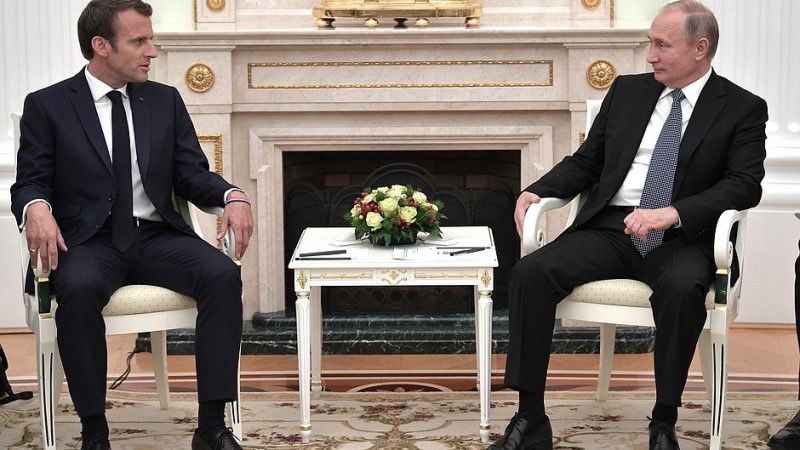
Photo. Kremlin.ru
Copy link
Send email
France’s relationship with Russia has entered a decisive and irreversible phase, shaped by the war in Ukraine, ideological confrontation and the growing risk of escalation with NATO. The assumptions that once underpinned dialogue with Moscow have collapsed, forcing a reassessment of deterrence and European security.
Dr Aleksander Olech speaks with Aurélien Duchêne, author of Putin Against the West, about Russia’s long-term strategy, the credibility of NATO’s red lines and France’s real capacity to act as a security actor in Europe.
Dr. Aleksander Olech: In your book, you argue that Putin’s Russia is once again prepared to turn even the most improbable scenarios into reality. What, in your view, constitutes the most underestimated long-term threat Russia poses to Western countries over the coming decades?
Aurélien Duchêne: The Russian government remains deeply opportunistic, but its ideological dimension is underestimated: this ideology is reinforced by a coherent, albeit composite, body of thought that permeates both Putin’s speeches and school textbooks. The result is a social project that perpetuates confrontation with the West and radicalises it.
The Russian regime officially promotes anti-democratic and Western thinkers, who seem to inspire part of its policy. Putin’s favorite thinker, who is mentioned in many of his speeches and whose books he has distributed to senior officials, is Ivan Ilyin. However, Ivan Ilyin was an openly fascist thinker who supported Mussolini, Franco, and even Hitler at one point.
Putin’s Russia now borrows almost all the characteristics of fascism. This also involves indoctrination from an early age, for example in a youth army, the Yunarmiya. While Russia is not yet totalitarian, it is approaching it in the sense that Arendt understood it: a dynamic that begins with the destruction of truth in order to brainwash the population. And, of course, the population is being prepared for direct war against the West.
Photo. The White House
It is also clear that in this clan-based regime, the »siloviki«, who like their leader Vladimir Putin come from the Russian or Soviet security apparatus, have seized all the levers of power: it is highly likely that Putin’s successor (or even his downfall) will come from among them. Their hard line is no longer contested, as economic circles that were once in favour of rapprochement with the West have rallied to their cause, willingly or by force: it will undoubtedly survive Putin, who is not the most radical member of the group.
Most Russians are allowing this drift to happen or consenting to it with a mixture of resignation and approval, just as they do with the war in Ukraine, which they overwhelmingly support but for which they refuse to mobilise fully. The Kremlin is exploiting this apathy by promoting ideas and personalities that were once considered too extremist, to which Russians are becoming accustomed. And within this passive majority, the millions of the regime’s most fervent supporters form an active minority that is gradually transforming society.
Despite military setbacks, economic sanctions and international isolation, Russia has not collapsed. What internal political, social or ideological mechanisms allow the Russian system to absorb such pressure and continue its confrontational course?
As historian Georges Sokoloff said, Russia is a „poor power,” meaning that even with more limited resources than other powers, it does not hesitate to allocate more resources than richer countries to its power policy, particularly its military power. This is done at the expense of the population, but it must be acknowledged that the Russian people accept economic sacrifices.
Russia cannot afford its »derjavnost«, its supposed vocation as a great power. Its demographic situation in particular promises relative decline. But this »poor power«, which continues to prioritise its international ambitions over the needs of its population, will long remain capable of maintaining a military potential capable of threatening Europe.
Russia ranks only eleventh in the world in terms of nominal gross domestic product (GDP). But in terms of purchasing power parity, which better reflects the size of less developed economies, Russia ranks sixth. This is reflected in its military spending: in terms of purchasing power parity, this is two to three times higher than the statistics commonly used indicate. And Russia’s defence spending, which will amount to 6% of GDP in 2025 (compared to 2% for France), remains sustainable: the United States was at the same level in the 1980s, while the USSR was at 20%.
On the military front, the old arms stocks from which thousands of armoured vehicles sacrificed in Ukraine are drawn could be depleted by 2027. Production in the Russian defence industry has plateaued for most equipment. However, it remains well above that of European countries and can still grow by overcoming labour shortages. Although it cannot make up for all its losses in Ukraine, Russia can rebuild enough to wage a new high-intensity conflict in three to five years, relying on ruggedness and mass.
Finally, the Russian army is adapting, albeit painfully. Admittedly, it is not about to recover the equipment it has lost in Ukraine, but its forces will be larger and, above all, more battle-hardened. It will have recent experience of a major conflict and will have strengthened its capabilities in crucial areas such as drones.
The sanctions are having an impact, particularly on the budget, with Russia forced to dip into its sovereign wealth fund because it is unable to borrow on foreign markets, or even domestic markets, as high inflation is forcing it to pursue a draconian monetary policy. Behind the strong growth figures, many civilian sectors are in the red, and military spending, which is largely responsible for the Russian economy’s good health, is exacerbating its imbalances and causing it to overheat. Added to this are worsening structural problems such as labour shortages.
However, the Russian economy is proving to be more resilient than expected in the face of Western sanctions, both in terms of overall performance and sectoral adaptation, and Russia still has considerable fiscal room for manoeuvre. While an economic collapse cannot be ruled out given the mounting imbalances, the Kremlin will probably have the means to sustain the war economy in the years to come.
Finally, Russians seem to accept enormous military losses for three reasons. First, because they are not used to questioning what those in power do, of course. Secondly, because this war is so profitable for certain sections of the population that people overlook the level of human losses. And worst of all: I spoke with young Russians who said they were proud that their people were shedding blood to remain a people that would count in history, unlike, in their view, the European populations.
You describe Russia’s confrontation with Western democracies as a form of ongoing struggle that does not necessarily require open war. Under what conditions could this confrontation realistically escalate into a direct military conflict with the West?
The most likely scenario is a Russian »test« of Article 5 of the NATO founding treaty, which stipulates that an attack on one member of the Alliance will result in a response from all allies (which is neither automatic nor necessarily military). To test Article 5, Russia would conduct operations that come close to its activation threshold without crossing it, ranging from increasingly aggressive destabilisation campaigns to a limited military operation. The aim for Russia would be to achieve victory over the Western powers without having to fight them, by inflicting a humiliation that they would not dare to respond to with war, which would also show that our alliances and security guarantees are unreliable. However, if the Russians underestimate the threshold at which the Allies would decide to invoke Article 5, a conflict could break out even if that was not Moscow’s initial intention.
Next come scenarios directly linked to the war in Ukraine, whether it escalates to the point of prompting Western intervention (unlikely), or Russia attacks the country again after a few years of armistice, at the risk of coming up against Western security guarantees.
The second scenario is highly likely, as the Russian regime would be tempted to »finish the job«, either to take revenge for a frustrating peace, or because a more favourable peace would encourage it to start again despite the sacrifices made so far. And whether it has revenge to take or an advantage to exploit, Russia could attack a target other than Ukraine, which brings us back to the previous scenario.
Prezydent Karol Nawrocki i prezydent Emmanuel Macron.
Photo. Mikołaj Bujak/KPRP/X
There remains the risk of miscalculation or uncontrolled escalation, which could be triggered by yet another Russian provocation or a serious accident. There are certainly numerous crisis prevention and management mechanisms in place on both the Russian and British sides, but these are not foolproof. This is all the more true with leaders who are uninhibited and even less willing than ours to lose face, especially since the Russians seem to consider that they are already at war with us.
In all these scenarios, Russia would be almost certain to lose, even if it might have a local advantage in the early stages, and its leaders know this. However, they also know that they will have ways out to prevent a total debacle. For example, by resorting to nuclear threats before the conflict spreads to Russian soil or threatens to sweep away the ruling regime.
Because a conflict between Russia and NATO members would, of course, take place under the shadow of nuclear weapons. But the nuclear threshold remains high (contrary to popular belief, Putin has not yet deviated from the fundamentals of deterrence and has never issued a formal nuclear warning), and as long as one of the nuclear powers involved does not consider its vital interests to be at stake, a conventional conflict could reach high levels of intensity.
All in all, while Russia may not want to launch a frontal attack on a much more powerful NATO, it could trigger a war through irresponsible behaviour. Everything points to it preparing for the worst-case scenario, that of a heterotelic war against countries it would rather defeat without fighting them. Not only is Russia willing to risk war with us, it is prepared to wage one. Its leaders have rational reasons for doing so: rather than refusing to believe it, we must understand how much Putin’s and his entourage’s rationality may differ from ours, as the invasion of Ukraine has shown.
In France, debates about Russia have long been dominated by two opposing schools of thought: pro-Russian accommodation and outright rejection. Can we now say that France has made a definitive strategic break with Russia, or does the risk of a future return to „dialogue at any cost” still exist?
Yes, France has clearly made a strategic break with Russia. Of course, there will probably be a desire to resume some form of dialogue, and there will be calls to ease tensions, but it is very unlikely that we will return to the idea of partnership as before. There is a scenario in which even Macron could resume dialogue, but it would be firm dialogue with a hostile power. There will also always be a belief that behind Putin’s criminal madness, there will always be another Russia waiting for its moment, and that one day we will be able to reconnect with it. But we are not likely to see another major presidential candidate proposing an alliance with Russia, or a president proposing to build a „relationship of trust” in the middle of his term. Within the military and diplomatic administration, pro-Russian figures are marginalized, whereas they previously formed a powerful lobby. And public opinion has truly broken with Russia.
President Macron has increasingly framed France as a key actor in European defence, even raising the prospect of direct involvement in deterring Russia. How realistic is France’s ability — politically and militarily — to assume a leading role in the defence of Europe?
In my opinion, France cannot claim complete European leadership for two reasons. First, its leaders (and its population) still seem unaware of what this means and lack any real ambition for leadership, failing to provide the necessary resources. As much as the French are concerned about France’s place in the world, and that of Europe, they do not think enough about what a real French leadership strategy in Europe could be, including in military terms. Secondly, we do not have the capacity to restore a military budget greater than that of Germany, or to build a land force even stronger than that planned by Poland.
That said, France has real capabilities for a form of leadership in the defense of Europe. On the industrial front, even if we no longer produce everything and not fast enough, we know how to do everything and we could produce much more massively by cooperating with countries such as Poland. Militarily, we still have the most comprehensive army model, with unique and sovereign capabilities that we can strengthen and better put at the service of Europe, from space to the seabed, including, of course, nuclear power. Even if it could not send as many soldiers against Russia as neighboring Poland in the event of war in the Baltic countries, France is the European country that can send the most forces far from its borders, and it can still improve on this without breaking the bank. France can make a very high-level contribution in the event of conflict, particularly in terms of air superiority or „enablers” that would be useful to all European armies.
The idea of „dying for Warsaw or Tallinn” remains controversial in parts of French public opinion, while gaining support among others. How do you assess this debate, and can it meaningfully influence Europe’s deterrence posture?
There is clearly still work to be done: it would be wrong to claim that the French are overwhelmingly willing to risk a major war, let alone a nuclear war, for cities that many have never heard of. This is especially true given that some French people (a minority) still harbor contempt for Central and Eastern Europe. However, a growing number of French people are willing to see France intervene militarily to protect an ally against Russian aggression, and this is probably true of the majority of them if we look at the polls.
What dominates among those who favor non-intervention is (as in other countries) the fear of embarking on a conflict against a nuclear power; those who would refuse to help Poland or Estonia for ideological reasons (support for Russia, or simply pacifism) are very much in the minority. And, of course, pro-Russian propaganda focuses on the fear of an escalation that could lead to apocalypse, because millions of people who are ready to defend Europe’s freedom against an aggressor may resign themselves to the idea that it is desirable but too risky.
But I sincerely believe, and I am not saying this because I think France should get heavily involved in a conflict in the East, that France would intervene and that the French people would support this. If only because the French know that if we do not help our allies, it will not only be a huge moral failing, but also a huge historical failing. France would be discredited as a power. Intervening to help our allies would not only mean „dying for Warsaw,” but also defending France’s role, which is incentive enough.
From the perspective of Central and Eastern Europe, Emmanuel Macron is often viewed as one of the most strategically consequential French presidents of the 21st century. Do you agree that his approach marks a genuine shift in France’s understanding of security on NATO’s eastern flank?
It will be up to historians to determine Emmanuel Macron’s long-term impact. But I believe that his approach marks a real turning point, one that his successors will be called upon to continue. The future of the French armed forces will involve a greater focus on NATO’s and the EU’s eastern flank, regardless of who becomes president. More broadly, there is a real understanding that nothing can be achieved in Europe without our partners on the eastern flank, regardless of how they are viewed by French leaders.