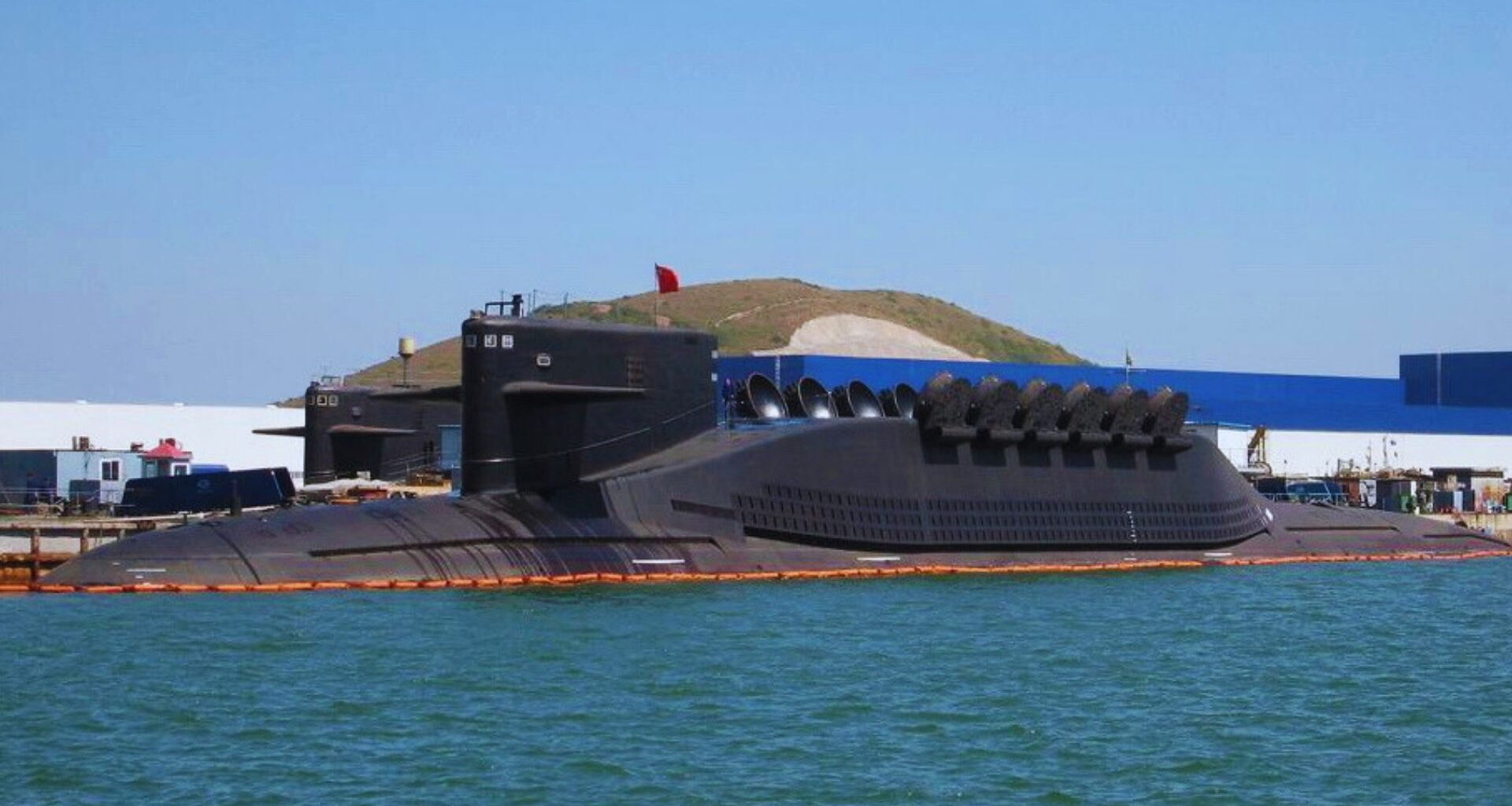
China has overtaken Russia to become the world’s second-largest operator of nuclear-powered submarines.
Updated force assessments indicate that China now operates an estimated 32 active nuclear submarines, surpassing Russia’s fleet of roughly 25 to 28 operational boats. Only the United States remains ahead, with the world’s largest nuclear submarine force.
The United States Navy continues to lead by a wide margin, operating about 71 nuclear-powered submarines as of the end of 2025. That fleet includes fast-attack submarines, ballistic missile submarines, and guided-missile submarines.
However, China’s rapid fleet expansion has narrowed the gap and altered long-standing assumptions about undersea dominance, particularly in the Indo-Pacific region.
China’s expanding nuclear submarine force
According to an assessment cited by Defense Blog, China’s nuclear submarine inventory has reached a level that places it firmly ahead of Russia for the first time. The fleet comprises a mix of attack submarines, guided-missile submarines, and ballistic missile submarines, reflecting a maturing, diversified undersea force structure.
China currently operates nine Type 093 and 093A Shang-class nuclear-powered attack submarines, which form the backbone of its SSN fleet. These boats are assessed as China’s fully deployed multi-mission nuclear attack submarines. Alongside them, China has introduced the Type 093B guided-missile submarine, which features vertical launch systems for firing cruise missiles.
Approximately 16 Type 093B hulls are assessed to exist, with several already in service and others under construction or undergoing sea trials. This production run represents the largest series of nuclear-powered strike submarines currently being built anywhere in the world.
China’s sea-based nuclear deterrent is anchored by nine Type 094 and 094A Jin-class ballistic missile submarines. These vessels are equipped to carry JL-2 and the newer JL-3 submarine-launched ballistic missiles and are described as fully operational.
In addition, China is moving ahead with two next-generation submarine programs. One Type 095 nuclear attack submarine is under early assembly, while the first Type 096 ballistic missile submarine is reported to be in construction. These next-generation designs are intended to improve stealth, range, and survivability.
Taken together, these platforms bring China’s active nuclear submarine fleet to 32 boats in 2026, excluding the next-generation hulls still under construction.
Russia falls to third place
Russia, long considered the second-largest nuclear submarine operator, now ranks third by total active hulls.
According to Defence Blog, the Russian Navy is assessed to operate between 25 and 28 nuclear-powered submarines, including Borei-class ballistic missile submarines and Yasen and Yasen-M guided-missile submarines, along with older legacy platforms that remain in commission.
While Russia retains advanced designs and strategic capabilities, its overall fleet size no longer matches China’s rapidly expanding force.
Implications for the United States and undersea competition
While the US Navy retains a substantial numerical advantage, its production tempo remains comparatively constrained. Recent milestones in the Virginia-class program include the commissioning of USS Iowa in April 2025 and the delivery of USS Massachusetts and USS Idaho later that year, both expected to be commissioned in 2026.
Despite these additions, US production has struggled to sustain a steady pace due to workforce and supply chain challenges.
In contrast, China’s shipbuilding capacity allows it to launch multiple nuclear hulls in parallel, accelerating fleet growth. Beijing is expected to continue expanding its submarine force through the 2030s and plans to surpass the total number of U.S. nuclear-powered submarines by 2035.
For Washington, the implications extend beyond fleet size alone. China’s expanding nuclear submarine force is increasingly aligned with a bastion-style strategy focused on operating ballistic missile submarines within protected maritime zones such as the South China Sea. The deployment of Jin-class submarines armed with the JL-3 missile allows China to maintain a credible sea-based nuclear deterrent while remaining under the cover of its land-based air and naval defenses.
In response to this shifting undersea balance, the United States is placing greater emphasis on forward presence, alliance integration, and anti-submarine operations across the Indo-Pacific.
The AUKUS partnership has emerged as a central pillar of this approach, with rotational basing of US and UK nuclear-powered submarines in Australia becoming an increasingly important element of Western undersea posture by 2026.
Kaif Shaikh is a journalist and writer passionate about turning complex information into clear, impactful stories. His writing covers technology, sustainability, geopolitics, and occasionally fiction. A graduate in Journalism and Mass Communication, his work has appeared in the Times of India and beyond. After a near-fatal experience, Kaif began seeing both stories and silences differently. Outside work, he juggles far too many projects and passions, but always makes time to read, reflect, and hold onto the thread of wonder.