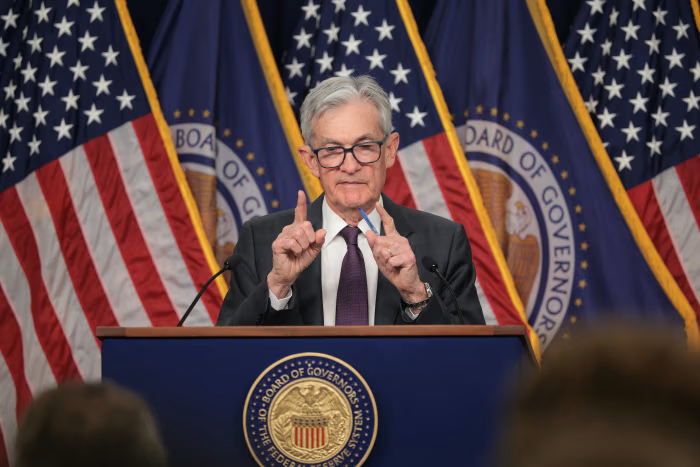
Washington, United States, January 2026 — Brussels Morning Newspaper states that global central banks Powell coordination has taken on renewed significance as senior monetary officials move toward a unified public signal supporting leadership stability at the U.S. Federal Reserve. The initiative emerges at a moment when global markets remain sensitive to political pressure, inflation uncertainty, and questions surrounding central bank independence, elevating the importance of coordinated messaging among the world’s most influential financial institutions.
The effort is widely viewed as a stabilizing measure rather than a response to immediate crisis. Officials involved describe it as an affirmation of long-standing monetary principles at a time when confidence itself has become a critical economic variable.
Monetary Leaders Emphasize Collective Stability
Central banks rarely issue joint signals unless conditions warrant exceptional coordination. In this case, officials argue that preventive clarity is preferable to reactive intervention. The emphasis is on reinforcing trust before volatility escalates.
Within this context, global central banks Powell alignment reflects shared concern that uncertainty surrounding leadership at the Federal Reserve could have disproportionate effects across interconnected financial systems. By reinforcing confidence early, policymakers aim to anchor expectations and discourage speculative disruption.

Why the Federal Reserve Anchors Global Finance
The Federal Reserve’s influence extends far beyond U.S. borders. Its interest-rate decisions shape capital flows, currency valuations, and borrowing conditions worldwide. For emerging markets, shifts in Fed policy can directly affect debt sustainability, while developed economies often adjust policy in response.
As a result, global central banks Powell engagement is rooted in practical necessity. Stability at the Fed translates into stability elsewhere, making leadership continuity a matter of global rather than national concern.
Market Volatility and Policy Sensitivity
Recent fluctuations in bond yields, equity markets, and currencies have highlighted how sensitive investors remain to perceived threats against central bank independence. Even indirect political commentary has triggered market reactions.
In this environment, global central banks Powell support is intended to counter destabilizing narratives. Monetary officials argue that reaffirming institutional norms reduces the risk of abrupt market moves driven by uncertainty instead of fundamentals.
Behind Closed Doors in Washington
According to officials familiar with the discussions, the initiative has been shaped through informal consultations during international financial meetings and bilateral exchanges. While the final wording is expected to remain measured, its intent is clear: reinforce respect for institutional autonomy.
The focus on global central banks Powell cooperation underscores a collective defense of monetary governance rather than an endorsement of specific policy decisions.
Jerome Powell’s Role in the Global System
As chair of the Federal Reserve, Jerome Powell occupies one of the most scrutinized positions in the global economy. His policy guidance influences not only U.S. financial conditions but also global liquidity and risk appetite.
Supporters argue that global central banks Powell alignment reflects confidence in a steady, data-driven approach that prioritizes predictability. They note that such consistency has become increasingly valuable during periods of economic transition.

Independence as a Shared Red Line
Central bank independence remains a cornerstone of credible monetary policy. By insulating decisions from short-term political influence, institutions can focus on long-term objectives such as price stability and financial resilience.
The emerging consensus highlights that global central banks Powell cooperation is fundamentally about defending this independence. Officials stress that once credibility is weakened, restoring trust becomes exponentially harder.
Implications for Global Monetary Coordination
A unified signal from major central banks may influence how markets interpret future policy shifts. Analysts suggest it could dampen volatility by clarifying that leadership continuity at the Fed remains intact.
From this perspective, global central banks Powell backing carries tangible implications. It reinforces the idea that monetary policy functions as an interconnected system, where confidence in one institution supports stability across many others.
A Single Remark That Captures the Moment
During a private discussion cited by multiple officials, one senior central banker summarized the broader concern, stating:
“When trust in institutions weakens, markets respond faster than policymakers can react.”
The comment encapsulates the rationale behind global central banks Powell coordination at this critical juncture.
Political Context and Cautious Language
Central bankers remain acutely aware of the political sensitivities surrounding the Federal Reserve. Any public statement risks misinterpretation if perceived as political intervention.
For this reason, global central banks Powell messaging is expected to focus on principles rather than personalities. The emphasis will be on professionalism, continuity, and respect for established monetary frameworks.

Investor Sentiment and Market Expectations
Early signals suggest that investors view coordinated central-bank communication positively. Markets tend to reward clarity, particularly when uncertainty is elevated.
If delivered effectively, global central banks Powell alignment could help stabilize expectations around interest-rate trajectories, inflation paths, and currency movements, reducing risk premiums across asset classes.
The Broader Financial Stability Message
Beyond immediate market reactions, the initiative conveys a message about the resilience of the global financial system. In an era marked by geopolitical tension and economic fragmentation, cooperation among central banks signals continuity.
Observers note that global central banks Powell action also reflects concern about precedent. Allowing pressure on one institution could embolden challenges elsewhere, making collective defense increasingly important.
Lessons From Past Monetary Coordination
Historical episodes of central-bank coordination, from liquidity swaps to crisis interventions, demonstrate the power of unified action. While the current situation is less acute, policymakers appear intent on applying those lessons early.
In this sense, global central banks Powell backing can be seen as an extension of established crisis-prevention strategies adapted to a more complex global environment.
Long-Term Implications for Central Banking
The episode may shape how central banks communicate in the future. Increased transparency, coordinated messaging, and proactive defense of institutional norms could become more common as political and economic pressures intensify.
For many officials, global central banks Powell cooperation represents a test case for how monetary authorities can collectively safeguard credibility without compromising independence.
Global Reactions Beyond Washington
Reactions from financial centers in Europe and Asia have been closely monitored. Analysts report cautious optimism that coordinated messaging will help calm markets and reinforce policy coherence.
International observers emphasize that global central banks Powell alignment strengthens confidence not only in U.S. monetary leadership but in the broader architecture of global finance.
A Distinctive Closing Perspective
What distinguishes this moment is its anticipatory nature. Rather than responding to crisis, central bankers are acting to preserve confidence before instability emerges. The initiative underscores a shared belief that trust is as vital to monetary policy as any technical instrument.
As 2026 unfolds, the coordinated stance taken in Washington may be remembered as a subtle but significant effort to reinforce the foundations of global financial stability at a time when those foundations face increasing pressure.