On New Year’s Eve a few years ago, I was in Medellín, Colombia, the city that gave its name to one of the world’s most notorious drugs cartels. Our taxi driver offered us some cocaine to fuel the party we were heading to: $10 for a gram; $15 for the “luxury” product. Our group decided to splash out and get a gram of the really good stuff. I’d tried coke a couple of times in London. It was like snorting drain cleaner.
Whoosh… I found that half a line of Medellín’s best was enough to keep you going until sunrise. But the next day it was difficult to be within six feet of another human being, the coke having burned up all the dopamine in my brain. Coke is evil. I imagine a lot of other people were feeling the same in Medellín that New Year. The party in a vast dance hall was wild, but no one was drinking much.
The real power in Sinaloa was los sicarios, Spanish for hitmen or assassins, the cartels’ muscle
Later, we met some local politicians who insisted that the government had beaten the cartels. Violence in Colombia has certainly fallen – Medellín was once the world’s murder capital. But the cartels have not disappeared in narco economies such as Colombia’s: they have just reached an accommodation with the politicians.
Donald Trump is fighting a new American war on drugs and so is also fighting some of Latin America’s corrupt governments. After putting Venezuela’s leader in handcuffs, he told reporters on Air Force One: “Colombia is very sick, too, run by a sick man, who likes making cocaine and selling it to the United States.” He added, ominously for Colombia’s President, Gustavo Petro: “And he’s not going to be doing it very long.” Petro had better “watch his ass.”
Trump also warned Mexico to “get their act together because they [drugs] are pouring through Mexico and we’re going to have to do something.” Trump likes Mexico’s President, Claudia Sheinbaum – a “terrific person” – but Mexico poses a bigger drugs problem for the US than either Venezuela or Colombia, because of the long border used by smugglers. Despite the “wall” – or fence – billions of dollars worth of drugs come through that border every year.
Trump said the Mexican authorities wanted to end the smuggling, but the cartels were very strong. He offered to send troops. I once spent a few days following the Mexican army on anti-drugs operations in Sinaloa, home of a cartel of the same name known for its extreme violence. It was hard to tell how much of the drugs war was real, how much of it performance.
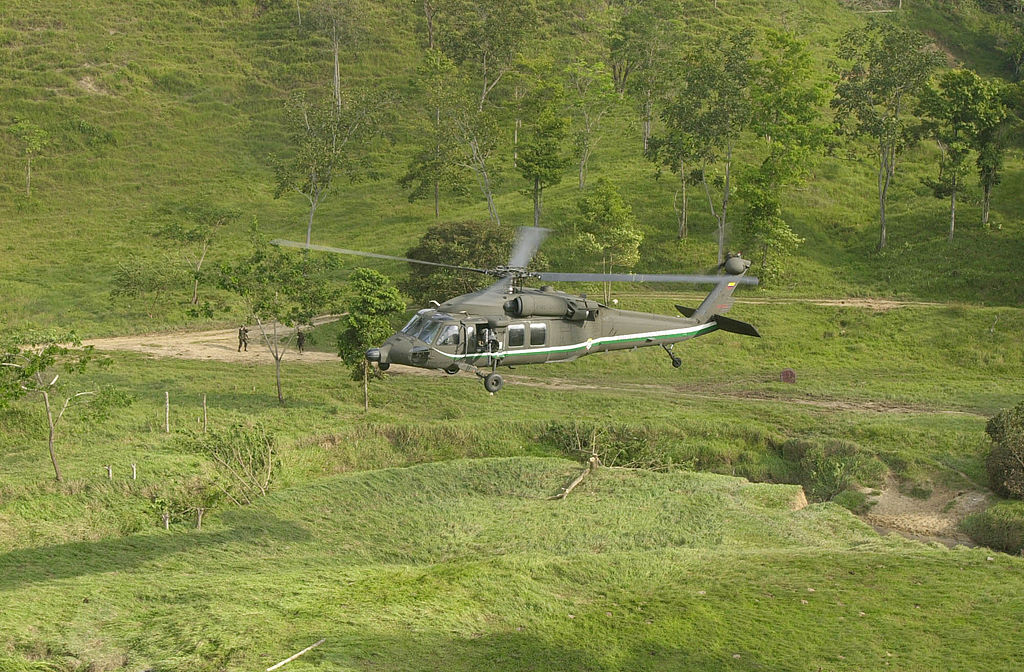
The soldiers descended by helicopter onto a remote marijuana field high in the hills and torched the plants, which were standing 8ft tall in the sun. The crop was tended by a thin, leather-skinned peasant woman who twisted her hands in anguish as her livelihood went up in flames. A few miles away in the nearest town, the police chief – squat and menacing as a pitbull – laughed and told me he had been put into his job by one of the cartels. A local politician said that 80 cents of every dollar earned in Sinaloa came from drugs. The real power in Sinaloa was los sicarios, Spanish for hitmen or assassins, the cartels’ muscle. I had one of the most tense and uncomfortable afternoons of my life with a gang of sicarios. They had a lot of firepower, grenade-launchers as well as Kalashnikovs. Most of them were still teenagers, and all of them had killed to be allowed to join the gang. One told me matter-of-factly that he’d strangled an “informer” only a few days earlier. (If you’re ever tempted to buy coke, this is where your money goes.)
The corruption in places such as Sinaloa or Medellín is so total, the drugs economy so vast, that a change of president or a change of government might be little more than window dressing. Trump sending US Special Forces to seize a country’s leader in the night is as performative as the Mexican army descending from the skies to destroy a poor peasant’s marijuana field. It will have some effect but barely touches the main problem.
But then the war on drugs is a handy pretext. Venezuela claims to have the world’s largest reserves of crude oil; Colombia has copper, nickel, platinum and barium, which are increasingly in demand for renewable energy; Cuba – which President Trump said was “going down” – has the world’s third-largest cobalt reserves. China and Russia want these resources too, but Trump has his version of the Monroe Doctrine, the “Donroe Doctrine,” and it sends a message to the world: “Stay out of our backyard.”
James Monroe was a war hero who took a musket ball to the shoulder after crossing the Delaware River with Washington. The Donald is a draft-dodger who didn’t go to Vietnam because of “bone spurs” on his heels (though this didn’t affect his golf game). But both Monroe and Donroe allow for America to use force to advance its interests without hypocrisy or pretense. Stephen Miller, the White House deputy chief of staff, discussed these new realities in a brutally frank interview with Jake Tapper on CNN. “International niceties” were just talk, he said, “but we live in a world, in the real world… that is governed by strength, that is governed by force, that is governed by power. These are the iron laws of the world.”
When I visited another region of Mexico known for its production of narcotics, Michoacán, they were still talking about an incident years earlier involving one of the cartels. Gunmen had entered a nightclub, firing into the air. They ordered everyone to lie down and then dumped the contents of a plastic bag onto the dance floor. Five severed heads rolled out, belonging to people who had crossed the cartel.
Trump takes the same approach with Latin American countries who cross him. Bend the knee, pay the tax, or we will decapitate your government and feel good about doing it. If all this wasn’t clear enough after the capture of Nicolás Maduro, Pete Hegseth, the Secretary of Defense, explained it again. Speaking from the podium at the Pentagon, Hegseth used the language of a back-alley enforcer. He told the American people that Maduro “effed around, and he found out.” FAFO, as Hegseth likes to abbreviate it. The Monroe – or the Donroe – Doctrine is really too abstract for a President who decides what to do moment to moment, tweet to tweet. FAFO: that’s the world we live in now.
This article was originally published in The Spectator’s January 19, 2026 World edition.