Introduction
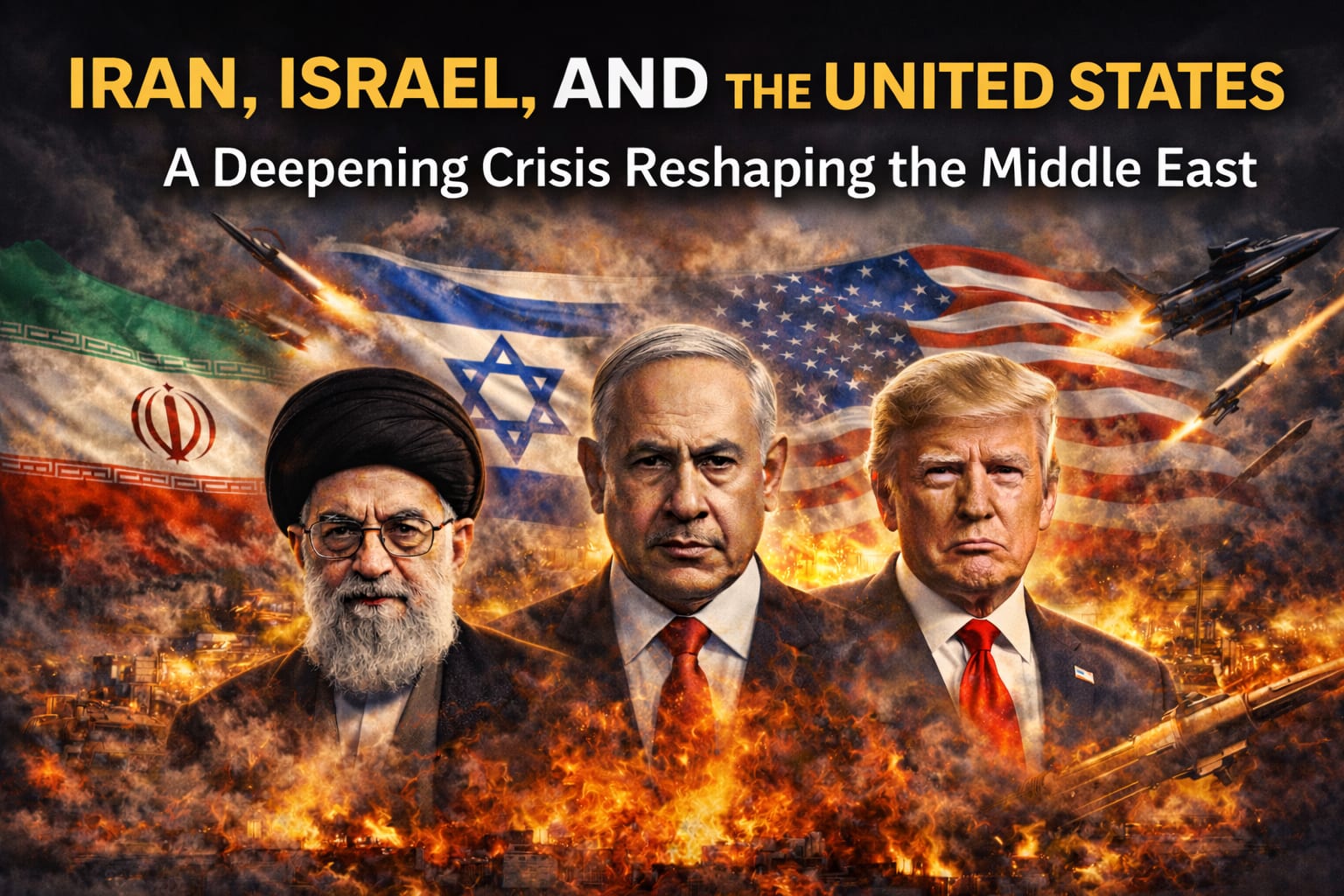
The relationship between Iran, Israel, and the United States is one of the most complex, volatile, and consequential trilaterals in global politics. The tensions among these three actors are rooted not only in ideology or security concerns, but in decades of conflict, nuclear fears, proxy wars, shifting alliances, and regional ambitions.
As the Middle East faces renewed instability, the Iran–Israel–USA conflict has evolved into a persistent crisis that influences global energy markets, military strategies, international diplomacy, and the safety of millions of civilians.
In recent years, the situation has worsened:
Iran has advanced its nuclear program,
Israel has increased its regional military operations,
and the United States has struggled to balance diplomacy with deterrence.
Together, these dynamics have created a fragile and unpredictable environment where a single miscalculation could lead to a regional war.
This article explores the history, motivations, military confrontations, nuclear tensions, proxy conflicts, diplomatic failures, and possible futures of this dangerous geopolitical triangle — in a clear, human-written style.
Historical Foundations of the Conflict
1. Iranian Revolution and the Break with the West
The 1979 Iranian Revolution dramatically altered the geopolitical landscape. Iran transformed from a U.S.-aligned monarchy into an Islamic Republic that viewed Washington as a hostile foreign power. This shift created a ripple effect across the region, fueling a rivalry that has continued for decades.
2. Israel as a Regional Rival
Iran’s new leadership quickly adopted a strong anti-Israel ideology. The Israeli state, in turn, viewed Iran as a strategic and existential threat — particularly as Iran expanded its military alliances and influence across the region.
3. U.S.–Israel Strategic Alignment
Since the late 20th century, the United States has maintained a deep military and political alliance with Israel, including intelligence sharing, military aid, and coordinated regional strategies. This partnership has placed Washington in direct opposition to many of Iran’s interests.
These background elements set the stage for the conflict we see today: a long chain of confrontations, diplomatic standoffs, and intermittent crises.
The Strategic Interests of Each Actor
Iran’s Goals
Iran seeks to:
Expand its regional influence,
Support allied groups and militias,
Counter U.S. presence in the Middle East,
Maintain leverage through its nuclear program.
Iran sees itself as a defender of regional independence against what it calls Western domination.
Israel’s Goals
Israel’s top priorities are:
Preventing Iran from acquiring nuclear weapons,
Limiting Iranian military presence in Syria and Lebanon,
Protecting itself from Iranian-backed groups such as Hezbollah.
Israel often pursues pre-emptive strikes and intelligence operations to weaken Iran’s reach.
The United States’ Goals
The United States focuses on:
Safeguarding regional allies (especially Israel),
Preventing nuclear proliferation,
Maintaining freedom of navigation in strategic waterways,
Countering groups that threaten U.S. forces or interests.
Each actor’s strategy overlaps with and contradicts the others’, which makes compromise extremely difficult.
The Role of Proxy Conflicts
A defining feature of the Iran–Israel–USA dynamic is that much of the confrontation occurs indirectly, through proxy groups and regional partners.
1. Lebanon: Hezbollah
Hezbollah is Iran’s most powerful regional ally. Israel considers Hezbollah its most dangerous non-state enemy due to its missile arsenal and military experience.
2. Syria: A Battleground for Influence
Iran supports the Syrian government and uses Syria as a strategic base. Israel frequently targets Iranian-linked facilities inside Syria to prevent the transfer of advanced weapons.
3. Iraq: Militia Activity
Iran-backed militias in Iraq have increased attacks on U.S. military positions during regional flare-ups, drawing Washington back into Middle Eastern tensions.
4. Yemen: The Houthis
The Houthis, aligned with Iran, have targeted shipping routes and regional infrastructure, prompting concern from the U.S. and international community.
These proxy theaters amplify the risk of escalation, because a conflict in one country can quickly drag the rest of the region into the crisis.
The Nuclear Question
Why Israel and the U.S. Are Concerned
Iran’s nuclear program lies at the center of the crisis. While Iran has long insisted its program is peaceful, Israel and the U.S. fear that Tehran is edging closer to weapons capability.
Diplomacy and Breakdown
Attempts to negotiate limits on Iran’s nuclear program have repeatedly stalled. Agreements have crumbled due to:
political mistrust,
verification issues,
sanctions,
leadership changes in both the U.S. and Iran.
As negotiations fail, military tensions rise.
The Red Line
Israel has repeatedly declared that a nuclear-armed Iran is unacceptable and has hinted — sometimes openly — that it would take unilateral military action if diplomacy fails.
This nuclear stalemate is one of the main reasons the crisis remains near a breaking point.
Military Escalations and Dangerous Incidents
In recent years, the region has witnessed several alarming escalations involving all three actors.
1. Airstrikes and Missile Exchanges
Israel has conducted hundreds of airstrikes on Iranian-linked sites in Syria. Iran has responded indirectly through militias and, in rare instances, directly with missiles or drones.
2. Maritime Confrontations
Ships linked to Iran or Israel have been attacked in the Persian Gulf and Mediterranean, escalating tensions in global shipping lanes.
3. Attacks on U.S. Bases
Iranian-backed groups have periodically targeted U.S. forces in Iraq and Syria, prompting American retaliation and further worsening the situation.
4. Cyber Operations
All three countries have engaged in cyber warfare — from targeting nuclear facilities to hacking military networks.
Each of these incidents carries the potential for miscalculation and rapid escalation.
Diplomatic Struggles and Missed Opportunities
Diplomacy has repeatedly failed for several reasons:
1. Deep Mistrust
Decades of confrontation have made negotiations fragile. Each side doubts the other’s intentions.
2. Domestic Politics
Political pressure in Washington, Tehran, and Jerusalem often restricts leaders’ ability to compromise.
3. Shifting Alliances and Regional Competition
Countries such as Saudi Arabia, Russia, and China influence the crisis through alliances, energy markets, and military support.
4. Unclear Goals
While each actor says they want stability, their definitions of “stability” differ dramatically.
As a result, diplomatic efforts often collapse before substantial progress is made.
Future Scenarios: What Could Happen Next?
Scenario 1: Limited but Repeated Military Clashes
This is the most likely scenario. Airstrikes, missile attacks, and proxy confrontations will continue without full-scale war.
Scenario 2: Diplomatic Revival
If pressure builds internationally, talks could resume — especially regarding Iran’s nuclear program and regional security.
Scenario 3: A Major Escalation
A single miscalculation — a deadly strike, a failed interception, or a proxy attack — could trigger a broader conflict involving multiple countries.
Scenario 4: Regional Realignment
Shifting alliances, especially between Arab states and Israel, could reshape the strategic map of the Middle East.
Conclusion
The Iran–Israel–USA crisis is one of the most critical geopolitical challenges of the modern era. It involves military strength, nuclear concerns, ideological rivalry, proxy warfare, and global strategic interests. Despite periodic pauses in violence, the underlying tensions have not disappeared — and each actor continues to expand its capabilities and influence.
What makes the situation especially fragile is how many different factors can spark escalation:
A single drone strike,
A maritime confrontation,
A failed negotiation,
Or a regional militia attack.
As the world becomes increasingly interconnected, the consequences of a wider Middle Eastern conflict would extend far beyond its borders — affecting global security, trade, and political stability.
For now, the region remains suspended between deterrence and danger, diplomacy and division — with no clear end to the crisis in sight.