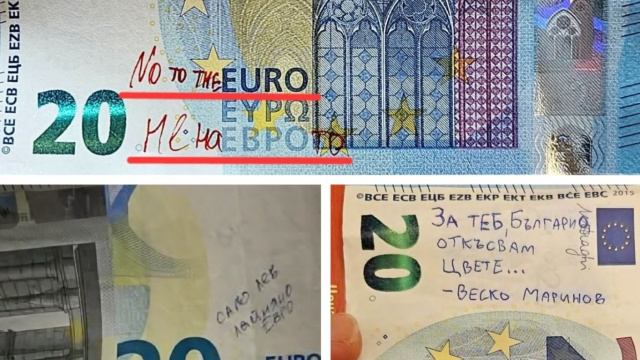
The Bulgarian National Bank (BNB) has clarified that euro banknotes that are scratched, intentionally damaged, or otherwise defaced cannot be reimbursed and should not be accepted in transactions. Chief Treasurer Stefan Tsvetkov emphasized during a briefing at the National Coordination Center for the Euro Mechanism that both series of euro banknotes in circulation remain legal tender, but only in proper condition. Merchants across the country were urged to carefully check banknotes and refuse damaged bills.
Regional coordination centers have been activated to handle reports related to euro circulation. Citizens are encouraged to submit local signals to the relevant regional structures for processing. Measures have also been taken to simplify currency exchange at banks: coins can be exchanged without fees, regardless of whether they are sorted, and no additional identification forms are required for most transactions.
The Coordination Center, headed by Vladimir Ivanov, confirmed that banks cannot refuse service to non-clients. For exchanges up to €5,000 (about 9,775 BGN), only an ID is required, while larger amounts are subject to general anti-money laundering legislation, including declarations of the origin of funds. Citizens and merchants were advised to obtain euro banknotes and coins in advance, ahead of the January 31 deadline when dual circulation ends. After that date, all payments in Bulgaria will be made exclusively in euros. Post offices will provide free exchange services until June 31, while commercial banks continue to supply cash without restrictions.
As of now, 48.3% of the lev money supply has been withdrawn from circulation, up from 35.3% the previous week. Authorities expect that by January 20, there will be sufficient euro cash in circulation, exceeding initial expectations. The Association of Banks reported 32 irregularity signals among hundreds of thousands of daily customer interactions. Over 100 bank branches are working extended hours every Saturday until the end of January to facilitate exchanges and ease public access.
The Consumer Protection Commission reminded merchants that they cannot impose conditions such as providing change only in the currency of payment, nor can they refuse cash payments under the pretext of accepting cards only. Violations carry fines ranging from €600 to €7,000 (around 1,165 to 13,950 BGN).
Price monitoring has also been strengthened. Between January 5 and 11, inspections covered over 70 paid parking lots, medical laboratories, courier services, and more than 500 beauty and hair salons. Price hikes were discovered in four laboratories and in five school cafeterias in Sofia; authorities intervened, returning prices to pre-New Year levels.
During the same period, the National Revenue Agency (NRA) conducted 1,401 inspections, identifying 116 breaches of the Euro Adoption Act and issuing 12 penalty orders. A few cases of counterfeit euro banknotes were also detected, prompting immediate action. Traders were advised to equip themselves with devices for verifying genuine euro banknotes to prevent circulation of counterfeits.