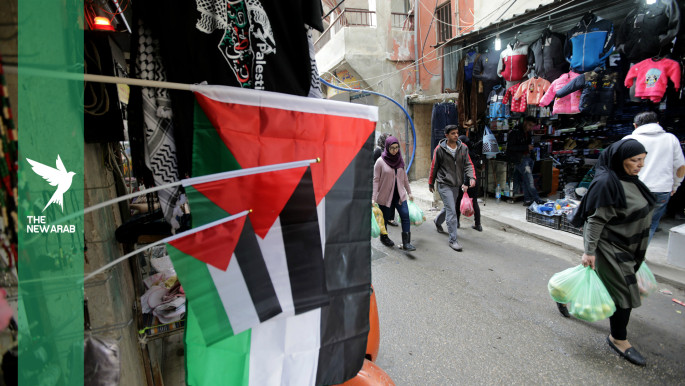
Closure of Beddawi camp’s side entrances restricts movement for Palestinian refugees in Lebanon [Getty]
A decision by Lebanese authorities to close most of the side entrances to Beddawi refugee camp, citing security concerns, has intensified the suffering of around 23,000 Palestinian refugees living there.
What was initially presented as a temporary security measure has become a daily reality, severely affecting freedom of movement and disrupting livelihoods, education and access to healthcare inside the camp and in surrounding areas.
Ahmed Ghanoumi, head of the Popular Committees in north Lebanon, told The New Arab that Beddawi camp has 23 side entrances, 19 of which have been closed.
Four small entrances remain open, allowing passage only for motorcycles, tuk-tuks or pedestrians. The two main entrances that allow vehicles to enter the camp remain open.
According to statistics from the UN Relief and Works Agency for Palestine Refugees (UNRWA), around 23,000 registered refugees live in Beddawi camp, most of whom face poverty and unemployment amid growing demand for basic services.
Activist Dalal Shahrour says the closures have left thousands of refugees confined to an area of less than one square kilometre, with the possibility of further restrictions.
She said the justification for the closures was the alleged presence of a small number of wanted individuals inside the camp, despite coordination mechanisms already in place between the Lebanese state, Palestinian factions and camp security committees.
“It is well known that when there is a wanted person, they are handed over through established mechanisms,” Shahrour said, adding that drug trafficking and crime were not unique to Beddawi but exist across Lebanon.
She stressed that the camp had not suffered from security chaos and was considered safer than many surrounding neighbourhoods.
“There are no recorded cases of theft or mugging. Residents feel safe, and people can move freely at any time,” she said.
Shahrour said closing the side entrances had effectively cut the camp off from its surroundings, despite long-standing social ties, including intermarriage with neighbouring communities.
The decision has damaged the local economy, she added, noting that many Lebanese, Syrians and Palestinians previously entered the camp to shop due to lower prices and the availability of goods.
“With the entrances closed, access to the camp market has become difficult. Buying and selling have declined, worsening the suffering of families who depend on small shops or vegetable stalls for income,” she said.
The closures have also disrupted education. Shahrour said children attending schools and kindergartens outside or on the edges of the camp now require transport, turning what was once a five-minute walk into a journey of more than half an hour.
She added that congestion on the only remaining main road has made school drop-off and pick-up times chaotic.
Medical access has also been affected.
“Emergency cases are now at risk,” Shahrour said, explaining that patients often have to walk long distances to reach ambulances because vehicles struggle to enter the camp’s narrow alleys.
She said residents were experiencing a sense of enforced isolation and argued that instead of imposing further restrictions, Palestinian refugees should be granted their rights after more than 70 years of living in Lebanon.
She also called on the Palestinian Authority to defend the rights of Beddawi’s residents and urged a review of an “unjust decision” that has led to increased siege, unemployment and frustration.
Inside the camp, residents described the impact as collective punishment.
Palestinian refugee Ibrahim Mohammad told The New Arab that the closures harmed everyone, both inside and outside the camp.
“Children and women are forced to jump over walls in humiliating and inhumane scenes,” he said.
Mohammad, who suffers from kidney problems and requires hospital visits three times a week, said restrictions have made it harder to access treatment.
“Punishing the entire camp for the actions of a few is not fair. Those who break the law should be held accountable, not ordinary residents,” he said, describing the closures as collective punishment.
Abu Ahmed, a father of three, said repeated promises to reopen the roads have so far gone unfulfilled. “We do not object to security checkpoints or gates, but the roads must be reopened. The situation has become unbearable,” he said.
Abu Rami Khattar, secretary of the Palestinian Popular Committee in Beddawi camp, said the closures targeted side crossings that have long served as vital links between the camp and surrounding neighbourhoods.
He said the restrictions have disrupted daily life for Palestinians and Lebanese alike, noting that the camp has historically functioned as an important market for nearby areas.
“Lebanese residents were accustomed to entering the camp to buy vegetables, fruit and basic goods. Since the closures, the market has been noticeably affected,” he said.
Khattar said the most severe impact had been on schoolchildren, particularly after the closure of Fatima Gate, which linked the camp to Jabal al-Beddawi and al-Sumoud, where a school, kindergarten and mosque are located.
Closures of roads linking the camp to Talat al-Mankoubin have also affected large numbers of residents.
“Even family visits have become limited despite the close social ties in the area,” Khattar said, urging authorities to approach the issue from a humanitarian perspective by opening pedestrian crossings and allowing vehicles to pass, particularly for medical access.