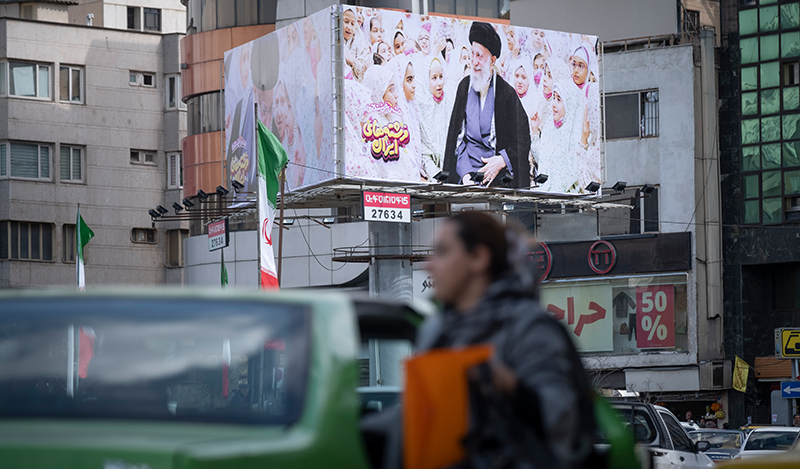
If he chooses to stand by while Iran burns, Donald Trump runs the risk of repeating his predecessors’ mistakes.
On January 2, President Donald Trump took to Truth Social to warn Iran’s leaders not to crack down on snowballing protests: “If Iran shots [sic] and violently kills peaceful protesters, which is their custom, the United States of America will come to their rescue. We are locked and loaded and ready to go. Thank you for your attention to this matter!”
The Iranian regime evidently brushed off the threat. According to reports filtering out of Iran, the Islamic Revolutionary Guard Corps, perhaps in conjunction with Iraqi militias, have killed thousands of Iranian protesters.
Trump now faces a choice: He can repeat the mistakes of President George H. W. Bush, a man whose stewardship of foreign affairs he repeatedly criticized, or he can learn from them.
The elder Bush entered office as perhaps the most experienced foreign policy expert to become president. He was a decorated World War II fighter pilot who had been the U.S. ambassador to the United Nations and then a de facto U.S. ambassador to the People’s Republic of China. He then became the director of Central Intelligence before becoming vice president under Ronald Reagan. Ironically, it was his position as a bastion of mainstream, conventional diplomatic opinion that led Bush to stumble into what, in hindsight, were the greatest stains on his legacy: throwing a lifeline to China during and after the Tiananmen Square crisis, and then failing to crush Saddam Hussein and stand up for freedom when he had the chance.
That the Tiananmen Square protests caught the Bush administration by surprise reflected the tunnel vision under which Bush’s White House and State Department operated. In a precursor to the generations of American policymakers who believed reformism might prevail in the Islamic Republic, Bush believed such reform could triumph in Beijing. For a man of such great experience, he simply did not understand the ideology that motivated his adversaries.
Here, historians must credit Deng Xiaoping, China’s paramount leader from 1978 to 1989, for so thoroughly fooling Bush. Deng rose to power in the wake of the Cultural Revolution. He spoke of modernizing China’s economy, reforming society, and relaxing foreign relations. His rhetoric affirmed American wishful thinking and, in 1986, propelled Deng onto the cover of Time as Man of the Year.
Chinese students knew a different Deng. While Americans treated Deng as a true reformer, students instead honored Hu Yaobang, the general secretary of the Chinese Communist Party, whose dismissal and then death set off demonstrations and commemorations that culminated in the Tiananmen Square protests. There, leaders demanded free speech, more democracy, and an end to government corruption. Their numbers grew for weeks until, on June 4, 1989, Deng ordered a crackdown that caused the deaths of several hundred to several thousand people, based on the estimates of contemporary observers.
In hindsight, the New York Times embodied the clash between wishful thinking and reality. On February 21, 1989, the paper preached, “Like the bamboo shoots that emerge everywhere after a spring rain . . . democracy is sprouting again in China.” Less than four months later, its headline blared, “Troops attack and crush Beijing protest; thousands fight back, scores are killed.”
Both within the United States and in international circles, outrage was palpable, but Bush did not want to abandon his fantasy of Chinese reform. While Congress demanded that Bush treat China as a pariah, Bush sought to return to business as usual as quickly as he could. Just over two weeks after the crackdown, he sent National Security Adviser Brent Scowcroft and Deputy Secretary of State Lawrence Eagleburger to Beijing to reassure Deng of America’s continued support. Just months later, Scowcroft apologized for sanctions imposed “to satisfy the demands of the American people.” He clinked glasses with Foreign Minister Qian Qichen and apologized for the U.S. Embassy having previously hosted Tiananmen protest leader Fang Lizhi at a reception.
Democrats condemned Bush’s obsequiousness. At his 1992 Democratic National Convention speech, Bill Clinton promised “an America that will never coddle tyrants, from Baghdad to Beijing.” Then–Senator Joe Biden demanded “the United States should now cease to court and must no longer appease.” For Clinton and Biden (and, later, Barack Obama, who muted his support for Iranian protesters to encourage Supreme Leader Ali Khamenei to engage with him), it was politics more than principle, especially demonstrated by Clinton’s subsequent engagement of North Korea and both his and Biden’s indulgence of China and Iran. Indeed, Clinton later welcomed his Chinese counterpart, Jiang Zemin, to Washington.
While both Bush and Clinton sought to resurrect China in the belief that they could become a partner for diplomacy, neither Deng nor his successors ever had that intention. In hindsight, the Tiananmen uprising represented the best chance to derail the “hundred-year marathon” that Mao Zedong launched to make China a great power, a status China’s Communist leaders believed was mutually exclusive with cooperation and instead required America’s defeat. Bush embraced the conventional and never had the imagination to realize that fueling the fire of democracy could, at best, end a long-term threat. At worst, failure would leave a regime no less hostile to the United States than it is today.
Bush repeated his mistake in Iraq. At a February 15, 1991, campaign stop, shortly after the triumph of Operation Desert Storm and Kuwait’s liberation, he called upon the Iraqi people “to take matters into their own hands and force Saddam Hussein, the dictator, to step aside.” Iraqis rose up in response. Saddam responded with helicopter gunships and automatic weapons. Counseled by Colin Powell, then chairman of the Joint Chiefs of Staff, Bush stood down.
In hindsight, this set Bush’s son up for a choice. With the status quo disintegrating, the United States could either allow Saddam to reconstitute his weapons program or oust the Iraqi dictator. The intervening twelve years, however, allowed Iran’s Islamic Revolutionary Guard Corps to form and train Shi’ite militias that have hampered Iraq’s trajectory ever since and now may be complicit in the atrocities in Iran itself.
Back to Trump: Like Bush, he threw down a gauntlet. And like Bush, he has a choice. He can help the Iranian people end the Islamic Republic, or he can stand aside while Khamenei directs a massacre that will consolidate theocracy for a generation to come. If he does, a much bloodier conflict becomes far more likely. Trump once castigated Bush’s stewardship. As he wavers, he risks replicating it.