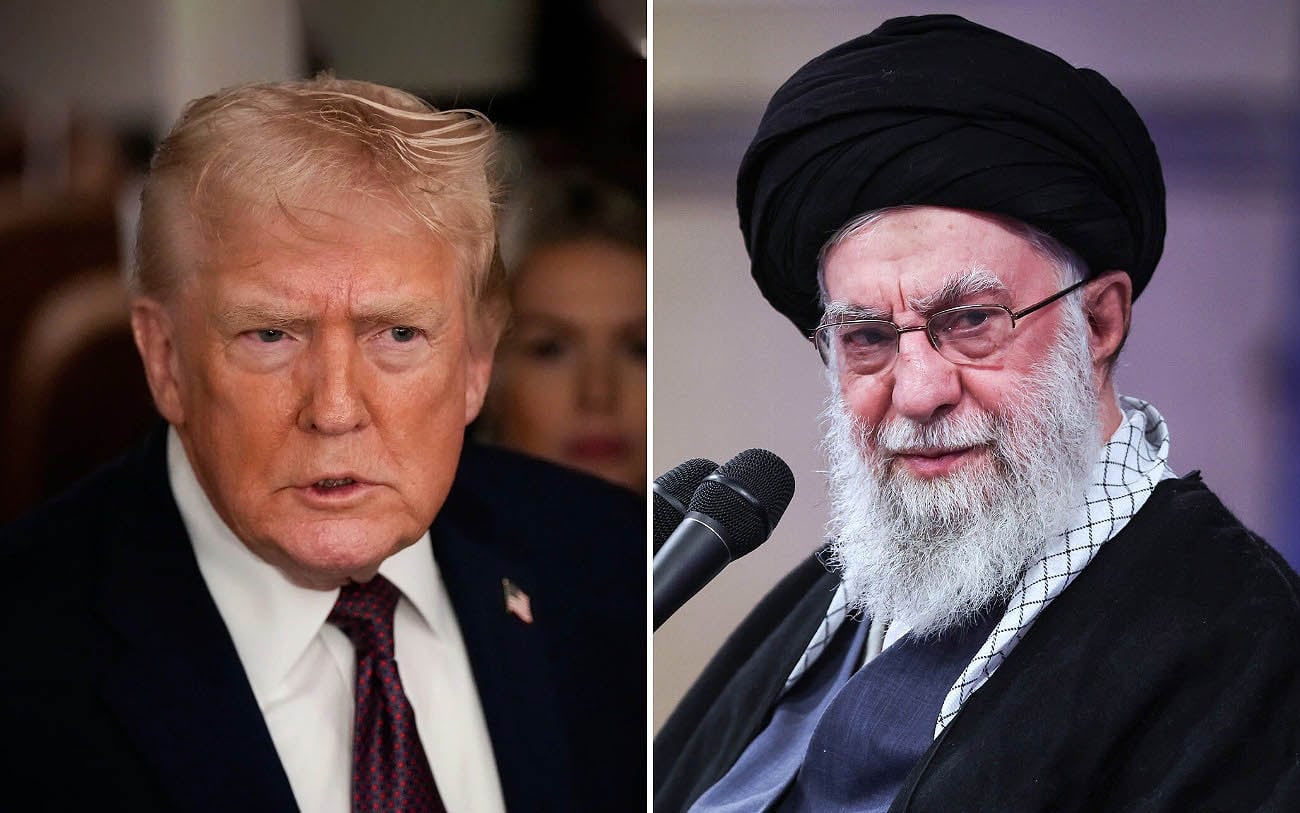
If Trump strikes Iran, what are the scenarios for the Middle East and the world order?
Since the outbreak of the revolt in Iran, at the beginning of January 2026, American rhetoric has brutally hardened. Donald Trump now explicitly links the internal repression of the Iranian regime to a regional strategic threat, openly mentioning the military option. An American strike against Iran would not be a simple tactical episode: it would open up a sequence of heavy consequences for the Middle East and for the already fragile world order.
Several scenarios must be considered, not as abstract hypotheses, but as plausible trajectories in an unstable international system.
The signal scenario: hit to dissuade.
The first scenario is that of a limited and calibrated strike. Objective: to send a clear political message without getting bogged down in open war. Targets would be carefully chosen—military infrastructure, command centers, and sensitive capabilities of the regime—to restore the credibility of US deterrence.
In this logic, Washington would seek to demonstrate that the internal weakening of the Iranian regime does not constitute a strategic white paper. Tehran’s response would probably be measured: indirect responses, cyberattacks, and pressures via regional relays, but without “crossing” the threshold of an uncontrollable escalation. The regime, weakened by the protest, would avoid a frontal confrontation that could accelerate its downfall.
Israel, directly exposed, would go on high alert, while the Gulf states would adopt a cautious stance: political discretion, strengthening of defenses, and calls for de-escalation. Even limited, such a strike would cause an immediate shock to energy markets and maritime routes, reminding us of the strategic centrality of the Middle East.
The expanded campaign: the war without the name
A second scenario would see the United States engage in a longer military campaign, aimed at permanently degrading Iranian capabilities: air defenses, missiles, logistical networks, and even certain nuclear facilities. We would then fall into a form of “mini-war,” without formal declaration but with very real effects.
The main risk would be regional overflow. Iran would multiply asymmetric responses against American and Israeli interests while seeking to internationalize the cost of the conflict. The Middle East would enter a phase of increased polarization, with each actor trying to avoid conflagration while protecting its alliances.
On a global scale, Russia and China would strongly condemn the intervention, without, however, directly confronting the United States. Their strategy would be opportunistic: diplomatic support for Tehran, indirect assistance, and above all the strategic benefit of a Washington absorbed on a new front. The multilateral order, already weakened, would find itself paralyzed by bloc logics and cross-sanctions.
Asymmetric escalation: the regional trap
Even if Washington intends to remain within a limited framework, Iran may choose to expand the conflict. This third scenario is based on a survival logic: hit indirectly where the cost is maximum for the opponents.
Pressures on sea lanes, targeted attacks against regional interests, and activations of allied networks: Israel would then become a central player in the conflict, caught in a spiral of strikes and counter-strikes that could degenerate into a regional war.
This scenario is one of the most dangerous because it does not rely on a long-term strategy but on an emergency dynamic. A cornered regime may prefer outer chaos over inner collapse.
The external shock and the internal fracture
A fourth scenario, more uncertain but decisive, would see an American strike act as a catalyst for internal Iranian tensions. The combination of a persistent popular revolt and military shock could either reinforce repression or cause a fragmentation of power.
In the first scenario, further closure of the regime would result in lasting isolation. In the second, even more destabilizing, internal struggles could emerge, weakening central control and opening a period of prolonged instability. For the region, this would mean a major uncertainty: proliferation of armed actors, risks on sensitive sites, refugee flows, and lasting insecurity.
Coercion followed by compromise
Finally, a paradoxical but credible scenario would be that of a strike conceived as a prelude to negotiation. The use of force would then serve to impose a favorable power relationship before the opening of a diplomatic channel.
This approach, combining coercion and transaction, corresponds to a method already proven by Trump. But it is politically fragile. For Tehran, accepting a compromise too quickly would be perceived as capitulation. For Washington and Israel, the temptation would be strong to prolong the military advantage.
An explosive equation
An American strike against Iran would never be an isolated event. It would interact with a deep internal crisis, fragile regional balances, and an already exacerbated global rivalry. The real danger lies not only in the decision to strike but also in the chain of reactions it would trigger.
The decisive factor will not only be the initial decision to strike but also how each actor—the United States, Iran, Israel, Europe, Russia, China, and the countries of the Middle East—interpreted the situation and adjusted its calculations.
Gilles Touboul is passionate geopolitical analyst and former trader specializing in Asian and Middle Eastern markets. An observer of international upheavals, he regularly speaks on topics related to conflicts, international relations, and the impact of geopolitics on the global economy. A graduate in oriental languages and international relations, Gilles lives in Israel