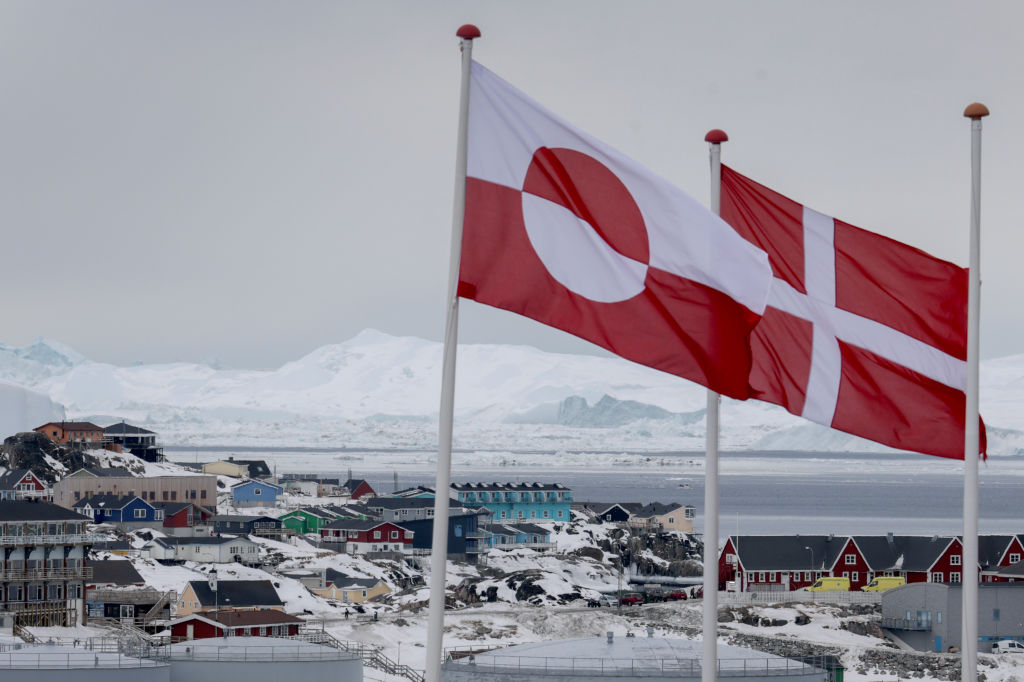
President Donald Trump has renewed his push for the United States to acquire Greenland from Denmark, again prompting gasps and outrage from elected Democrats and European elites. But the historical record and geopolitical reality suggest that acquiring the island territory would be not only fair compensation for American involvement in Europe since the start of World War II, but also a critical check against encroaching Chinese and Russian influence in the Arctic.
Trump’s latest quip that Greenland’s defense is “two dog sleds” has the global liberal media tripping over itself to “fact-check” this obvious hyperbole and declare Trump an evil imperialist. But Trump is only highlighting a glaring security lapse in what is fast becoming one of the most important regions on the planet. It doesn’t require anything more than basic common sense to understand that Denmark, Europe, the United States, and the entire free world would be better off if Washington, rather than Copenhagen, took the lead on defending Greenland.
The idea of the United States purchasing Greenland is hardly some wild brainstorm cooked up on social media. American leaders proposed buying the island for $5.5 million as far back as 1868, and again offered $100 million in 1946.
The strategic logic was obvious even then. Greenland sits astride vital North Atlantic and Arctic sea routes that are becoming increasingly important in the 21st century. The United States also controls the most significant military installation on the island, the Pituffik Space Base, which plays a critical role in missile warning, space surveillance, and Arctic operations.
In short, the United States already shoulders the real burden of Greenland’s defense, just like American taxpayers carry the financial load when it comes to the defense of continental Europe.
That reality exists because of a much larger story that U.S. allies prefer to forget. In inflation adjusted 2025 dollars, the United States spent roughly $5 to $6 trillion to wage and win World War II (not to mention the human cost). That staggering sum paid for the ships, planes, weapons, and soldiers who crossed an ocean to liberate Western Europe, including Denmark, from Nazi tyranny.
Moreover, without American intervention, the continent’s fate after the war would have looked far closer to what befell much of Eastern Europe; namely, decades of dictatorship, economic ruin, and political repression under the Soviet boot. U.S. taxpayers poured billions of dollars into rebuilding Europe through the Marshall Plan, stabilizing shattered economies and halting the spread of communism at a moment when it was rapidly advancing across the continent.
This was not charity in the narrow sense, but it was an extraordinary act of national self-confidence and goodwill. It allowed European nations to rebuild, modernize, and prosper while the United States absorbed the cost and risk.
Denmark and the rest of Europe should be tripping over themselves to acknowledge that debt. Without American blood and treasure, their modern welfare states, their stable democracies, and their comfortable standard of living would be inconceivable.
Handing over Greenland in a fair sale would not even begin to balance the ledger, but it would be a meaningful start. It would recognize that global security has long depended on American power, and that the benefits of that power have flowed disproportionately to Europe.
Even after the collapse of the Soviet Union, the United States has acted as the piggy bank of the free world, underwriting NATO and global stability while many U.S. allies focused on expanding social programs at home. Today, the United States spends well above three percent of its gargantuan $29 trillion GDP on defense, much of it directed toward protecting Europe and maintaining the alliance’s credibility.
Meanwhile, Denmark and most NATO members have consistently failed to meet their own commitment to spend two percent of GDP on defense. The result has been an implicit subsidy, with American workers financing European security while European governments lecture Washington about responsibility.
Against that backdrop, the Arctic is rapidly becoming a new front line. New shipping lanes are opening, exposing mineral wealth and creating strategic choke points that did not exist a generation ago. Greenland is now a theater of competition between major powers – one in which hesitation carries real consequences.
Russia already operates the world’s largest icebreaker fleet at 57 vessels, including eight nuclear-powered ships – the world’s only such fleet. China, which likes to describe itself as a “near-Arctic state,” deployed four icebreakers to the region in 2025 and is planning to expand its presence further.
By contrast, the United States currently has only five icebreakers in service, a gap the Trump administration has prioritized closing. Of all the nations in the Western alliance, only the United States has the wealth, industrial base, and technological depth to realistically compete with Russia’s Arctic dominance.
Greenland sits at the center of this emerging contest. Beneath its ice and rock lie massive, untapped reserves of rare earth elements, uranium, oil, and other critical minerals, worth up to trillions of dollars by some estimates. These are precisely the resources modern economies and advanced militaries depend on, and China in particular has made no secret of its interest. Allowing Beijing or Moscow to gain a significant foothold there would hand two of America’s most aggressive rivals a strategic perch on the doorstep of the North American mainland.
It is also worth noting what this proposal is not. The United States is not demanding Greenland for free. Trump has been explicit that he wants to buy it and that he is willing to pay a fair price.
That is how sovereign transactions between serious nations are supposed to work. Denmark would receive a substantial financial windfall, relieve itself of an enormous defense responsibility, and deepen its relationship with its most important ally. Greenlanders would gain access to American investment, infrastructure, and security guarantees that Copenhagen could never realistically provide.
There are reasonable arguments to be made on both sides of any territorial purchase. But pretending that Trump is unhinged or sinister for pressing the issue is dishonest. The question of Greenland goes to the heart of how the free world will defend itself in the 21st century, who will bear the cost, and who will shape the Arctic’s future.
The American people deserve a serious debate grounded in history and reality, not reflexive mockery. They deserve to hear the full story before deciding whether buying Greenland is bold, unnecessary, or simply overdue.
Shane Harris is the Editor in Chief of AMAC Newsline. You can follow him on X @shaneharris513.