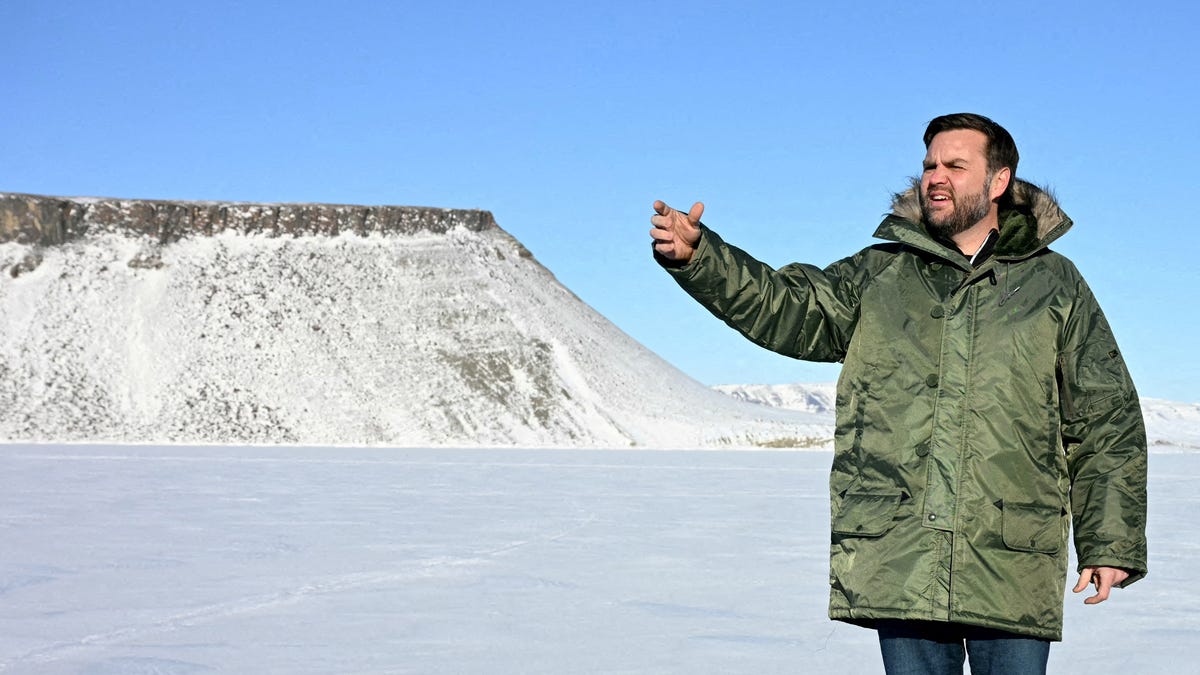
Next steps on Greenland could come as soon as a few ‘weeks,’ a US official tells USA TODAY in an exclusive interview.
President Donald Trump‘s desire to annex Greenland will not be thwarted and there could be meaningful U.S. action related to the Arctic island within “weeks or months,” according to a senior administration official.
That’s the view of Thomas Dans, Trump’s Arctic commissioner. He’s regarded as one of the main proponents of the president’s interest in Greenland, an idea first brought to Trump by billionaire and former diplomat Ronald Lauder.
Dans has been working on the issue since 2020.
“This is a train route with multiple stops,” he said in an exclusive interview with USA TODAY. “Things could move on an express basis, skip the local stops and go direct to the main station. That’s where President Trump wants to move it − at high speed.”
Still, Dans said that while he thinks there could be noticeable progress on negotiations or a deal on Greenland sooner rather than later, he ultimately expects the acquisition to take longer than that to complete.
“We need to get the people of Greenland on board,” he said, referring to polls that show while the majority of Greenland’s 57,000 inhabitants want to eventually secede from Denmark, the vast majority do not want Greenland to become the 51st U.S. state. Denmark and Greenland have said Greenland is not for sale.
How fast could the US acquire Greenland?
Dans added that “things can happen quickly from a transactional standpoint” but there will be “a process to gain trust and support of the Greenlandic people and this will require time and effort from the U.S. side.”
The assessment from Dans comes as Vice President JD Vance hosts a meeting with senior Danish and Greenlandic officials at the White House on Jan. 14, U.S. officials confirmed to USA TODAY.
The meeting was requested by Denmark amid Trump’s threatening insistence that the United States must “have” Greenland − and was supposed to be with U.S. Secretary of State Marco Rubio. But in one sign that momentum on Greenland could be gathering pace, Vance will now steer the discussion.
Vance asked to join the meeting, Danish Foreign Minister Lars Løkke Rasmussen told reporters on Jan. 12. Rubio will still be in attendance, he said.
While escalatory, the venue change is being viewed by the Danish government as an opportunity to pitch the vice president, who’s close to Trump and led a delegation to the United States’ sole remaining military base in Greenland last year.
Speaking from the White House podium on Jan. 8, Vance advised European leaders to heed Trump’s warnings on Greenland. “What we’re asking our European friends to do is to take the security of that land mass more seriously, because if they’re not, the United States is going to have to do something about it,” Vance said.
Trump’s preferred option for acquiring the minerals-rich Arctic island is to buy it outright or gain control of it through other diplomatic means, according to his own public comments, White House statements and people familiar with the range of options actively being considered by his administration.
“I would like to make a deal the easy way, but if we don’t do it the easy way, we’re going to do it the hard way,” Trump said on Jan. 9.
Trump says the United States needs Greenland, which is part of the kingdom of Denmark, to prevent Russia or China from occupying it. And while he has not ruled out using the U.S. military to get it, that possibility remains slim, according to Dans.
He said that only “those who live in a state of ignorance” should be alarmed about a U.S. invasion of Greenland because the United States already controls the security environment. “You can’t invade when you’re already there.”
Aside from a direct purchase of Greenland, one idea Trump administration officials have discussed is providing Greenlanders with direct, coercive lump-sum payments valued between $10,000 to $100,000 per person. The hope is that these payments might persuade Greenlanders to accelerate an independence movement from Denmark.
Under this model, an independent Greenland could then join a so-called Compact of Free Association with the United States, where the United States provides exclusive security guarantees to the island in return for making the direct payments.
Another idea − also post-independence − could see the United States offer to lease Greenland from Denmark for an extended period. This would be similar to what China did with its Hong Kong territory when it leased it to Britain for 99 years. However, in recent days Trump has appeared to pour scorn on this proposal, saying, “countries have to have ownership and you defend ownership, you don’t defend leases. And we’ll have to defend Greenland.”
Will Denmark agree to let go of Greenland?
A Danish official declined to comment on Dans’ remarks or say what, if any, compromises the Danish government might be willing to make on Greenland.
Polls show that while the majority of Greenland’s 57,000 inhabitants want to eventually secede from Denmark, the vast majority do not want Greenland to become the 51st U.S. state.
At a news conference in Copenhagen on Jan. 13, Jens-Frederik Nielsen, the prime Minister of Greenland, said his government’s goal is a “peaceful dialogue based on collaboration, with respect for our constitutional status, international law, and our right to our country and to our self-determination.”
But Nielsen was emphatic: “Greenland does not want to be owned by the United States. Greenland does not want to be governed by the United States. Greenland does not want to be part of the United States.”
Denmark provides the strategically located island with an annual $600 million grant for welfare services and public infrastructure, as well as additional funds for security and defense. It’s not immediately clear how much Trump would be willing to offer to pay for Greenland in any attempt to buy the territory in a direct sale. The United States in 1946 proposed to pay Denmark $100 million in gold to buy Greenland. The sale didn’t go through.
Interior Secretary Doug Burgum said Jan. 8 during a Newsmax interview that the United States bought Alaska “for $15 million and that turned out to be a great bargain. Buying Greenland for $5 billion could be a great deal too.”
Trump and his close circle of advisers have repeatedly refused to rule out military force if diplomacy fails over Greenland. Trump’s ambition to take over the vast territory roughly three times the size of Texas has prompted alarm in European capitals, particularly given that the United States and Denmark are NATO allies bound by a mutual defense agreement. The White House has also shown itself willing to undertake unorthodox military interventions, such as the raid that captured Venezuela’s strongman president, Nicolás Maduro, and his wife Cilia Flores on Jan. 3.
Speaking in Sweden on Jan. 12, Andrius Kubilius, the European Union’s defense commissioner, warned that any U.S. military takeover of Greenland would effectively mark the end of the NATO military alliance. Denmark’s Prime Minister Mette Frederiksen has described the impact on NATO of a U.S. seizure of Greenland in similar terms.
NATO was set up in 1949, initially to create a military deterrence and counterweight to Soviet armies stationed in central and eastern Europe after World War II. It now has 32 members and its combat, peacekeeping, training, surveillance and disaster-relief missions have expanded beyond Europe to the Middle East and the Horn of Africa.
One of NATO’s founding provisions, known as Article 5, states that an armed attack on one NATO member should be considered an attack on all NATO members. It has only been invoked once in its history, following the Sept. 11, 2001, attacks. That led to NATO’s deployment to Afghanistan. One senior European defense official, who spoke on the condition of anonymity, said there’s no provisions in NATO’s treaty that accounts for the idea of one NATO member attacking another member. Mette, Denmark’s leader, has called Trump’s Greenland obsession “absurd.”
“We already have a defense agreement between the Kingdom and the United States today, which gives the United States wide access to Greenland,” she said earlier this month, urging Washington “to stop the threats.”
Denmark has acknowledged neglecting the territory’s military capabilities. It has limited military forces on the island, including ageing vessels and dog sled patrols. It has pledged to spend billions to boost security.
Dans said in the interview that claims by Denmark that it was investing heavily in Arctic security amounted to disingenuous rhetoric. “They have 27,000 miles of coastline and only four ships that are over 30 years old, two of them don’t have working cannons on them. They’ve made promises. There’s been no delivery.”
He also said he did not expect Trump to back down on his quest to take control of Greenland.
Contributing: Francesca Chambers