There is a comforting myth in Western commentary that “restraint is always safer than action.”
But in the Middle East, that myth gets civilians buried.
For a country like Israel — small, crowded, and openly targeted — time is not neutral. Time belongs to the attacker. And when an enemy publicly declares intent, rehearses it in stages, and tests the perimeter through proxies, the debate is no longer theoretical. It is about whether Israelis face violence on their enemy’s timetable or their own.
Thereby, this is precisely the moment when strategic clarity matters more than diplomatic choreography. Israel is not debating abstraction; it is managing a countdown. Acting now against the Ayatollah’s genocidal dictatorship is not escalation for its own sake, but an assertion that Israeli civilian security cannot be subordinated to foreign political calendars or Western comfort with managed ambiguity.
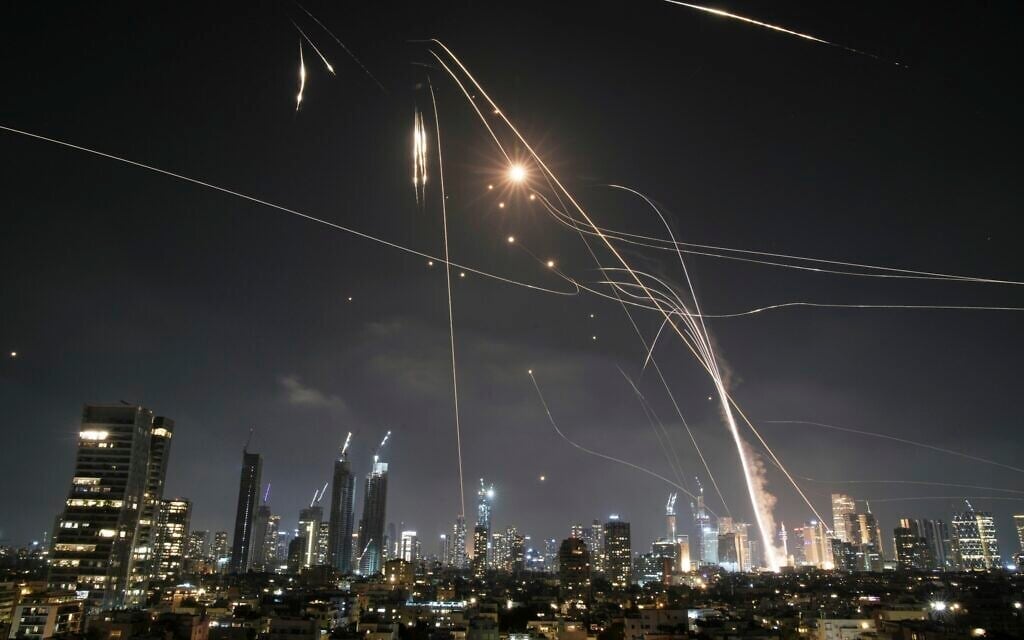
Last summer’s confrontation made this brutally clear. Israel did not stumble into escalation; it confronted a converging threat environment shaped by rockets, drones, and coordinated pressure from multiple fronts. What followed was instructive. Israel acted early, decisively, and with operational coherence. That posture — not apologies, not narrative management — is what reestablished deterrence.
Thanks to this, the result was not regional collapse but a reassertion of deterrence. Arab governments did not applaud publicly—but behind closed doors, respect followed capability.
In the Middle East, survival credibility is louder than press releases. Hence, that episode matters because it exposed a pattern too often ignored by Western analysts: Iranian strategy is cumulative, patient, and designed to mature beneath the threshold of response.
Evidently, the Islamic Republic of Iran does not seek rhetorical victories; it seeks a single knockout blow. It builds pressure gradually—arming proxies, positioning launch platforms, rehearsing command-and-control—while flooding the discourse with threats meant to normalize the idea of eventual conflict. This is not rhetorical excess; it is strategic conditioning. The danger is not the speech itself. It is the moment when speeches turn into synchronized fire.
At the same time, Washington’s regional posture has grown incoherent. Elevating Qatar as a preferred interlocutor while Doha remains entangled with Muslim Brotherhood–aligned networks across Jordan, Egypt, and Lebanon sends exactly the wrong signal. Qatar’s current anger at the United States for formally labeling those movements is not a policy dispute; it is a stress test revealing where loyalties lie. Israel acting decisively now would clarify, not complicate, American strategy by re-anchoring the region around capability rather than mediation theater.
Currently, Israel’s critics demand patience without explaining what patience buys. More missiles? More launch sites? More civilian exposure? For Israel, patience is not a virtue when it functions as a force multiplier for its enemies.
Evidently, Jerusalem cannot absorb a “first strike” the way continental powers can. There is no strategic depth, no empty hinterland to trade for time. A single coordinated barrage aimed at population centers is not symbolism; it is mass-casualty mathematics. In that reality, prevention is not aggression—it is civil defense by other means. This is the strategic grammar of Trumproe: initiative over inertia, disruption over absorption, and clarity over managed decline.
History favors this reading. Wars that begin on the aggressor’s schedule are longer, bloodier, and harder to stop. Wars disrupted mid-preparation tend to be shorter and more decisive. Israel’s experience is not exceptional in this regard; it is merely compressed by geography.
Thus, preemptive logic does not promise zero harm; it seeks to cap harm by breaking timing, coherence, and confidence before violence peaks. The alternative—waiting for perfect clarity—has never protected civilians in this region. It has only ensured that when war comes, it comes maximized.
Concurrently, the normalization question sits squarely inside this logic. Arab states do not align with Israel because they suddenly share narratives. They align because Israel proves it can act with discipline under threat. This is why the Abraham Accords emerged when Israel looked inevitable, not restrained. Last summer reinforced that perception. When Israel looks decisive, normalization accelerates. When Israel looks trapped by opinion cycles, regional actors hedge.
At this juncture, the post–Gaza erosion of normalization momentum is not about Israel being “too strong,” but about Israel being perceived as constrained—hemmed in by Western discourse while its enemies operate on strategy. Partnerships revive when Israel looks like a stabilizer, not a hostage to restraint. Acting now restores that image.
The cinematic truth of Israeli security is simple: deterrence here is kinetic memory. Enemies remember what happens when red lines are crossed. When that memory fades, threats multiply. When it is refreshed, escalation pauses. Preemption, in this framework, is not a war fetish—it is a refusal to let adversaries decide when Israeli civilians become targets.
Those who dismiss this logic from afar enjoy geography as insulation. Israel does not. Every delay compresses risk into apartment blocks, hospitals, and highways. The real moral gamble is not acting early; it is assuming that declared enemies will suddenly restrain themselves once fully armed. In the Middle East, history is unforgiving to those who confuse hope with strategy.
This is why the debate persists, and why it will not go away. For Israel, the question is never abstract. It is untamed, brutal, and immediate: stop the threat while it is still forming—or explain to families why the warning signs were ignored.
And because this reality extends beyond Israel’s borders, breaking Tehran’s strike timeline does more than save Israeli lives. It deprives the regime of the external confrontation it needs to survive.
In less than three weeks, Iran has reportedly killed between 5,000-20,000 of its own citizens—violence rendered invisible the moment foreign war dominates the headlines. Strip the regime of that manufactured confrontation, and what remains is a dictatorship forced to face its own people without excuses, without myths, and without the protective fog of external escalation.
In that sense, Israeli action now is not only self-defense. It is regional pedagogy. It teaches allies why normalization works. It teaches adversaries why preparation windows are liabilities. And it teaches Washington why Trumproe’s logic—choosing anchors, enforcing consequences, and rejecting ambiguity—remains the only strategy that has ever reshaped this region rather than merely managed its decline.
Consequently, the contrast is brutal. Saudi Arabia and the Gulf can afford restraint because geography, oil rents, and U.S. security umbrellas shield them from Iran’s first ‘udar’.
But Israel cannot. Densely populated, within missile range, and openly marked as the regime’s enemy, Israel knows that deterrence in the Middle East is not diplomacy—it is resolve, and delay shifts risk from leaders to civilians.
However, we live in a world where facts matter less than narratives. That is why the international extreme left, still reeling from the collapse of its Latin American idol Dictator and Kingpin Nicolás Maduro, stays silent as Tehran slaughters its own people—and as Christians are massacred across Africa—because acknowledging either would shatter the Gaza myth and expose years of anti-Western propaganda.
Make no mistake: waiting is not a restraint. It is narrative maintenance, paid for in blood.
Jose Lev Alvarez is an American–Israeli scholar.
Lev holds a B.S. in Neuroscience with a Minor in Israel Studies from The American University (Washington, D.C.), completed a bioethics course at Harvard University, and earned a Medical Degree.
On the other hand, he also holds three master’s degrees: 1) International Geostrategy and Jihadist Terrorism (INISEG, Madrid), 2) Applied Economics (UNED, Madrid), and 3) Security and Intelligence Studies (Bellevue University, Nebraska).
Currently pursuing a Ph.D. in Intelligence Studies and Global Security at Capitol Technology University in Maryland, his research focuses on Israel’s ‘Doctrine of the Periphery’ and the Abraham Accords’ impact on regional stability.
A former sergeant in the IDF Special Forces “Ghost” Unit and a U.S. veteran, Jose integrates academic rigor, field experience, and intelligence-driven analysis in his work.
Fluent in several languages, he has authored over 250 publications, is a member of the Association for Israel Studies, and collaborates as a geopolitical analyst for Latin American radio and television, bridging scholarship and real-world strategic insight.