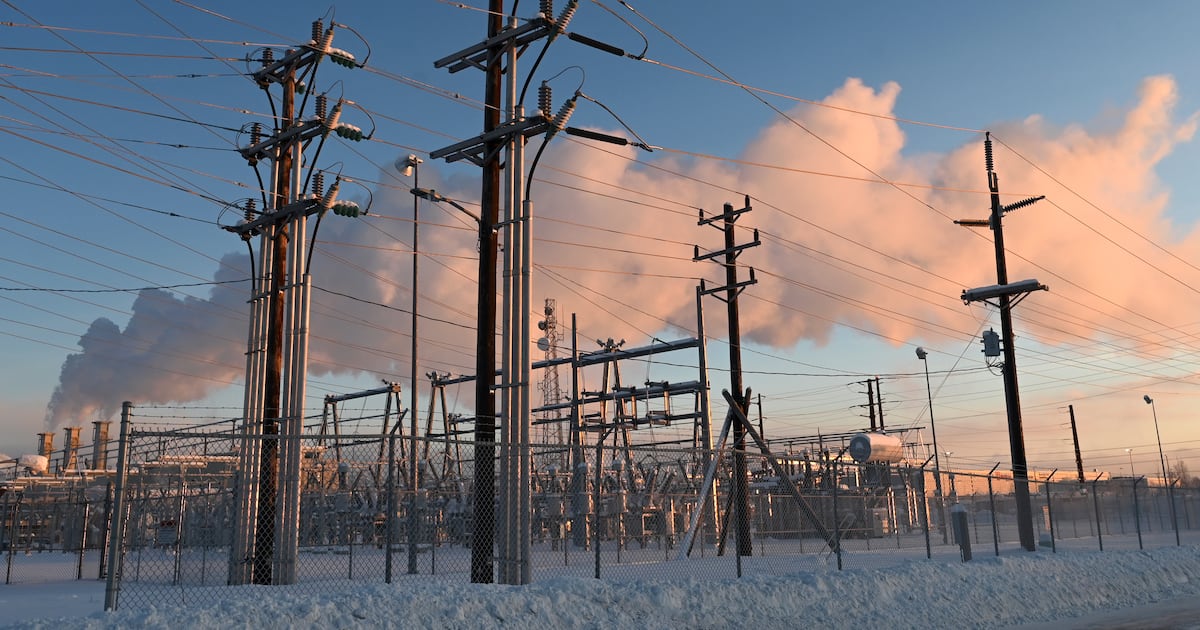
 The natural gas-fired power plant Southcentral Power Project, owned by Chugach Electric, produces power during subzero weather on Jan. 8. (Bill Roth / ADN)
Two major utilities in Anchorage are expanding their natural gas storage in reservoirs in the Cook Inlet region to help counteract a shortage of locally produced gas that’s the dominant energy source for much of Alaska.
The storage will help meet seasonal customer demand in winter, and can help manage liquefied natural gas when it is imported to Alaska as expected in the coming years, the utilities say. The storage can also provide space for gas from an in-state gas line, if it’s one day built from the North Slope.
Chugach Electric Association, the largest electric utility in the state, has signed an agreement with Hilcorp Alaska Gas Storage to stockpile gas in storage facilities near the Kenai gas field, it said in a statement last week.
The Hilcorp facility is only the second commercial option for gas storage in the Inlet, where entities like Chugach Electric can sign up to store gas.
Cook Inlet Natural Gas Storage Alaska, which is operated by Enstar and began operations in 2012 in a depleted reservoir, also provides commercial service.
Also, Enstar, the natural gas utility for Southcentral Alaska, filed paperwork on Monday with state regulators as part of its plan to purchase a depleted reservoir in the Kenai Loop field in Kenai.
Enstar would develop and operate the reservoir as a storage facility for its own gas, with storage not available for others, to support Enstar customers.
The shift to more gas storage adds to the evolving role of the Cook Inlet basin, where once-mighty gas production has waned over the decades, requiring utilities to increasingly look at storage to help meet demand.
Hilcorp, the region’s main gas producer, informed utilities in 2022 that it could no longer guarantee gas supply after contracts ended, including for Chugach Electric in 2028 and Enstar in 2033.
The extra storage options could help provide some breathing room for the utilities as those dates arrive.
Concerns about the dwindling supply of gas took on new consequence during a harsh cold snap two years ago that strained gas supplies and forced Joint Base Elmendorf-Richardson to turn down thermostats while residents were urged to conserve gas use.
In that episode, equipment problems that reduced gas deliverability from Cook Inlet Natural Gas Storage Alaska increased the urgency among utilities to pursue additional storage options.
The latest announcements for new storage come after an unusually prolonged and deep cold snap in the region.
But since 2024, Enstar has upgraded and expanded Cook Inlet Natural Gas Storage Alaska for $68 million, providing an extra buffer of storage this winter.
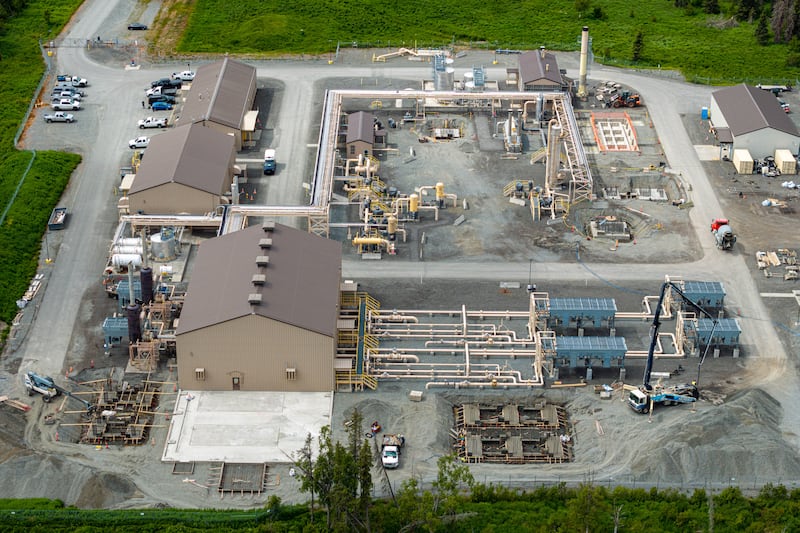 Workers pour concrete to expand the Cook Inlet Natural Gas Storage Alaska compressor facility on Monday, July 1, 2024 in Kenai. The facility takes natural gas from producers, including Hilcorp, and stores the gas underground in a depleted gas field until it is needed by its customers, which include Enstar and Chugach Electric. (Loren Holmes / ADN)
Meanwhile, extra production from the Beluga River gas field that’s primarily owned by Chugach Electric has also helped meet current needs, that utility has said.
Officials with both the utilities have said recently that the gas supplies are sufficient to meet current demand.
Chugach storage with Hilcorp
Hilcorp Alaska Gas Storage has already used the Kenai gas field to store some of its gas.
But it’s now available to hold third-party gas.
It can hold about 38 billion cubic feet of gas, according to records filed with state regulators.
That’s more than half the gas used annually to heat and power Southcentral Alaska.
Chugach Electric said it will store 5 billion cubic feet there. The gas will be built up slowly to that amount over three years, under a five-year contract.
Chugach Electric said that gas injections into the new storage facility could begin around April, if state regulators approve.
The total increase to residential bills is expected to remain below 1% as Chugach ramps up storage to 5 billion cubic feet in 2028, Julie Hasquet, a spokesperson, said in an email.
Chugach also owns 2.1 billion cubic feet in storage in the CINGSA facility, it said in the statement.
In a few years, the utility’s total stored gas will be 7.1 billion cubic feet.
That’s more than half of Chugach Electric’s annual gas use.
“This contract is a key element in ensuring Chugach’s natural gas supply for the future, particularly as our current Hilcorp Alaska gas contract ends in early 2028,” said Arthur Miller, chief executive for the utility. “The gas available for storage is a direct result of the tremendous success we’ve had in the Beluga River Unit gas field.”
Chugach, the primary owner of the Beluga River gas field on the west side of Cook Inlet, said the new storage facility will provide it with greater flexibility for storing and accessing gas. The facility will be important if there’s an unforeseen problem with gas production or storage deliverability, it said.
“Additionally, (Hilcorp Alaska Gas Storage) offers lower reservation rates and higher injection and withdrawal rates, giving Chugach more cost-effective options compared to relying solely on storage service from CINGSA,” Chugach Electric said.
Hilcorp, which has multiple gas storage facilities in Cook Inlet, said in a statement that the stored gas has for years enabled it to meet its gas supply commitments to customers.
“Reliable gas storage is critical to Alaska’s energy future, particularly during periods of peak demand or unexpected disruption,” Hilcorp spokesperson Matt Shuckerow said in a statement. “Since 2012, Hilcorp’s storage assets have consistently enabled us to meet our gas supply commitments to our customers — even through major events such as the 2018 earthquake, the 2019 Kenai wildfires, and recent Cook Inlet storage disruptions.“
“This agreement expands access to that same proven storage capability, providing third-party customers with a reliable tool to better serve their ratepayers, improve system resilience, and manage supply during critical periods,” Shuckerow said.
Enstar’s gas storage plans
Enstar, for its next storage facility, proposes to buy a depleted gas reservoir from AIX Energy in the ground beneath Kenai.
The proposed $240 million facility will initially hold 25 billion cubic feet of gas, according to filings with state regulators.
The usable gas — some of it must remain in the reservoir to keep pressure up — could cover close to half of the utility’s annual demand for 38 billion cubic feet.
The project will add up to $12 a month to the average customer bill, the filing says.
“The changing gas supply environment in Southcentral Alaska has led to a simple reality: ENSTAR must have additional storage to meet its Customers’ needs,” Enstar said in its petition.
“With additional storage capacity, the Company will be able to purchase gas supply as it becomes available and then store those volumes for future customer use,” the petition says. “Given the gas supply challenges in Cook Inlet, having the ability to procure gas produced at any time — rather than scrambling to procure it ‘just in time’ — will help ensure reliable, uninterrupted service to Customers.”
Enstar says in the filing that it considered using the new Hilcorp storage facility.
But Hilcorp Cook Inlet plans to use most of the space there to store gas, leaving insufficient room for Enstar, the filing says.
The Enstar project will inject about $50 million into the Alaska economy, including through the hiring of large numbers of contractors, the filing says.
Enstar is asking for expedited consideration of its filing, with approval sought within 45 days, in part to support new gas production efforts by Cook Inlet producers.
Hilcorp provides 85% of Enstar’s gas, so only a small amount is left for other producers to provide, dissuading them from taking on financial risks to explore and develop more gas production, Enstar said in a recent email to employees.
But with more storage, the calculation improves, Enstar said in the email.
“A natural gas production company in Alaska — BlueCrest Alaska Operating, Inc. — has already committed to supplying ENSTAR with gas by the fourth quarter of 2026, but only if the Company has the ability to store those volumes (or use them immediately),” the filing says.
“Additionally, the Company also will need new storage in 2027 so that it can receive new gas supplies from Furie Operating Alaska, Inc.,” the filing says.
John Martineck, president of BlueCrest, said in a letter supporting Enstar’s application that under a gas sales framework with the utility it could provide about 11 billion cubic feet of gas for an initial one-year term following the completion of two new development wells.
“From BlueCrest’s perspective, access to expanded storage is essential to justify continued investment in Cook Inlet gas development, as it provides a reliable outlet for new production that would otherwise be constrained,” Martineck said in the letter.
Mark Slaughter, chief commercial officer at Furie, said in an interview Tuesday that more storage will open up opportunities for more production.
“Our plan of development is to drill two, possibly three wells in 2026, so we have additional production by the end of the year,” he said.
More storage will also allow wells to produce gas at a more stable pace during periods of high demand, reducing the risk of production wells getting damaged by problems like sand intrusion, he said.
That will also help support gas production in Cook Inlet, Slaughter said.