January 14, 2026
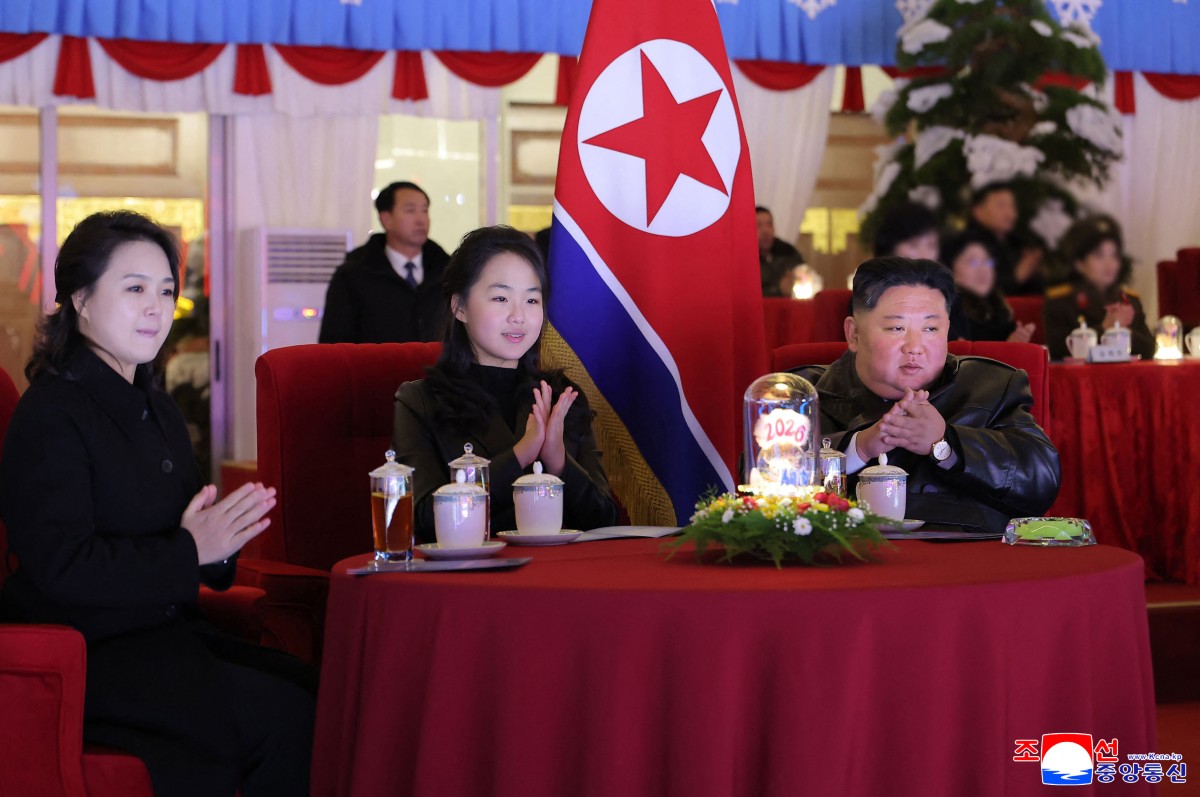
SEOUL – Speculation over North Korea’s next leader has resurfaced as Kim Jong-un’s teenage daughter, believed to be named Ju-ae, appears with growing frequency at high-profile public events, prompting debate over whether the regime is laying the groundwork for another dynastic succession.
Fueling the discussion is a March 2025 article published in Geunroja — a key Workers’ Party magazine distributed among party officials — that underscored the importance of formally designating a successor while the incumbent leader remains alive. Though the article made no reference to Ju-ae, it stressed the need to establish a successor’s leadership, secure party consensus and cultivate loyalty among officials and the public — language that analysts view as notable given the timing.
The article was released roughly a month before Ju-ae reappeared in state media after a brief hiatus, accompanying her father during an inspection of a construction site in Pyongyang. Her subsequent appearance alongside Kim Jong-un at the Kumsusan Palace of the Sun on New Year’s Day — paying tribute to former leaders for the first time — further intensified speculation that she could be positioned as a future heir.
North Korea has yet to formally name a successor, instead referring to Ju-ae simply as Kim’s “beloved daughter” whenever she is mentioned in state media.
South Korean officials caution against reading Ju-ae’s public exposure as a clear signal of succession.
A Unification Ministry official said her prominent presence in public events is more likely intended to reinforce the regime’s “socialist great family” narrative — a propaganda concept portraying the leadership as parental figures and society as a single family — rather than to outline a succession structure.
“The current pattern appears focused on projecting family symbolism rather than emphasizing the succession framework,” the official said, requesting anonymity. The official pointed to Ju-ae’s placement between her parents during the mausoleum visit. If succession had been the message, she would more likely have stood behind Kim Jong-un, according to the official.
Ju-ae also recently appeared at a ceremony to plant trees for a memorial facility honoring North Korean soldiers killed while fighting alongside Russian forces in Ukraine — another highly symbolic setting that placed her at the center of public attention.
While Seoul officials stress caution, some experts argue that Ju-ae’s expanding public profile carries political significance that should not be dismissed.
Lee Sang-keun, a research fellow at the Institute for National Security Strategy, said in a report published Jan. 7 that Ju-ae’s public appearances have increased to an unprecedented level, with state media releasing images “in which Ju-ae appears ahead of Kim Jong-un or occupies the center of photographs in his place.”
“Despite skepticism based on her young age and gender, it is difficult to rule out the possibility of succession,” Lee said.
Lee noted that even in societies where women traditionally hold lower social status, daughters or wives of powerful political figures have risen to the highest leadership positions. In such systems, the authority of a ruling family can offset gender barriers by reinforcing political legitimacy.
“Given North Korea’s deeply entrenched dynastic and monarchical political tradition, it would not be difficult for the supreme leader to designate a young child as a future successor and simultaneously build that successor’s image while providing political training,” Lee said.
He suggested Kim Jong-un’s approach may reflect lessons learned from his own rise to power. Unlike Kim Jong-il — who received decades of systematic grooming under Kim Il-sung — Kim Jong-un was thrust into leadership following his father’s sudden death in 2011, leaving little time for preparation.
The early years of Kim Jong-un’s rule were marked by instability, which he consolidated through fear, including the assassination of his half brother Kim Jong-nam and the public execution of his uncle Jang Song-thaek. More than 140 elite figures were purged, a process that secured authority through coercion rather than institutional legitimacy.
“Kim Jong-un may be attempting to avoid a repeat of that uncertainty by revealing his daughter early and gradually shaping her public image,” Lee said.
Others stress that while Ju-ae’s visibility is politically meaningful, institutional barriers make near-term succession unrealistic.
Hong Min, a senior research fellow at the Korea Institute for National Unification, dismissed speculation that adolescent daughter could be granted an official title anytime soon.
“At age 13, Ju-ae does not meet the requirements for party membership, let alone holding an official position,” Hong said. “Both Kim Jong-il and Kim Jong-un joined the party only after reaching adulthood.”
“Party titles come with the authority to exercise official duties,” he added. “It would be implausible for a minor to hold such authority, and such a move would lack credibility among North Korean residents.”
Hong emphasized that North Korea, despite its opaque nature, operates according to internal party norms and procedures, making a premature conferral of authority highly unlikely.
Analysts broadly agree that while Ju-ae’s succession is neither confirmed nor imminent, it remains a possibility that carries long-term strategic implications.
Lee projected that efforts to build Ju-ae’s successor image could accelerate further in 2026, but cautioned that any formal designation would take considerable time. Steps such as independent public activities without her father would likely precede any official move.
“Succession to Ju-ae is not an urgent matter, but it is a significant one that cannot be excluded,” Lee said.
For now, Ju-ae’s appearances appear to straddle the line between symbolic family imagery and the early, cautious shaping of a potential future leader — a balancing act that reflects both the regime’s dynastic instincts and its institutional constraints, according to observers.