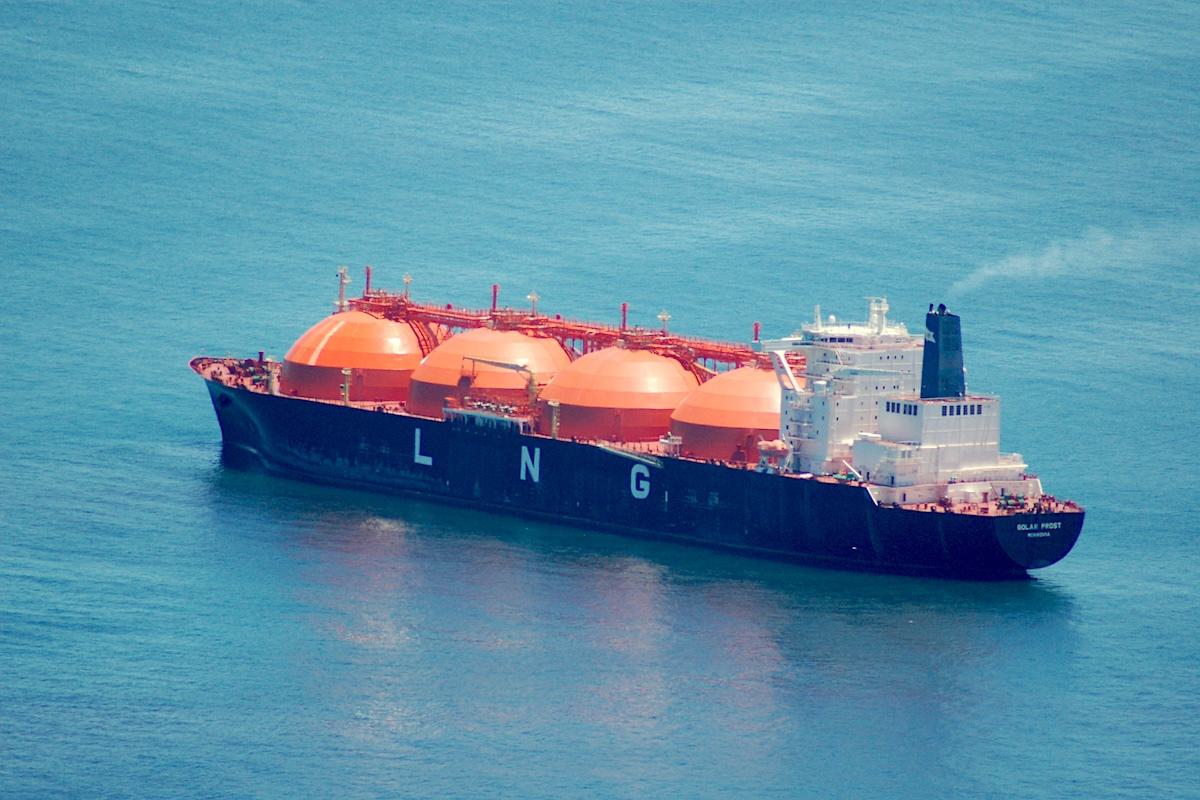
Higher exports of liquefied natural gas in 2025 played a significant role in rising utility bills, an analysis of federal data found.
During the 2024 campaign, President Donald Trump promised voters that his policies would lower their energy prices by 50 percent, repeating this pledge in speeches in New York, Pennsylvania, and North Carolina. “We will cut energy and electricity prices in half within 12 months — not just for businesses but for all Americans and their families,” he wrote in a Newsweek op-ed.
That hasn’t happened. Nationwide, electricity bills are up 13 percent compared to last year, with some states facing steeper jumps than others. One of the reasons for those increases is the growing export of liquefied natural gas and a corresponding spike in gas prices, argues a new report from Public Citizen, a nonprofit consumer advocacy organization.
The analysis, based on data from the U.S. Energy Information Administration, found that Americans paid $12 billion more for natural gas between January and September 2025 than they did over the same period last year. Because natural gas is used to heat homes directly and to power the electric grid, its price has an outsized impact on Americans’ utility bills. Higher exports leave Americans more exposed to swings in the global market.
LNG exports were up 22 percent this year, according to the report. While the U.S. is already the world’s largest exporter of the fuel, the second Trump administration has made increasing LNG exports a priority.
“Trump’s prioritization of LNG exports is directly in the way of efforts to address energy affordability,” said Tyson Slocum, author of the report and the director of Public Citizen’s energy program. “Twenty-five percent of all of America’s natural gas production is being dedicated to natural gas exports.”
Millions of Americans are struggling to pay their utility bills, Slocum said. The latest Census Bureau data on the subject, from September 2024, showed that 23 percent of Americans reported not being able to pay at least one energy bill in full in the prior year.
In a statement to Inside Climate News, Taylor Rogers, a White House spokesperson said: “Fixing Joe Biden’s energy crisis has been a priority for President Trump since day one, and lowering energy costs for American families and businesses will continue to be a top priority in the new year.”
“High energy prices are a choice,” she said. Rogers blamed higher electricity bills in blue states like California on “green energy scam” projects and said red states have succeeded in “lowering energy costs for their residents by embracing President Trump’s ‘DRILL BABY DRILL’ agenda.”
While it’s true that California, Hawaii and states in New England have higher prices on average, electricity prices in Missouri, North Dakota, Oklahoma, Nebraska and Wyoming — all Republican-leaning states — have gone up the most since Trump took office, an Inside Climate News analysis of EIA data through September shows. Missouri is contending with a nearly 42 percent increase since January.
The second Trump administration has championed LNG exports from the beginning. One of Trump’s first acts as president was to reverse former President Joe Biden’s pause on permitting for new LNG exports as part of an executive order, Unleashing American Energy. Last December, the Biden administration released a study that found increasing LNG exports could lead to significant greenhouse gas emissions and higher energy prices for American consumers.
The Trump-led U.S. Department of Energy says it has already approved applications from LNG projects authorized to export approximately 25 percent more than 2024 levels.
“They put the LNG industry on speed dial inside the Oval Office,” U.S. Sen. Ed Markey, a Massachusetts Democrat, said in a press briefing about the Public Citizen report. “Whatever they need, they’re getting.”
In June, Energy Secretary Chris Wright and Interior Secretary Doug Burgum announced four agreements between U.S. producers and the Japanese company JERA to export up to 5.5 million tons of LNG per year over a two-decade period.
“This investment is a message to the world that American LNG is back thanks to President Trump and we’re leading on the world stage,” Burgum said in a press release at the time.
In September, Burgum and Wright traveled to Europe to attempt to persuade the European Union to reconsider a new regulation limiting methane emissions for imports beginning in 2027. The law would likely curtail the import of U.S. LNG. Trump’s August trade deal with the E.U. included stipulations that the E.U. would “procure U.S. liquified natural gas, oil, and nuclear energy products with an expected offtake valued at $750 billion through 2028.”
“European benchmark natural gas prices have been declining at the same exact time and rate that U.S. prices are increasing. What this means is American families are subsidizing cheaper gas for Europeans,” Slocum said. In 2024, Europe was the leading destination for U.S. LNG exports, accounting for 53 percent.
Elizabeth Marx, the executive director of the Pennsylvania Utility Law Project, testified at a public hearing about LNG exports and a proposed LNG terminal held last month by the Pennsylvania House Environmental and Natural Resource Protection Committee. Her legal aid organization helps Pennsylvanians struggling to pay their utility bills.
“We are deeply concerned about the impact of the rapidly expanding LNG export markets on the affordability of gas and electric service for Pennsylvania families — and the corresponding impact on the ability of economically vulnerable households to maintain energy service to their home,” she said there.
As of September, terminations for electricity service were up 27 percent year over year in Pennsylvania, and increasing LNG exports are one of the causes, she said. In addition to the electricity price increases triggered by the push to rapidly build and power more data centers, the shutdown and massive cuts within the federal government this year led to disruptions to benefits that typically help residents pay their utility bills and afford groceries, worsening the situation for people barely getting by, Marx said.
Marx’s work puts her on the frontlines of the energy affordability crisis, and she sees the profound impacts of rising electricity and gas prices on Pennsylvania’s families. Evictions. House fires caused by the electric space heaters that residents turn to when they can’t afford their heating bill. People cutting back on medication and oxygen that they need to control health conditions.
“These are real consequences that are happening because of utility insecurity and increasing costs,” she said in an interview.
“I’m hopeful about the conversation that’s unfolding about affordability, but what I’m very concerned about is that we’re not focusing enough on the overall drivers of the problem. I’m not seeing a willingness of regulators to regulate in the way that we need in order to address the fundamental problem,” she said. “What concerns me most is that affordability will become a buzzword, and we will lose sight of the reality that individual consumers are facing, which is they cannot afford to keep heat on in their homes at a safe temperature.”
—Kiley Bense, Inside Climate News
ALSO ON YALE E360
It’s a ‘Golden Age’ for U.S. LNG Industry, But Climate Risks Loom