As these and other anti-immigration operations ramped up, Maryland’s executive secretary for agriculture emailed a group of farmers and industry representatives, asking how new restrictions on immigrants’ ability to access federal benefits might impact agricultural operations in the state. He was asking on behalf of Governor Wes Moore, a Democrat.
Maryland has a massive poultry industry, shared with Delaware and Virginia on the Delmarva Peninsula, home to the highest concentration of industrial chicken production in the country.
Zach Evans, an executive manager at Mountaire Farms, the fourth-largest chicken company in the U.S., was among the recipients of that email, which Civil Eats obtained through a public records request. Within the hour, he wrote back to say that those particular policy changes would not affect Mountaire’s employees.
However, he wrote, he wanted to call attention to another federal policy change that would threaten food processors, including Mountaire.
“My company alone will lose approximately 15 percent of our total workforce within the next 45 days—nearly 1,300 employees, including over 900 on Delmarva—on top of prior losses resulting from changes.”
Trump’s decision to revoke a designation called Temporary Protected Status (TPS) for immigrants from certain countries, he continued, combined with the end of other humanitarian programs for immigrants and refugees, would likely result in the loss of more than 20 percent of jobs at chicken processing plants on the Delmarva Peninsula.
“My company alone will lose approximately 15 percent of our total workforce within the next 45 days—nearly 1,300 employees, including over 900 on Delmarva—on top of prior losses resulting from changes,” Evans wrote, including supervisors, shift leads, managers, and superintendents.
“Individuals under TPS or Parole have been fully contributing to Social Security and federal programs but will now be cut off from those same programs,” he wrote. “Additionally, many are being compelled to liquidate their 401(k) and profit-sharing accounts as we are compelled to terminate their employment.”
Evans referred Civil Eats to Mountaire’s director of communications, Catherine Bassett, who declined requests for an interview. Bassett did not respond to later emails that detailed Civil Eats’ findings in the documents and again requested an interview or comment.
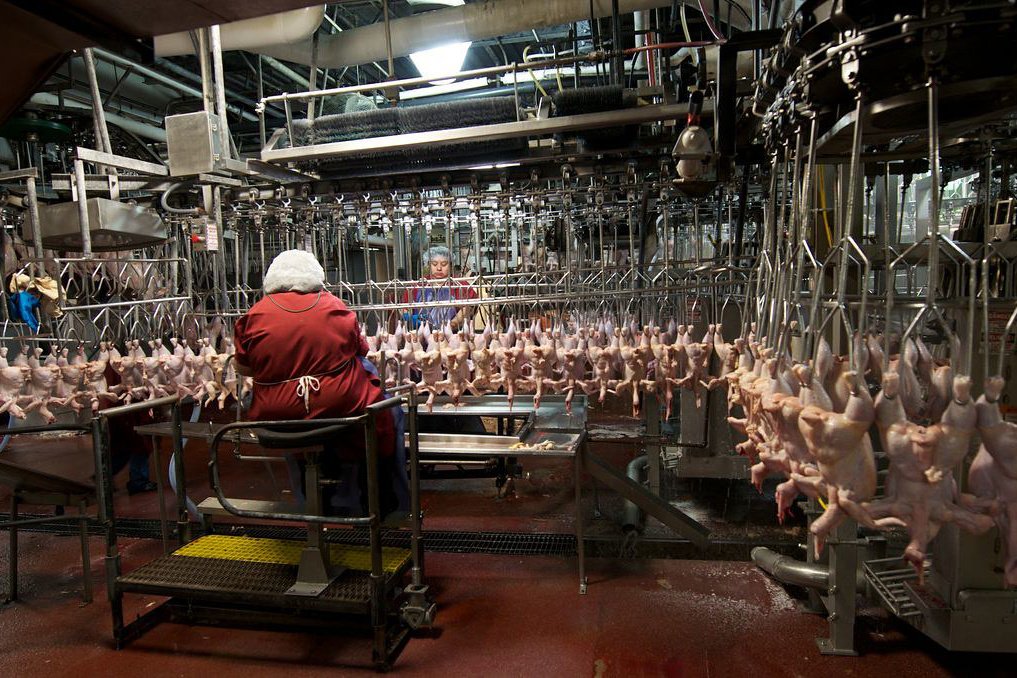
Poultry plants like this one in Edinburg, Virgina, rely heavily on immigrant labor. (Photo credit: Aaron Ansarov/USDA)
While he works for Mountaire, Evans represents the larger, influential poultry industry on the Maryland Agriculture Commission. In 2024, the industry on the Delmarva Peninsula produced 613 million chickens worth $4.8 billion dollars in an area under 6,000 square miles and employed nearly 18,000 people.
Some of its workers enjoy temporary protections under federal law. TPS allows non-citizens to live and work in the United States legally for up to 18 months, if they are coming from countries deemed unsafe due to political unrest or natural disasters. The protections, expanded under the Biden administration, apply to a large number of people from Haiti and Venezuela, and can be repeatedly renewed.
Under the Trump administration, hundreds of thousands of people were to lose those protections in August 2025, though the move was delayed after a court intervened. Officials now say protections will expire on Feb. 3, pending another legal challenge, where a judge is expected to rule by Feb. 2.
The end of TPS would upend the lives of thousands of Haitian immigrants who live and work in Delmarva chicken plants. It could also, as Evans indicated, create a major workforce challenge, and contribute to higher food prices.
Documents obtained by Civil Eats through a public records request show that the companies of Delmarva are bracing for the impact of Trump policies while quietly putting the issue in front of state agencies and elected officials, who are Democrats. The documents underscore the complicated nature of business and politics under the Trump administration’s sweeping changes to immigration. And while this is true for many companies, the public records provide a closer view of the TPS issue.
Mountaire, for example, has longstanding ties to Trump. According to a Vox analysis, Mountaire CEO Ronald Cameron has spent more than $75 million over the past decade helping Republicans get elected. That includes $4.7 million exclusively on Trump’s 2020 and 2024 campaigns.