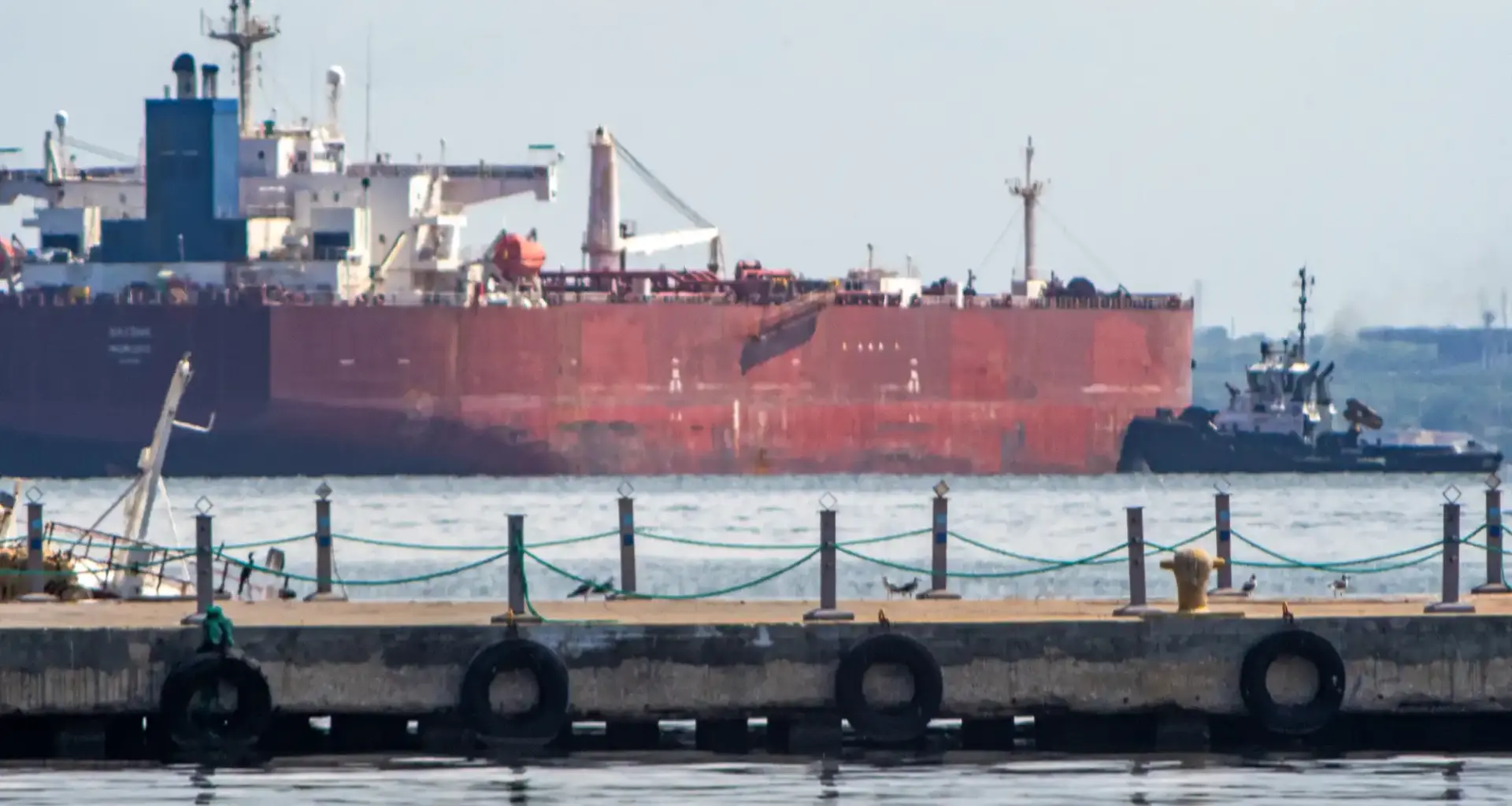
According to multiple reports, Venezuela’s state-owned energy company has started to ramp up oil production as exports of crude restart under U.S. supervision. That oil production had fallen close to zero after the U.S. imposed a blockade on shipments from Venezuela. Now we’re watching to see what Venezuela’s oil industry will look like under U.S. control.
For more on this, “Marketplace Morning Report” host Sabri Ben-Achour spoke with Andrew Campbell, executive director at the Energy Institute at Haas at the University of California, Berkeley. The following is an edited transcript of their conversation.
Sabri Ben-Achour: So, President Trump declared that the U.S. would control, indefinitely, Venezuela’s oil production. What would that actually mean, given the current market environment for oil?
Andrew Campbell: Well, that’s the piece where it’s very questionable whether this would be a good idea for the United States or any international oil companies. I mean, the global oil market right now is very well supplied, so that’s good for consumers — good for oil consumers. The prices are modest. But for a country like Venezuela, whose oil reserves are some of the lowest quality oil reserves in the world, that’s a really bad thing. Just even producing it is very expensive due to the poor-quality oil.
Ben-Achour: Yeah, I mean, in one post on social media, the president said a big factor in the U.S. involvement in Venezuela is the “reduction of oil prices for the American people.” Would that actually lower gas prices for people?
Campbell: I mean, not anytime soon. I mean, there’s a little bit of a grain of an idea there, which is the Gulf Coast in the United States has tremendous refining capacity. Much of that capacity was built and expanded to process oil coming from Venezuela, so the refineries are able to produce gasoline, get it into the market, lower prices for consumers. But there are many other sources of oil too, and the biggest source actually is U.S. domestic oil, and that is why prices, in part, are low right now. It’s hard to see how Venezuela really would have any impact on that, even if oil production increased substantially.
Ben-Achour: The president met with oil executives last week. Exxon Mobil, ConocoPhillips — they have outstanding debts in Venezuela. At least one of the CEOs called Venezuela “uninvestable.” What would make Venezuela a profitable investment? What would make it investable?
Campbell: So, thinking back to the Venezuela of the past, in the 1990s Venezuela was highly investable. There were many U.S. oil companies, other foreign companies, operating very profitably in the country at that time. There were stable institutions; there were stable, understandable courts. So, there was a whole framework that was basically friendly to international investment. That system is long gone, and it would take decades to probably put that back together.
Ben-Achour: President Trump said that Venezuela and the unlocking of its oil would create massive wealth, lower taxes, and create a lot of jobs for Americans and Venezuelans. What do you make of that?
Campbell: You know, again, there’s a little bit of something there. I mean, the Venezuelan oil industry had historically employed many, you know, tens of thousands of Venezuelans. So, yeah, certainly a revitalized industry — if that were possible — would create jobs there in Venezuela. I don’t really see how it would create jobs in the United States. The oil industry is not really a labor-intensive industry; it’s a capital-intensive industry. It’s really about making money for companies, for investors. It’s not a big source of employment.
Related Topics