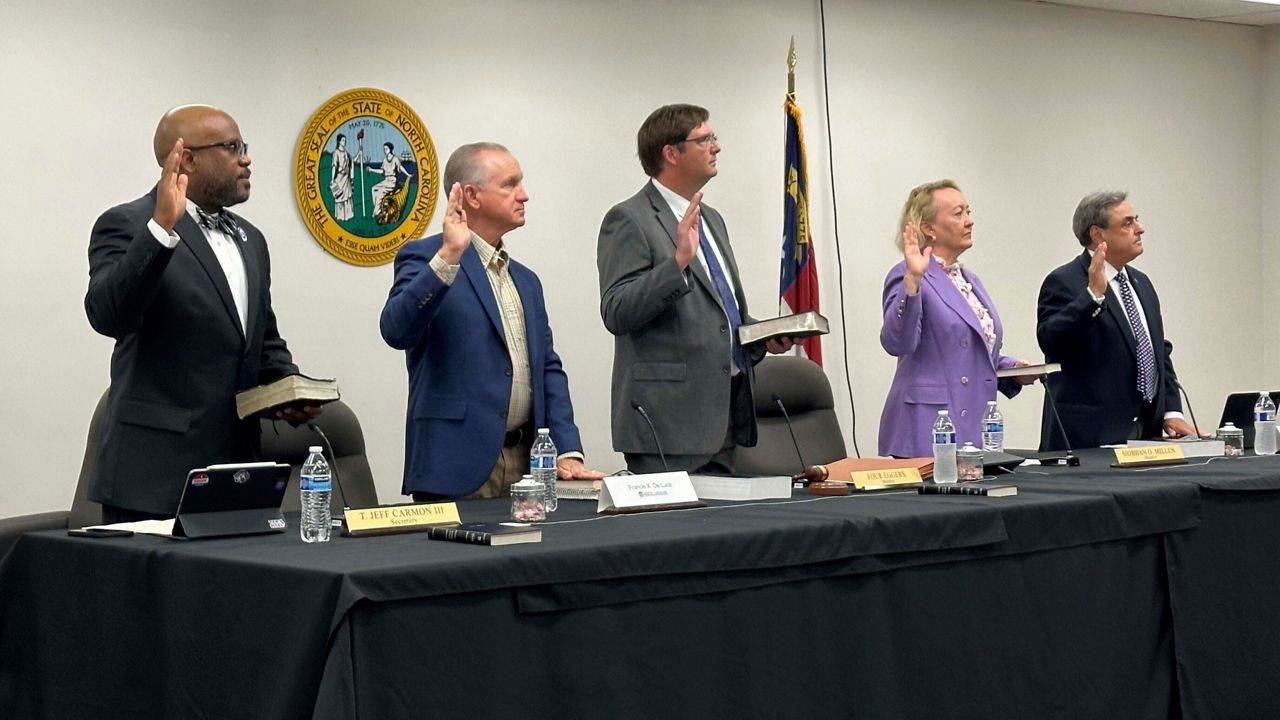
The North Carolina State Board of Elections adopted early voting plans for 12 counties at a Tuesday meeting.
In North Carolina, if a county board of elections is unable to come to a unanimous agreement on an early voting plan, the SBE may adopt a plan for them.
“Voting is not a flippant thing for me, nor these individuals here today,” SBE member Jeff Carmon said at the meeting.
The early voting plans centered on Sunday voting and using universities as early voting locations.
The state board decided against allowing Sunday voting for Brunswick, Columbus, Craven, Greene, Harnett and Wayne counties.
The SBE also voted against allowing N.C. A&T, UNC-Greensboro, Elon University and Western Carolina University to act as early voting sites in the 2026 primaries.
Students from N.C. A&T attended the meeting, filling the room and carrying signs expressing support for maintaining campus voting sites.
“It’s a war on students,” Siobhan O’Duffy Millen, a member of the state board, said following the vote against university early voting sites in Guilford County.
Other board members rejected Millen’s statement.
“There’s plenty of places — go vote,” Francis X. De Luca, chair of the board, said while waving off the peaceful student protesters at the meeting.
All plans adopted by the about on Tuesday apply only to the 2026 primary elections.
The primaries in North Carolina will see some critical races, with U.S. Sen. Thom Tillis retiring, leaving his seat up for grabs. High-profile candidates in the Senate primary include former Gov. Roy Cooper seeking the Democratic nomination and former Republican National Committee chairman Michael Whatley seeking the GOP nod.
In addition to the U.S. Senate seat, all 100 seats in the N.C. House of Representatives and all 50 seats in the N.C. Senate are up for election.
Visit the State Board of Elections’ website to find out more on where and when to vote in the primary, which takes place March 3.
Follow us on Instagram at spectrumnews1nc for news and other happenings across North Carolina.