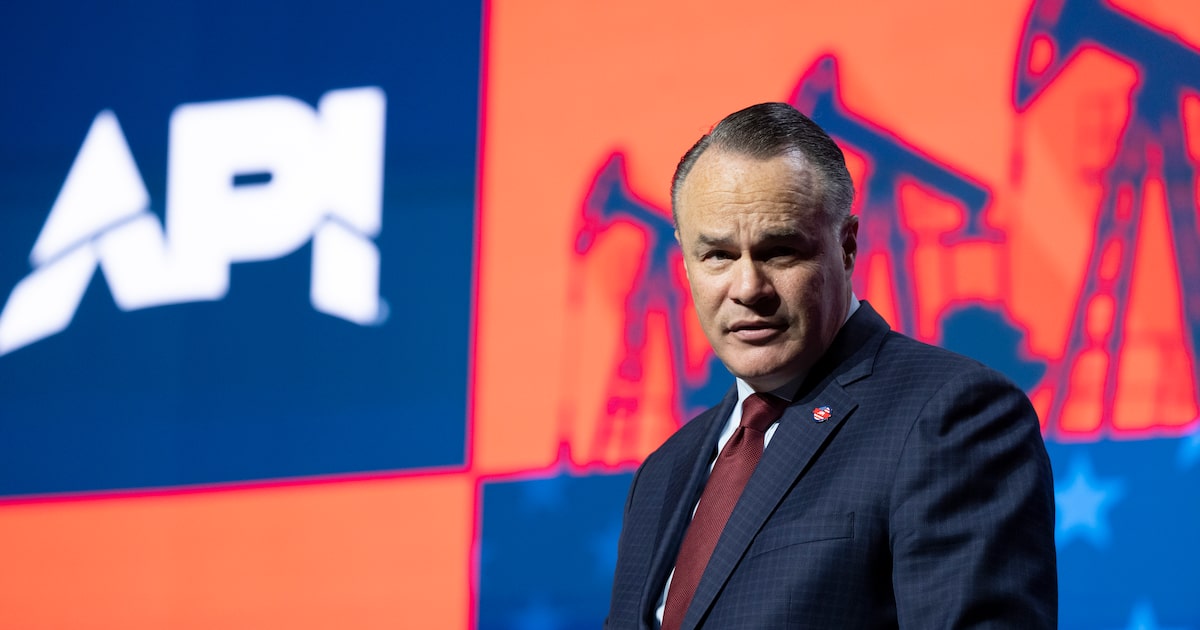
WASHINGTON — As the United States enters an energy inflection point, the country’s oil and gas producers indicate they are poised to meet insatiable needs.
However, permitting reform will be critical in them being able to do so, according to American Petroleum Institute president and CEO Mike Sommers.
“Right now, America has energy in the ground and demand on the grid, but too often the connection between the two is blocked by red tape, delay and endless lawsuits,” he told a crowd of industry leaders, policymakers and market analysts at API’s annual State of American Energy event in Washington, D.C. on Tuesday.
In spite of relatively soft crude prices hovering at levels below $70 per barrel amid fears of a supply glut, Sommers insisted the U.S. is entering a “demand decade” that will require historic amounts of new energy.
Related
“Whether our nation can meet that demand will define its trajectory,” he said.
At a moment when the world is demanding more energy than ever thanks to population growth and the surge of both artificial intelligence and digital transformation, the U.S. leads in both oil and natural gas production.
The industry has also driven down emissions per barrel of oil and natural gas, while output and productivity have climbed, Sommers said.
While Sommers said the state of American energy is strong, adding that no other country is better positioned to lead into the next 10 years, there’s still work to be done.

Oil and gas industry leaders gathered at American Petroleum Institute’s annual State of American Energy on Jan. 13, 2026, at The Anthem in Washington, D.C.
Ian Wagreich / capitolhillphoto.com
This year, API — one of the country’s most powerful oil and gas trade groups — is prioritizing infrastructure and permitting reform.
“America knows how to produce energy. The real question is whether we’re willing to build the infrastructure to move it at the speed, scale, and reliability the ‘Demand Decade’ requires,” Sommers said, calling permitting reform essential.
“ … It’s the difference between meeting demand or not, and API is all in until it becomes the law of the land because when America builds, America wins.”
The group’s other top energy policy priorities also include access and international competitiveness, something which API says will create durable policy that will outlast political cycles and support long-erm investment, reliability and growth.
Related
All sources of energy will be needed to meet demand, Sommers told a group of reporters after the prepared speeches.
“We’re going to need … a lot more energy going forward, and that means all sources of energy,” he said.
“We’re not in competition with each other so if we’re going to win the race for artificial intelligence, we’re going to have to have all sorts of energy at the table. And that means everybody puts the weapons down.”
The United States has been setting oil and gas production records, currently producing more than 13 million barrels of oil per day. That’s more than any other country.
Texas, home to the most petroleum refineries and most refining capacity in the nation, plays a large role in that. The state’s production also broke records last year, including crude oil production reaching 5.85 million barrels per day in July and market natural gas averaging 35.4 cubic feet per day in August.


This reporting is part of the Future of North Texas, a community-funded journalism initiative supported by the Commit Partnership, Communities Foundation of Texas, The Dallas Foundation, the Dallas Mavericks, the Dallas Regional Chamber, Deedie Rose, Lisa and Charles Siegel, the McCune-Losinger Family Fund, The Meadows Foundation, the Perot Foundation, the United Way of Metropolitan Dallas and the University of Texas at Dallas. The News retains full editorial control of this coverage.