It’s been a volatile start to 2026 for Canadian oil stocks, with uncertainty over revitalized Venezuelan production at one point prompting Prime Minister Mark Carney to give reassurance that the industry will remain competitive.
For investors, it was a lot to digest. U.S. President Donald Trump has declared his government will run Venezuela’s oil industry “until such time as we can do a safe, proper and judicious transition.” Venezuela has the world’s largest oil reserves, and produces a heavy grade of crude similar to Western Canadian Select (WCS). However, much of the country’s infrastructure is reportedly crumbling, and the CEOs of America’s oil giants don’t sound overly keen to pony up big bucks to fix this.
On the Toronto Stock Exchange, shares of Canadian producers fell. Some investors bought the dip.
On Wednesday, oil prices rose to a two-month peak as traders priced in risk from another key region. Iran is home to the world’s third-largest reserves, and strategically located along the Strait of Hormuz, arguably the most important energy transit chokepoint in the world.
Today, the iShares S&P/TSX Capped Energy Index ETF is trading near its 52-week high. The basket of Canadian oil and gas stocks has gained nearly nine per cent in the past five trading days.
Looking back, RBC Capital Markets analyst Greg Pardy puts it like this.
“January arrived like a runaway freight train,” he wrote in a research report earlier this week. “That said, inspection of fourth-quarter estimates across our coverage would generally point towards a more placid landscape, with few big surprises in store.”
Imperial Oil (IMO.TO)(IMO) is scheduled to be first among Canada’s top producers to report fourth-quarter financial results. The company is due to report prior to the opening bell on Jan. 30.
“We estimate that Canada’s majors — Canadian Natural Resources, Suncor Energy, Cenovus Energy and Imperial Oil — saw their free funds flow (before dividends and working capital movements) generation fall almost one-third sequentially ($2.2 billion) to $4.8 billion in the fourth quarter, in large part due to soft oil prices,” Pardy wrote.
RBC Capital Markets estimates U.S. benchmark crude (CL=F) averaged US$59.21 in the fourth quarter, down US$5.82 or nine per cent sequentially.
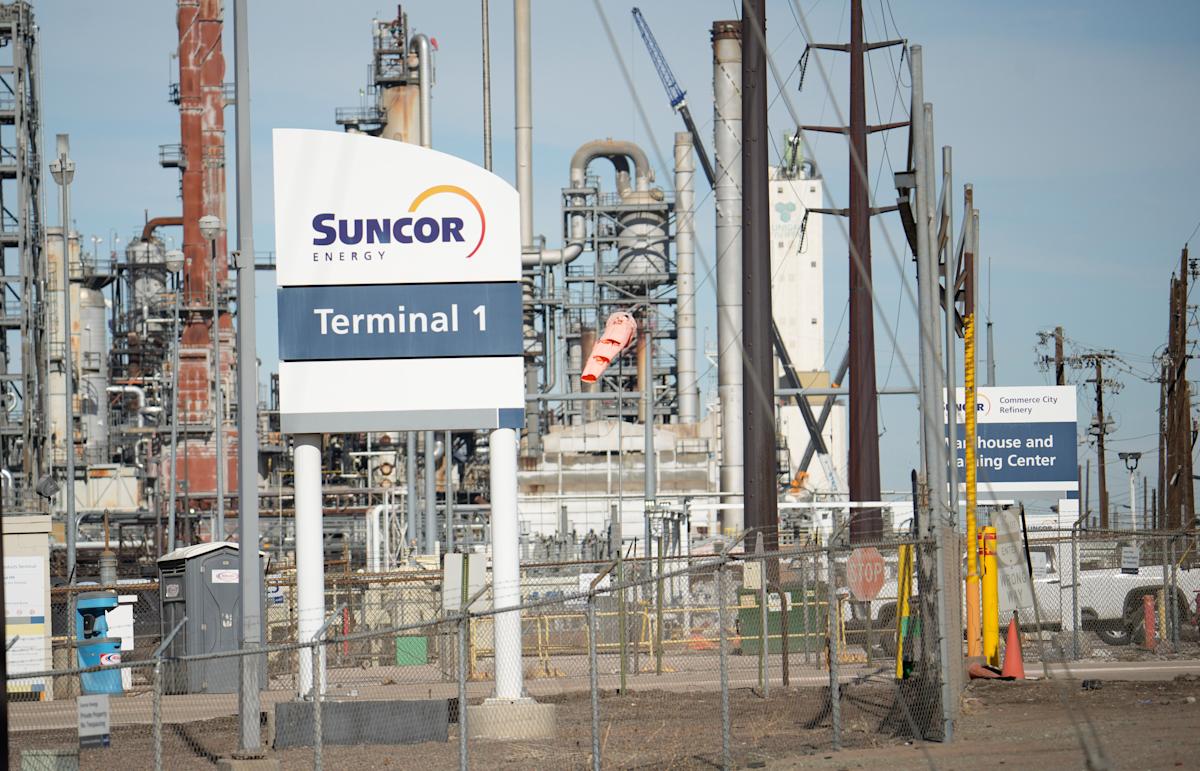
Pardy’s top pick among Canadian integrated producers is Suncor Energy (SU.TO)(SU). Among the non-integrated senior producers, he prefers Canadian Natural Resources (CNQ.TO)(CNQ).
Suncor is also a favourite at CIBC Capital Markets. Its oil and gas analyst, Dennis Fong, ranks the company among his top picks for 2026, next to Kelt Exploration (KEL.TO) and Tamarack Valley Energy (TVE.TO).