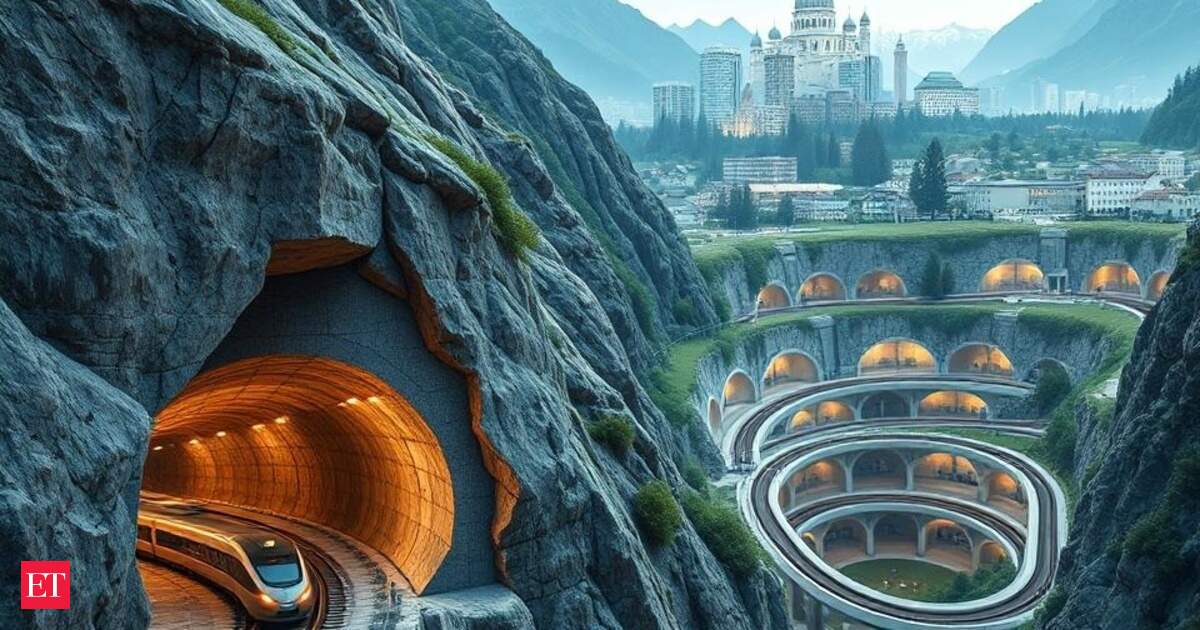
Over the years, tunnels have been established to transport people, goods, water, and energy in difficult terrain. The mountainous scenario, incorporated with high mobility requirements, made tunnelling a practical approach.Currently, Switzerland has several tunnels, short and local, others extending tens of kilometres. Urban regions like Zurich, Basel, Berne, Geneva, and Lucerne also showcase underground networks to aid everyday travel. This hidden build guarantees connectivity and efficiency while remaining largely not seen by the public.
Why Tunnels Are Essential in SwitzerlandSharp elevation shifts over short distances make above-ground roads or railways slow,extensive, or interruptive. Tunnels offer a way through without continuous exposure to severe weather, sharp gradients, or unstable areas. Mobility requirements also have a role. Switzerland has elevated levels of everyday movement both within its borders and internationally, and infrastructure must reach even remote regions efficiently. With time, tunnelling became a practical approach and a solution.History of TunnellingAccording to the Swiss community, significant expansion started following the Second World War. Around 1950, large-scale drainage tunnels were established for hydroelectric power. Road tunnel construction followed in the 1980s, and from almost 2000, railway tunnels became the major concentration.Currently, over a tenth of both motorway and railway networks function underground, a proportion regarded as a global record. Almost 50 railway tunnels and 55 road tunnels surpass two kilometres, and their total length remains to grow.

Scale of Switzerland’s Tunnel SystemAccording to the Swiss Tunnelling Society, Switzerland has built almost 1,852 tunnels, stretching approximately 2,544 kilometres. These are road tunnels, railway tunnels, and older structures linked with water and power systems. The scale is challenging to visualize from above ground, in length alone, the underground network rivals significant urban travel systems. In some areas, a major portion of travel happens completely below the surface.
Switzerland’s highway network ranks among the densest worldwide.Now, almost 1,840 kilometres of national highways are functional, which includes almost 250 tunnels. Once intended sections are over, the total length will reach around 1,893 kilometres, with over 270 tunnels spanning approximately 290 kilometres. Several highways pass through tunnels to minimize noise, restrict land use, or travel beneath towns. At least three-quarters of the network has four-lane divided roads, several having international traffic.Major Swiss TunnelsGotthard Base Tunnel – The world’s longest railway tunnel at 57 km, linking northern and southern Switzerland.
Ceneri Base Tunnel – Part of the Gotthard axis, enhancing rail travel via Alps.
Lötschberg Base Tunnel – 34.6 km railway tunnel connecting Bernese Oberland and Valais.
Simplon Tunnel – Historic railway tunnel linking Brig (Switzerland) to Italy.
Zimmerberg Base Tunnel – Railway tunnel near Zurich, managing heavy commuter traffic.
Brüttener Tunnel – A major rail tunnel aiding Zurich’s network.
San Bernardino Tunnel – Road tunnel under the Alps linking northern and southern areas.
Gotthard Road Tunnel – 16.9 km road tunnel beneath the Alps for vehicles.
Mont Blanc Tunnel (partially in Switzerland) – Road tunnel connecting Switzerland and France.
Sihl Valley Tunnels – Underground road and utility tunnels around Zurich.
FAQs:
Q1. What is Switzerland’s underground network?
Switzerland’s underground network includes thousands of tunnels for road, rail, and utilities. These tunnels help to pass through mountainous terrain and aid everyday mobility.
Q2. Why were tunnels built in Switzerland?
Tunnels were built to overcome steep gradients, severe weather, and weak slopes. They also enhance connectivity for urban regions and international travel.