COMMENTARY: In the case of Iran, the answer is complicated.
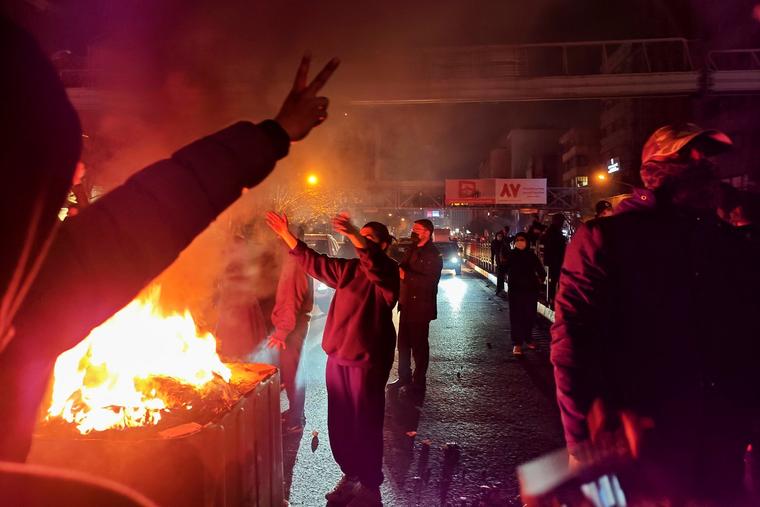
Coming a few days after Christmas 2025, the protests erupting in Iran caught much of the Western world by surprise. Of course, Iran has had major protests before (2009-2010, 2011, 2019-2020, 2022-2023), which have often been brutally suppressed by the Islamic Republic’s security forces.
This time, however, the protests appear to have been even larger, and the body count of victims greater than ever before.
The Shah never killed so many people. The number of dead has been estimated at between 2,000 and 12,000 so far, most of them killed by the regime’s Islamic Revolutionary Guard Corps (IRGC), the Basij paramilitary, and the police. This is likely the worst slaughter of civilians in the history of modern Iran.
Regime figures have responded that several hundred (200-300) security forces were killed by the protesters, and that there were many cases of vandalism and arson, including — according to the Tehran Fire Department — at least 34 mosques set on fire in the Iranian capital. Pro-regime social media sources highlighted the mosque burnings and also showed what supposedly was an oppositionist throwing a Molotov cocktail inside a locked mosque in Isfahan.
Why are Iranians — an overwhelming number of whom are supposedly Muslims (98% according to many accounts) — burning mosques?
Although extremism exists everywhere, targeting places of worship has often been considered a taboo. It certainly should be, in the East or in the West. And yet, in our time, we’ve seen more than 120 churches destroyed in Canada, mostly by arson, as a result of a frenzy of anticlericalism triggered by false, misleading or unproven claims of “mass graves” of children.
In the case of Iran, the answer is complicated. There is always the possibility that mosques are being burned by “agents provocateurs” of the Iranian regime itself — a regime with a long track record of lying and disinformation. There is also, it must be admitted, a type of nihilistic personality that likes to destroy things, a mindset immortalized in the 2008 Batman superhero movie The Dark Knight: “Some men just want to watch the world burn” (a line that later became a social media meme).
But there are a couple of additional, more Iran-specific factors that can shed some light on these mosque burnings. Some analysts have noted the use of certain mosques as recruitment and training centers for the Basij paramilitary forces. The Basij is a feared regime militia founded by Ayatollah Khomeini himself in 1979 as a supplement or counterpart to the regular army, meant to protect the Islamic Revolution.
The Basij were deployed as cannon fodder in human-wave attacks during the Iran-Iraq War. Since then, they have been used as inexpensive volunteer enforcers and agents of repression. They are drawn from “a slender minority” of the country that still believes — young men and boys who are “armed, ideologically brainwashed and easily mobilized.”
Another reason for targeting mosques goes to the heart of the regime and its reason for existence: this is explicitly the Islamic Republic of Iran. Everything the regime does — every excuse or explanation — is wrapped in the cloak of religion. And religion with absolute political power can sometimes end up discrediting religion itself.
I first visited Spain shortly after the death of Francisco Franco, the country’s long-ruling dictator, who had strongly enforced Catholic morality. The period immediately after Franco’s exit became known as el destape (the unveiling), and it was, among other things, a time of great reaction against morals and religion. Anything went; everything seemed to be permitted, as daring and as shocking as possible.
An Iranian-American scholar told me years ago that “Iran was the first Islamic Republic and it would be the first post-Islamic Republic,” meaning that the rigidity of the regime, the corruption and errors of decades of near-absolute rule, and the hypocrisy of its rulers and clerics would not only discredit the regime but also the religion it weaponized to justify its rule. To be called a hypocrite in Islam — a munafiq — is an incendiary charge. A munafiq can be considered worse than an infidel because of deceit.
Over the years, I have sat with Iranians who delighted in telling scandalous tales and jokes about the mullahs. Bitter corollaries to this are videos and stories about the hypocritical children of the clerical elite — from low-cut wedding dresses to drinking, partying and conspicuous consumption. The current wave of protests was triggered by economic turmoil and inflation connected to a banking crisis, in which corrupt banks subsidizing crooked “Islamic” ruling elites became insolvent.
One final element that raises questions about the mosque burnings is that we simply don’t know what percentage of Iran’s population remains religiously devout or even practices or identifies with their religion. The familiar claim that Iran is “98% Muslim” — most of them Twelver Shiite Muslims, followers of the official state religion — is worth examining critically.
An intriguing August 2020 study from the Netherlands by scholars Ammar Maleki and Pooyan Tamimi Arab concluded that only a third of Iranians still identify as Shiite Muslims (32.2%). In second place were Iranian “nones” with 22.2%, followed by atheists at 8.8%. Next were self-identified Zoroastrians, adherents of the ancient pre-Islamic religion of Iran, at 7.7%. (The official figure for Zoroastrians in Iran places them at less than 1%, smaller even than the country’s Christian population.) Although not a focus of the study, it also seems clear that Iran’s small Christian population — some of it underground in “house churches” — is larger than official statistics suggest.
Perhaps those enraged vandals and arsonists targeting regime mosques are drawn from what may now be the overwhelming majority of Iranians: those so scandalized and utterly disaffected by nearly 50 years of corrupt and bloody Islamic rule that they are willing to do almost anything to see it fall. And a hard fall it may yet turn out to be.