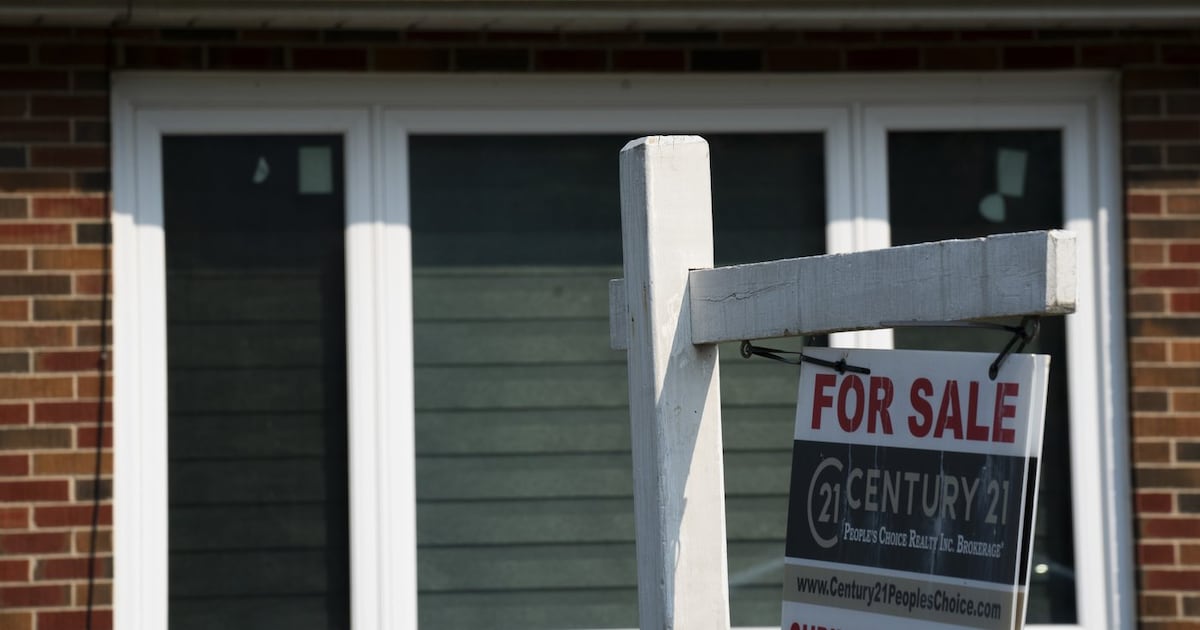
The Canadian Real Estate Association expects national home sales to grow 5.1 per cent in 2026, marking a rebound from last year’s tariff-induced slowdown in the market.
The association forecasts 494,512 residential properties will trade hands this year. The outlook released Thursday represents a downgrade from CREA’s prediction last fall of a 7.7 per cent national increase in home sales for 2026.
It also expects the national average home price to rise 2.8 per cent on an annual basis to $698,881, down from its earlier forecast of a 3.2 per cent increase.
National home sales are forecast to climb a further 3.5 per cent in 2027, with average home prices rising 2.3 per cent to $714,991.
The association said pent-up demand, particularly from first-time buyers, is the major factor underpinning its forecast for higher activity compared with 2025. It said many of those potential buyers have been shut out of the market over the past four years amid affordability challenges and previously high interest rates.
While interest rates have not fallen as much as some have hoped, the current level “is about as good as you’re going to get for now,” said CREA senior economist Shaun Cathcart at a news conference.
The Bank of Canada held its key rate at 2.25 per cent last month, and economists expect it to remain unchanged for much of this year. Bank of Canada governor Tiff Macklem said the rate is at the right level to balance inflation and economic growth.
That would halt a downward push that started in June 2024 to bring the key rate down from five per cent, including one percentage point worth of cuts last year. The central bank’s next decision is expected to be announced Jan. 28.
“The Bank of Canada is pretty much done cutting. We think that’s an important factor for first-time buyers because many of them have probably been waiting to get the absolute lowest rate possible before locking in,” said Cathcart.
A lower inflation rate should also spur more activity across the country, said Cameron Forbes, general manager at Re/Max Realtron Realty Inc.
“I do see first-time buyers coming back in,” he said, adding that employment has held steady on a national basis.
“We did see more activity in the latter part of 2025 for first-time buyers … so they’ve got good jobs. The confidence I think will come once they finally realize that with current rates and incomes, they can afford now to purchase and it’s a good time to purchase.”
The anticipated bounce back in activity this year is expected to be driven largely by B.C. and Ontario, CREA said, after big markets such as Vancouver and Toronto were hit hard by trade-related economic uncertainty in 2025.
“They’ve got a lot of room to recover,” said Cathcart. “They’re very low right now and a lot more supply for people to buy, whereas other places are more constrained.”
Activity in B.C. and Ontario is forecast to rise more than eight per cent in 2026. Most other provinces are expected to see gains of less than half of that, with sales already running at higher levels and supply far more constrained.
Sales fell nearly two per cent in 2025
In its report for December, also released Thursday, CREA said the number of residential properties that changed hands across Canada was 4.5 per cent lower than the same month a year earlier. Home sales also declined 2.7 per cent on a seasonally adjusted basis from November.
Overall, there were 470,314 transactions in 2025, a decrease of 1.9 per cent from 2024, which the association attributed in part to a “tariff-induced flight of buyers back to the sidelines” in the first quarter of the year.
However, the market underwent a rally beginning in April that saw sales climb 12 per cent by August, before activity slowed “into more of a holding pattern” to finish the year.
The market “fell into a slumber” last month, said Tony Stillo, director of Canada economics at Oxford Economics, adding that job insecurity and trade war-related uncertainty “will likely keep many potential homebuyers and sellers on the sidelines for a while longer.”
The national average sale price of a home in December was $673,335, just 0.1 per cent lower than December 2024.
CREA’s own home price index, which aims to represent the sale of typical homes, edged 0.3 per cent lower between November and December 2025, but was down four per cent on a year-over-year basis.
Stillo said resale home prices will likely slide lower before hitting bottom, but the market “should break out of its slump by mid-year, supported by favourable mortgage rates, improved affordability, less trade policy uncertainty and a resumption of modest job growth assuming a successful renegotiation of the USMCA.”
Cathcart said he expects 2025’s mid-year bump to repeat itself in 2026 “barring any other major black swan events.”
“In a macro sense, we’ve seen a lot of buyers coming back. It’s a lot of confidence coming back compared to at least what it was one year ago,” he said.
While there are always risks that could upend such projections, Cathcart said he couldn’t pinpoint one as significant as the looming trade war that then-incoming U.S. President Donald Trump was threatening a year ago around this time.
The association said new listings were down two per cent month-over-month, the fourth straight monthly drop.
There were 133,495 properties listed for sale across Canada at the end of December, up 7.4 per cent from a year earlier but 9.9 per cent below the long-term average for that time of the year.
This report by The Canadian Press was first published Jan. 15, 2026.
Sammy Hudes, The Canadian Press