
Overall, the month was classified as normal for average air temperature and as rainy for precipitation.
Regarding air temperature, it was the 11th-warmest December since 2000, with an average of 9.94 °C, 0.19 °C above the 1991-2020 average. The average maximum temperature, 13.85 °C, was 0.06 °C below the average, while the average minimum temperature, 6.04 °C, was 0.45 °C above the average, according to IPMA.
Rainfall was a defining feature of the month, as it was the 7th wettest December since 2000. The total monthly precipitation in December was 157.8 mm, corresponding to 137% of the seasonal average. The mild drought that persisted at the end of December in the districts of Évora, Beja, and Faro officially ended.
Among the highlights in mainland Portugal was a surprisingly cold period, when, towards the end of the month, air temperatures dropped well below average, especially overnight. 26 December stands out, with 45% of stations recording freezing minimum temperatures.
Another highlight was snowfall between December 21st and 24th at elevations above 400 m across many locations in northern and central Portugal.
Analysis by IPMA also found that globally, December 2025 was 0.49 °C warmer than the 1991-2020 average, with a mean surface air temperature of 13.15 °C, making it the 5th-warmest December on record.
Europe
 Author: Copernicus/ECMWF;
Europe as a whole experienced an unusually warm month. The average air temperature in December was 2.68 °C, 1.99 °C above the long-term average, making it the 4th warmest December on record.
Most of Europe recorded above-average temperatures, particularly in Norway, Sweden, and Iceland. The Iberian Peninsula showed greater variability, with a mix of above- and below-average values. In northern Scandinavia, western Turkey, and France and Germany, despite a cold snap at the end of the month, temperatures were near or slightly above average.
Precipitation in December 2025 was above average across western Great Britain and northern Europe.
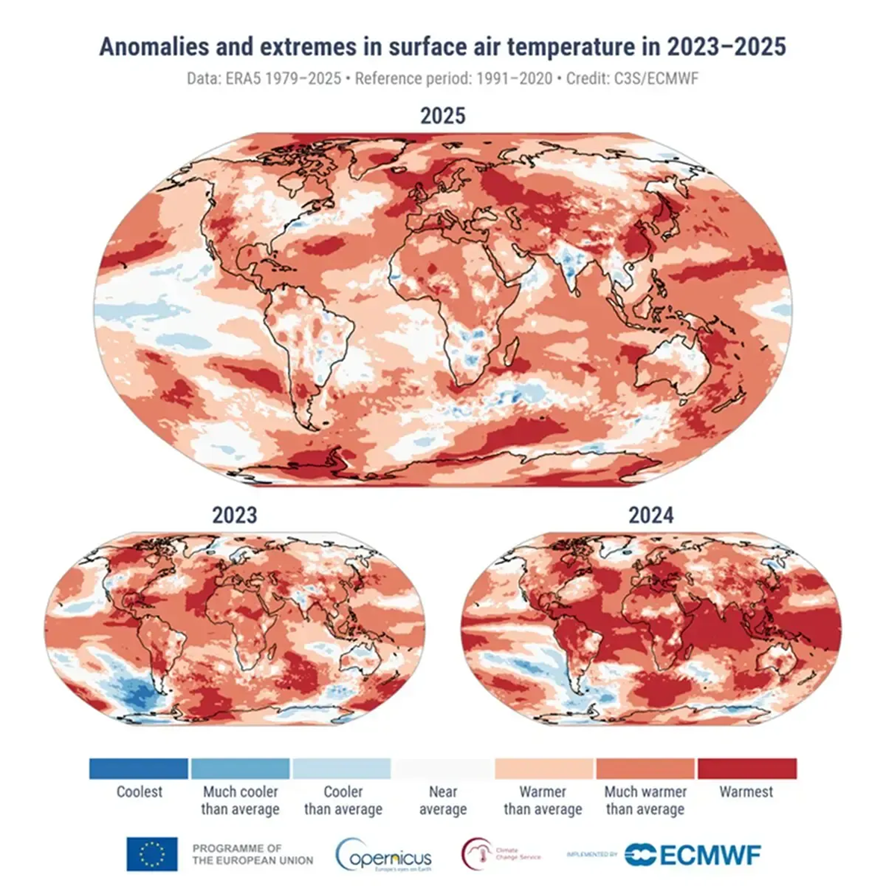
It wasn’t only December — the year 2025 was also the third warmest globally
The year 2025 was not the warmest on record, but it ranked third, behind 2023 and 2024. This information was officially confirmed by the Copernicus service.
Although we did not fall to a “new temperature bottom” this time, we remain at critically high values, and a return to the old climate norm is not in sight.
The situation is analogous to stepping onto an escalator that is constantly moving upward; in fact, we are not going down; we are merely taking a step in response to the moment when the floor beneath us is rising.
Climate is not defined by a single year’s ranking, but by long-term development, as evidenced by the fact that the last 11 years are also the 11 warmest years in the entire monitored period.
The planet continues to warm
This is clear evidence of the planet’s already-stable, deep-rooted warming. In 2025, the average global temperature was about 1.47°C above the pre-industrial average, a slight decrease from 1.60°C in 2024.
Copernicus data indicate that 2025 was the third-warmest year on record, only slightly cooler (0.01°C) than 2023 and 0.13°C cooler than 2024, the warmest year on record.
This slight retreat from the record peak does not signal the end of warming; rather, it reflects natural variability associated with the transition from an intense El Niño, which increases temperatures, to a neutral phase or a weak La Niña, which has a dampening effect.
Cooling is a mistake
Calling this state a “cooling” is a technical mistake, because 2025 does not mark a reversal of the trend but only a normal fluctuation after the peak. Moreover, the 1.5 °C threshold of the Paris Agreement refers to a long-term average, not to a single-year fluctuation.
Current estimates indicate that we are already at 1.4 °C, and at the current rate of emissions, we could exceed the permanent 1.5 °C threshold by the end of this decade.
“We are bound to pass it,” said Carlo Buontempo, the director of the Copernicus climate change service. “The choice we now have is how to best manage the inevitable overshoot and its consequences.”
Although 2025 was not an absolute record-breaker, it ranks among the warmest years in history and does not change the trajectory of climate change we face.