(Yicai) Jan. 16 — The People’s Bank of China said it will cut relending and rediscount interest rates by 0.25 percentage points from Jan. 19, a move that signals room for further reductions in policy interest rates and the required reserve ratio for commercial banks this year.
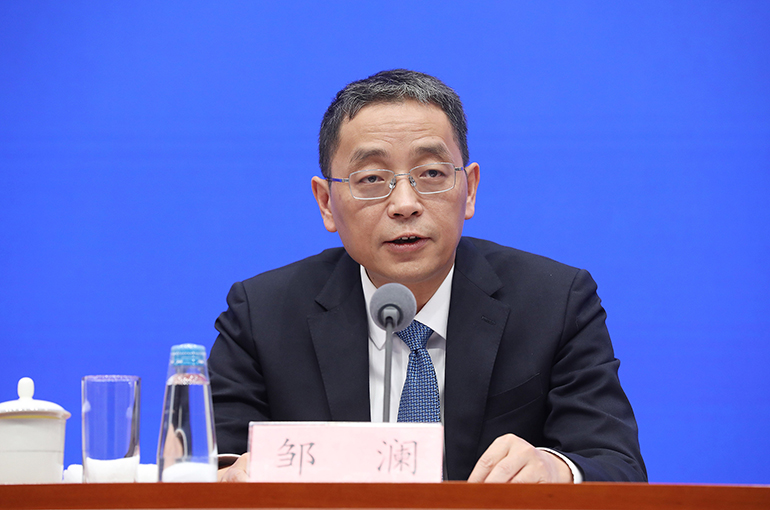
The adjustment aims to guide financial institutions to increase support for major national strategies, key sectors, and weak areas of the economy. The announcement was made by Zou Lan, deputy governor of the PBOC, at the central bank’s first press conference of the year held yesterday.
Zou said the PBOC will take promoting stable economic growth and a reasonable recovery in prices as key considerations in formulating monetary policy. The bank will continue to implement a moderately loose monetary policy and leverage the combined effects of incremental and existing measures to create a favorable monetary and financial environment for price recovery.
The yuan exchange rate remains relatively stable, while the US dollar has entered a rate-cutting cycle, meaning interest rate cuts are unlikely to impose strong constraints on the yuan, Zou noted. Meanwhile, the net interest margin of domestic commercial banks has stayed at 1.42 percent for two consecutive quarters. With a large volume of long-term deposits maturing this year, banks’ funding costs are expected to further decline, helping stabilize margins and creating room for further benchmark interest rate cuts.
Room for Further RRR Cuts
Zou added that the average statutory required reserve ratio for financial institutions currently stands at 6.3 percent, leaving scope for further reductions this year.
“The PBOC still has room of at least 130 basis points for required reserve ratio cuts,” said Ming Ming, chief economist at Citic Securities. “Combined with other quantitative policy tools, the space for RRR reductions this year remains relatively ample.”
The PBOC also announced a series of supportive measures, including lowering the minimum down payment ratio for commercial property purchase loans from 50 percent to 30 percent to aid inventory reduction in the commercial and office real estate market, establishing a special CNY1 trillion (USD143.5 billion) relending facility for private enterprises, increasing relending quotas for technological innovation and technological transformation by up to CNY1.2 trillion, and raising relending quotas for agriculture as well as micro and small enterprises by CNY500 billion (USD71.7 billion), among several other policy measures.
The central bank will continue to flexibly conduct treasury bond trading operations alongside other liquidity tools to ensure ample market liquidity and create favorable conditions for government bond issuance at more reasonable costs, Zou said.
China’s finance ministry issued CNY16 trillion (USD2.3 billion) of government bonds last year, with the outstanding balance expected to reach about CNY40 trillion by the end of the year. Among the main holders, banks held CNY27 trillion, non-bank financial institutions CNY5 trillion, and foreign institutions CNY2 trillion.
The PBOC has not yet disclosed the balance of government bonds it directly held at the end of last year. As of the end of September, the balance stood at CNY2.22 trillion.
Zou reiterated that China will continue to let the market play a decisive role in exchange rate formation and keep the yuan basically stable at a reasonable and balanced level, stressing that the country has no intention of gaining a competitive edge in international trade through currency devaluation.
Editors: Tang Shihua, Emmi Laine