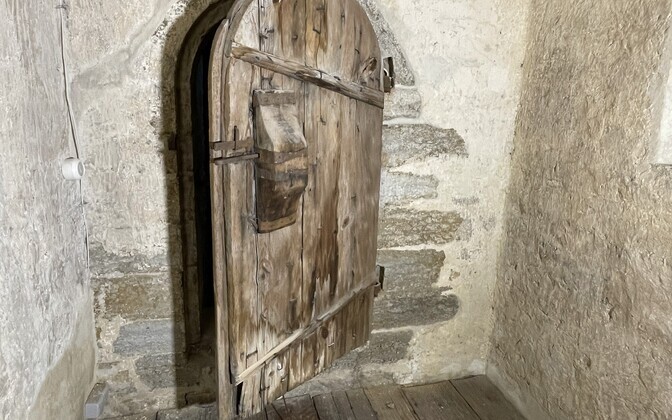
Researchers say a 14th-century wooden door tucked inside a medieval chapel in Tallinn is Estonia’s oldest, predating the previous record holder by more than a decade.
Until now, that title belonged to a nearly 630-year-old door in the Bremen Tower, part of Tallinn’s historic city walls on the other side of the Old Town.
New research, however, shows the door in the King’s Chapel of St. Mary’s Cathedral (Toomkirik) predates it by about 16 years.
The finding comes from a recently published study by dendrochronologist Alar Läänelaid and his team, who used tree-ring analysis to date the wood. Their conclusion: the door was likely made between 1378 and 1394, with evidence pointing most strongly to 1382.
The oak and pine door leads to the King’s Chapel, a small double-vaulted space tucked into the cathedral’s wall in the second half of the 14th century. While it can be seen by anyone visiting the tower, visitors don’t actually pass through the door itself often.
The chapel’s original purpose remains somewhat uncertain. Rev. Arho Tuhkru, the dean of St. Mary’s Cathedral, said it may have served as a private chapel for a ruler or noble. As a church historically associated with the nobility, the space would have allowed for quiet, solitary worship.
“The door leads to a beautiful little room that has been preserved in its original architectural form,” Tuhkru said, adding that it has no electricity either. “But it still works as a place for contemplation today.”
Läänelaid’s team dated the medieval chapel door using dendrochronology, which determines the age of wood by analyzing its growth rings. Because trees record environmental conditions year by year, their rings act as detailed natural archives.
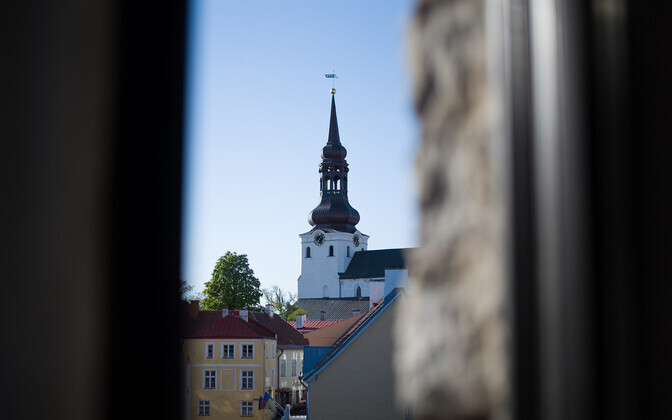 View of St. Mary’s Cathedral, Tallinn, also known as the Dome Church, taken from the Kiek in de Kök tower to the south. Source: Siim Lõvi/ERR
The King’s Chapel door also shows careful craftsmanship, with a pine interior clad on the exterior with oak planks.
Andres Uueni, director of the Cultural Heritage and Conservation Laboratory (MUKOLA) at the Estonian Academy of Arts (EKA) and one of the coauthors of the paper, said the results help place the door, and the building itself, more precisely in history.
“On one hand, this knowledge helps us better understand our cultural heritage,” he said. “And on the other hand, it helps us better understand the building’s construction history.”
Back where it belongs
As with various other artifacts and “Estonia’s oldest” titles, researchers note that while the King’s Chapel door is now considered the oldest known in Estonia, an even older example could still come to light someday.
Studying it required temporarily removing the door from its hinges, but it has since been rehung in the church. Tuhkru was glad to have it back.
“As you can see, our servants and workers endure for centuries,” he said. He added that it also saddles the church with the responsibility of continuing to preserve it “so that one day we can tell future generations the same thing: that this is Estonia’s oldest door.”
Learn more about the research and view the full paper here.
—