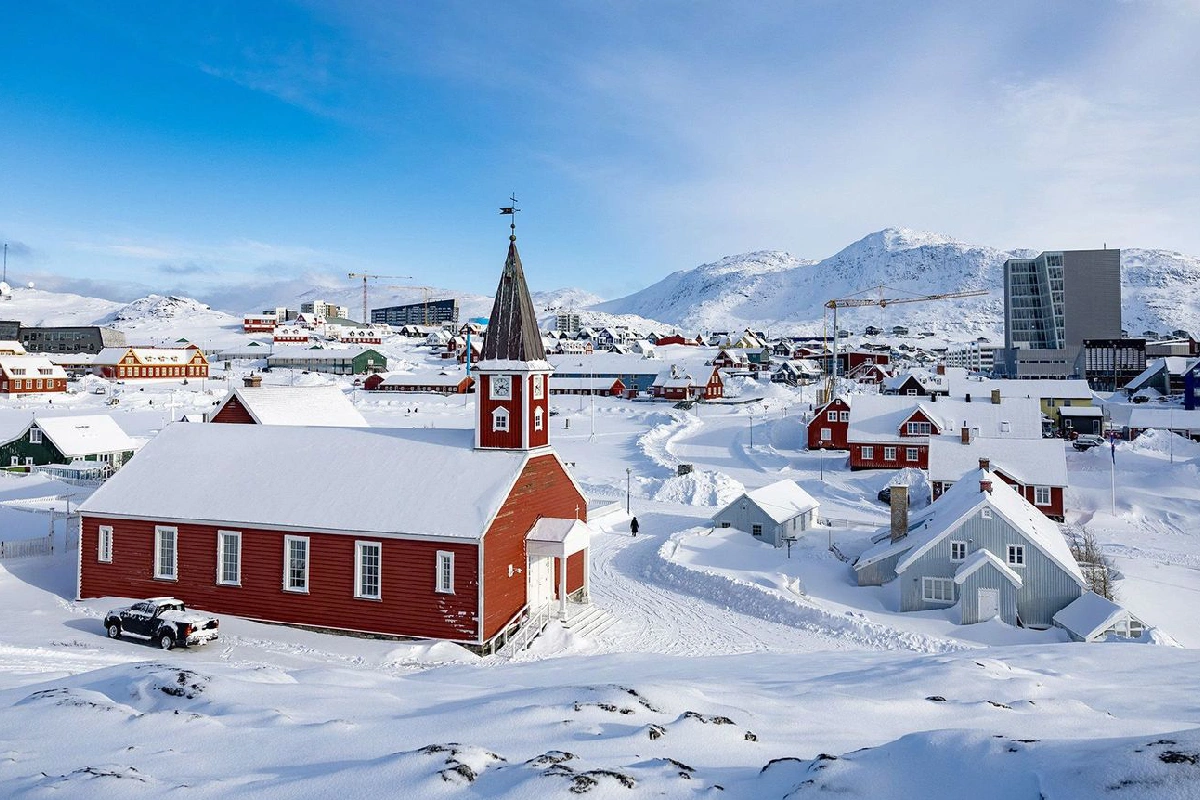
As winter tightens its grip across the northern hemisphere, a diplomatic chill is spreading through the transatlantic alliance.
A growing dispute over Greenland has exposed deep fractures between the United States and its NATO allies, raising fundamental questions about the future of the alliance and Europe’s long-term security architecture.
US President Donald Trump has made no secret of his desire to bring Greenland under American control, framing the issue as one of national security. However, the proposal has been firmly rejected by both Greenland’s autonomous government and Denmark, the NATO member state that continues to administer the Arctic territory. European allies including the United Kingdom, France and Spain have publicly backed Denmark and Greenland, warning that the dispute risks destabilising NATO at a critical moment.
Greenland, home to just over 56,000 people, may seem an unlikely flashpoint for global geopolitics. Yet its strategic location and vast natural resources mean the island carries weight far beyond its population size. The question now confronting Western leaders is whether this dispute could trigger a broader unraveling of NATO itself.
Why Greenland matters to Washington
Greenland’s significance lies first and foremost in its geography. Positioned between North America and Europe, the island sits within the so-called GIUK gap — a key maritime corridor linking Greenland, Iceland and the United Kingdom. This corridor has long been vital to NATO’s ability to monitor naval activity between the Arctic and the Atlantic, particularly during periods of heightened tension with Russia.
As Arctic ice continues to recede, Greenland’s role is becoming even more critical. New shipping routes are opening, and access to the Arctic is increasingly seen as a determinant of future military and economic power. Control over Greenland would give the United States a commanding position over emerging Arctic sea lanes and early-warning defence systems.
Equally important are Greenland’s natural resources. The island holds significant reserves of oil, gas and rare earth minerals — materials essential for modern technologies ranging from electric vehicles and renewable energy infrastructure to advanced weapons systems. With China dominating much of the global rare earths supply chain, US policymakers view Greenland as a potential counterbalance in an intensifying great-power competition.
NATO under strain
The Greenland dispute has revived long-standing concerns about the United States’ commitment to NATO under President Trump. During his first term and again in late 2024, Trump openly threatened to withdraw the US from the alliance, citing what he described as insufficient defence spending by European members.
While he has not explicitly threatened to leave NATO over Greenland, Trump has deliberately kept his intentions ambiguous. Asked directly whether the US could exit the alliance, he replied: “You don’t know what I’m going to do,” adding that he would not “give up options.”
US law now requires congressional approval — either a two-thirds Senate majority or an act of Congress — for withdrawal from NATO. However, European leaders remain uneasy, noting Trump’s willingness to challenge diplomatic norms and legal constraints in pursuit of strategic objectives.
Can NATO function without the US?
For many European leaders, the answer is clear: NATO cannot survive without American leadership. The alliance’s core principle, Article 5, states that an attack on one member is considered an attack on all. If the United States were to act militarily against Greenland — which is part of the Kingdom of Denmark — it would strike at the heart of NATO’s credibility.
Danish Prime Minister Mette Frederiksen has issued a stark warning, stating that NATO would effectively cease to function if the US attacked a fellow member state. “If the United States chooses to attack another NATO country militarily, then everything stops,” she said. “That includes NATO and the security structure that has existed since the end of the Second World War.”
Trump himself has cast doubt on NATO’s durability without US involvement, claiming this week: “I’m the one that saved NATO.”
Russia and China watching closely
The dispute has not gone unnoticed in Moscow and Beijing. President Trump has argued that US control of Greenland is necessary to prevent Russia or China from expanding their influence in the Arctic. In a post on Truth Social, he warned that if the US did not act, “Russia or China will — and that is not going to happen.”
China has pursued Arctic ambitions through its “Polar Silk Road” strategy, launched in 2018. While Beijing insists its interests are commercial and scientific, Western governments remain sceptical. Chinese Foreign Ministry spokesperson Mao Ning reiterated this week that China’s activities in the Arctic are peaceful and compliant with international law.
Russia, meanwhile, stands to benefit from any weakening of NATO. Former Russian President Dmitry Medvedev mocked the situation with a cryptic remark suggesting Greenland could theoretically vote to join Russia — a comment widely seen as an attempt to highlight Western divisions.
Any fracture within NATO would directly advantage Russian President Vladimir Putin, particularly as the alliance remains Ukraine’s most critical backer in its war against Russia.
A turning point for Europe
At its core, the Greenland dispute is about far more than one Arctic island. It reflects a broader struggle over the future of NATO, the balance of power in the Arctic, and Europe’s reliance on American security guarantees.
If the crisis deepens, European states may be forced to confront an uncomfortable reality: that their post-war security model, built on unwavering US support, can no longer be taken for granted. Whether this moment leads to renewed unity or lasting fragmentation may define the future of Europe for decades to come.