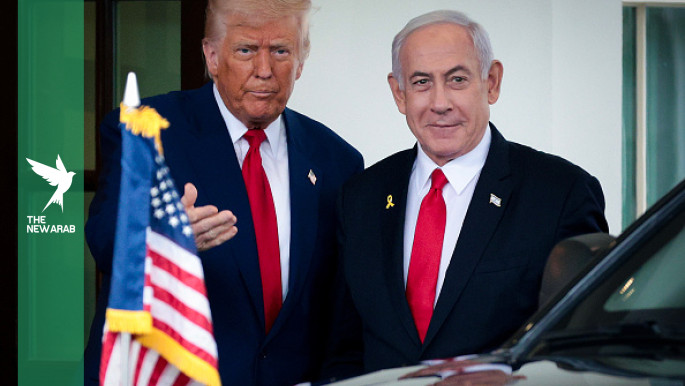
Benjamin Netanyahu [R] reportedly asked Donald Trump [L] to delay strikes on Iran [Getty]
The US is continuing its military buildup in the Middle East despite diplomatic efforts to de-escalate tensions with Iran showing signs of success with US President Donald Trump toning down rhetoric about possible military strikes on the crisis-hit country.
Egypt, Oman, Saudi Arabia and Qatar officials raised concerns in the last 48 hours that US military intervention would shake the global economy and destabilise an already volatile region, a diplomat told The Associated Press.
The tensions have already shaken oil prices, which tumbled a Trump signalled that he’s leaning away from attacking Tehran, after days of threats against the country due to the brutal suppression of anti-government protests in Iran amid a media blackout.
Nevertheless, White House press secretary Karoline Leavitt on Thursday maintained that “all options remain on the table” for Trump as he deals with Iran.
Israel asks for delay
On Thursday, The New York Times reported that Israeli Prime Minister Benjamin Netanyahu had urged Trump to postpone strikes on Iran, citing an unnamed US official. Tel Aviv has neither confirmed nor denied the report, which said that Israeli intelligence had received information – also cited publicly by the Trump administration- that the protests in Iran were dying down.
However, other reports indicate that Israel fears it is not ready for another direct confrontation with Iran. CNN quoted Israeli officials on Thursday as saying that the country’s air defence systems were overstretched, having been used extensively during the 12-day war in June. The officials added that attacks on Iran would be unlikely to effect regime change.
During the 12-day war between Iran and Israel in June, Tehran demonstrated its ability to bypass Israel’s air defence systems and adapt its attacks to swerve the missiles. Iran also carried out an unprecedented direct attack on the US’s Al-Udeid airbase in Qatar.
On Wednesday, the same day as Trump and Netanyahu’s conversation, the US president said he had received information that the killings of protesters in Iran had stopped.
Following the NYT report, Israel’s Channel 12 said that Tel Aviv’s leadership is divided over its approach to Iran. Ron Dermer, Israel’s former minister of strategic affairs, is reportedly pushing for a more hawkish stance, which he has conveyed to Washington.
Elsewhere on Thursday, senior Trump aide Steve Witkoff indicated that the US would prefer a diplomatic settlement.
Speaking at the Israeli-American Council conference in Florida, Witkoff was asked about the likelihood of American strikes, to which he replied: “I hope there’s a diplomatic resolution. I really do.”
Witkoff added that talks would need to address “nuclear enrichment, missiles — they have to cut back on their inventory; the actual [nuclear] material that they have, which is roughly 2000 kilograms enriched anywhere between 3.67 percent and 6 percent; and the proxies”.
Despite the softening rhetoric from Washington, analysts have noted that Trump delivered similarly ambiguous messages ahead of his strikes on Iran in June in support of Israel.
Meanwhile, US Senator Lindsey Graham is heading to Israel to push Netanyahu for “decisive” action on Iran.
Speaking on X, the Repubican blasted the diplomatic efforts of Washington’s “so-called Arab allies”, who he accused of advocating for Tehran.
“If it is accurate that the Arab response is ‘action is not necessary against Iran’ given this current outrageous slaughter of innocent people, then there will be a dramatic rethinking on my part regarding the nature of the alliances now and in the future,” Graham said.
Military buildup
On Wednesday, unnamed sources were cited by News Nation as saying that the Pentagon had ordered the redeployment of a carrier strike group from the South China Sea to the area under US Central Command (CENTCOM), which includes the Middle East.
The redeployment is expected to take around a week, with multiple reports stating that the group is headed by the USS Abraham Lincoln. The carrier strike group includes multiple warships and at least one attack submarine, according to News Nation.
Two officials who spoke to NYT said the US is deploying its assets to both deter Iran from attacking and to widen the president’s options.