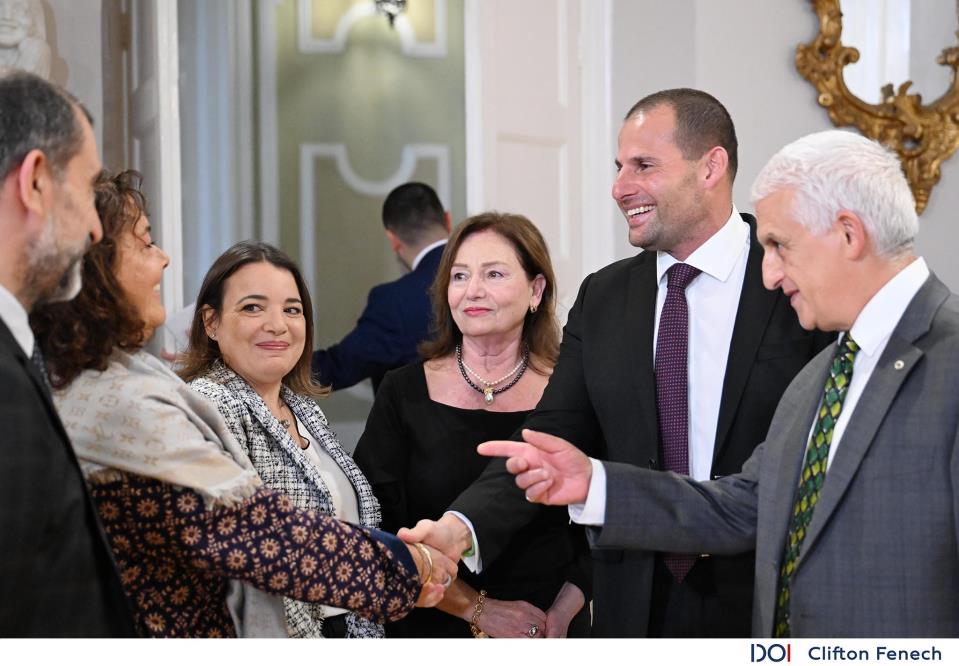

Prime Minister Robert Abela has called on Malta’s honorary consuls to play an even stronger role in translating the country’s foreign policy principles into concrete international partnerships, as he outlined the government’s long-term economic and social direction during the traditional exchange of New Year greetings.
Addressing the corps of honorary consuls, Abela described the annual meeting as a key fixture in Malta’s diplomatic calendar, bringing together individuals who voluntarily serve as an essential link between Malta and the countries they represent. He welcomed recently appointed consuls and thanked all members for their continued dedication and sense of service.
Abela reaffirmed that Malta’s foreign policy remains anchored in peace, security and international cooperation, with a firm belief in a rules-based international system and strong multilateral institutions. He said this approach has positioned Malta as a credible and reliable partner on the international stage, pointing to the country’s recent roles as a non-permanent member of the United Nations Security Council, Chairperson of the Organization for Security and Co-operation in Europe, and holder of the Presidency of the Committee of Ministers of the Council of Europe.
The Prime Minister stressed that honorary consuls play a unique and irreplaceable role in advancing these principles beyond formal declarations. While representing foreign states, they are also Maltese citizens with a direct and personal connection to the country, enabling them to act as authentic bridges between Malta’s aspirations and opportunities abroad. Beyond consular assistance, their work contributes to building trust-based bilateral relationships across economic, cultural, educational and scientific fields.
Reflecting on Malta’s development, Abela highlighted the country’s economic transformation from a war-based industrial economy to a diversified and resilient one built on its strategic maritime position. He noted that Malta now operates in a rapidly shifting geopolitical context, with key sectors including financial services, maritime transport and aviation, specialised manufacturing, digital technology, innovation and tourism forming the backbone of the economy.
According to Abela, this diversification has been driven by sustained investment in human capital, a solid regulatory framework and strong international connectivity. These factors, he said, have allowed Malta to create quality careers, attract foreign investment and secure a place within global economic value chains, while retaining the flexibility to respond to international uncertainty.
The Prime Minister reiterated the government’s commitment to an incentive-based economic policy rather than austerity, citing positive assessments by the International Monetary Fund. He referred to the implementation of a €9.3 billion Budget and the launch of Vision Malta 2050, which aims to ensure a safe, resilient country that balances historical heritage with progress and delivers a high quality of life for all.
Abela described Vision 2050 as a natural continuation of Malta’s long-term economic and social journey, underpinned by investment in lifelong learning, sustainable growth, efficient public services and improved urban and natural environments.
Concluding his address, Abela urged honorary consuls to continue strengthening bilateral ties and identifying early opportunities for collaboration aligned with Malta’s intermediate 2035 targets and Vision 2050. He assured them that the government would remain a committed and dependable strategic partner, working together to enhance quality of life in Malta while making a positive contribution internationally.