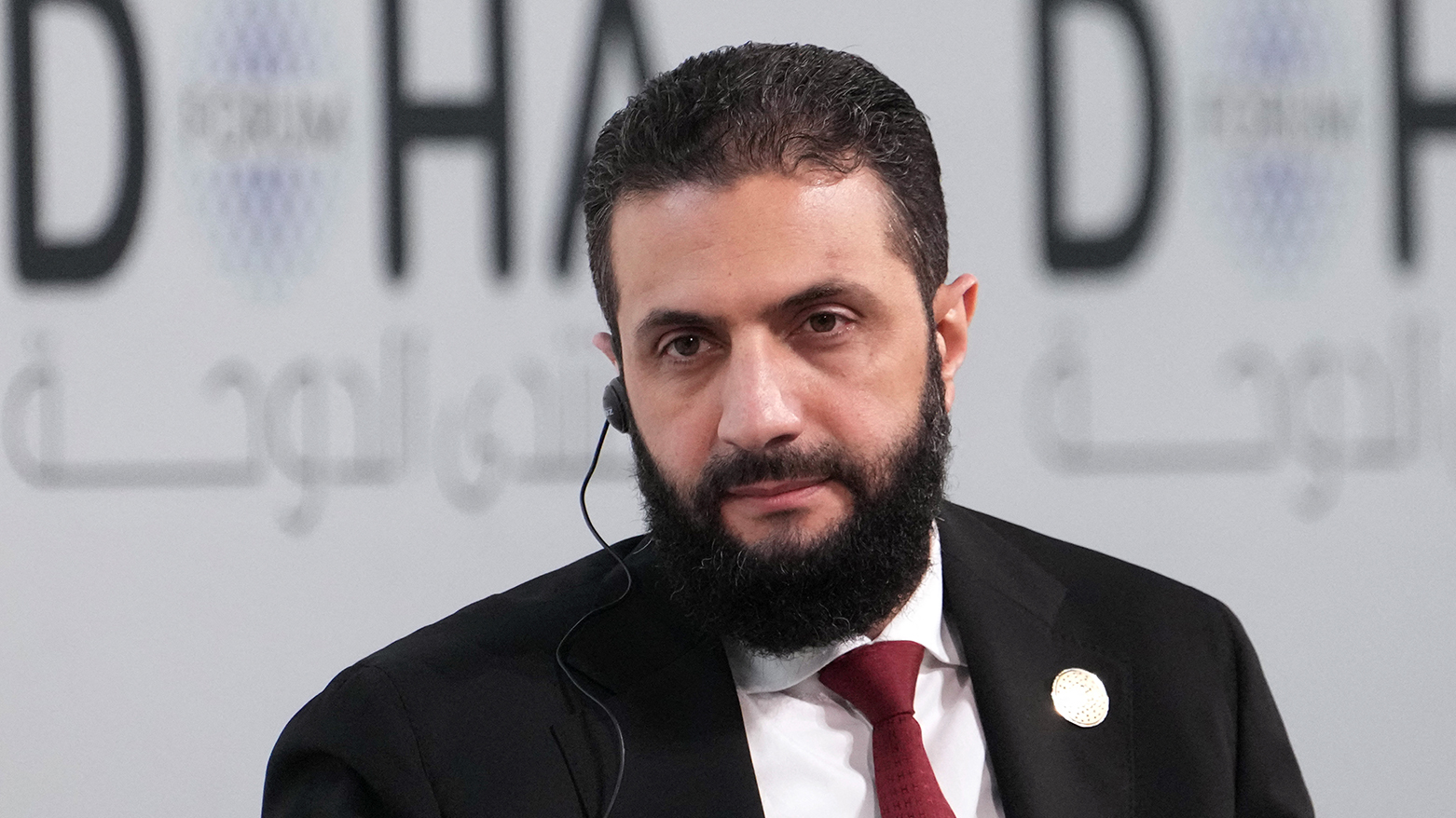
Syrian President Ahmed al-Sharaa visits Berlin Tuesday to discuss deportations with Chancellor Merz, amid rights concerns, before attending Davos to signal Syria’s global return.
ERBIL (Kurdistan24) – Syrian President Ahmed al-Sharaa is scheduled to hold high-level talks in Berlin on Tuesday, marking his first visit to Germany since assuming power. The diplomatic engagement comes as Chancellor Friedrich Merz’s government seeks to accelerate the deportation of Syrian refugees, a policy shift driven by domestic political pressures despite ongoing concerns regarding stability and human rights in the Levant.
According to a report by Agence France-Presse (AFP), al-Sharaa will meet with Chancellor Merz and German President Frank-Walter Steinmeier during his trip.
The visit is part of a broader effort by the new Syrian administration to normalize relations with Western powers following the ouster of Bashar al-Assad. The former rebel leader has undertaken a series of international travels, including visits to the United States and France, as global sanctions on Syria have been progressively lifted.
For the German government, the primary agenda item is the return of Syrian nationals.
A government spokesman confirmed to AFP that Berlin has an “interest in deepening and finding a new start with the new Syrian government,” explicitly noting that “the return of Syrians to their home country” will be among the topics discussed.
Germany currently hosts approximately one million Syrians, many of whom arrived during the 2015-2016 migration crisis fleeing the civil war.
Chancellor Merz, leading a conservative coalition, has faced increasing pressure from the far-right AfD party regarding immigration policy. He has previously stated that there is “no longer any reason” for Syrians who fled the war to seek asylum in Germany.
In December, Berlin executed its first deportation to Syria since the conflict erupted in 2011, repatriating a man convicted of crimes to Damascus.
Concerns Over Instability and Rights
The push for repatriations has drawn sharp criticism from human rights organizations and diaspora communities, who point to persistent violence in Syria.
AFP reported that instability has continued since al-Sharaa took power, citing repeated flare-ups of violence between the government and minority groups, including recent clashes involving the army and Kurdish forces.
Several non-governmental organizations, including those representing Kurdish and Alawite communities in Germany, issued a joint statement urging Berlin to cancel the visit, labeling it “totally unacceptable.”
“The situation in Syria is dramatic. Civilians are being persecuted solely on the basis of their ethnic or religious affiliation,” the statement read. The signatories argued that it is “legally and morally unacceptable” for the German government to receive a leader suspected of responsibility for such acts.
The Kurdish Community of Germany has taken legal action, filing a complaint with German prosecutors in November that accuses al-Sharaa of war crimes, genocide, and crimes against humanity.
Despite these objections, the German foreign ministry defended the engagement. A ministry spokesman told a press conference that the treatment of minorities in Syria remains “very important” for Berlin and is “one of the central topics we are discussing with the Syrian government.”
However, internal divisions within the German political establishment remain evident. Foreign Minister Johann Wadephul, who is also set to meet his Syrian counterpart next week, has previously expressed caution regarding returns.
During a trip to Damascus in October, Wadephul noted that the potential for repatriation was “very limited” due to the destruction of infrastructure, a comment that triggered backlash within his own centre-right party.
Armin Laschet, a senior MP and chairman of parliament’s foreign affairs committee, told AFP that while dialogue is necessary given the recent fighting, al-Sharaa must “clearly hear Europe’s expectations” regarding the protection of minorities.
Reintegration into the Global Fold
Al-Sharaa’s reception in Berlin aligns with a broader trend of Syria’s reintegration into international diplomacy. Al-Monitor reported that following his visit to Germany, the Syrian president is set to attend the World Economic Forum in Davos, Switzerland, next week.
His participation will mark the first time a Syrian head of state has attended the global gathering, signaling an end to decades of isolation that began under the Assad dynasty.
According to Al-Monitor, al-Sharaa became president in January 2024 after his forces, then operating as the Sunni Islamist militia Hayat Tahrir al-Sham (HTS), forced Bashar al-Assad to flee to Russia.
Since taking office, his administration has pivoted toward attracting foreign investment to address the catastrophic economic damage caused by 13 years of civil war. The World Bank has estimated reconstruction costs at $216 billion, while the United Nations places cumulative GDP losses at approximately $800 billion.
At Davos, al-Sharaa will join a cohort of nearly 65 heads of state, including U.S. President Donald Trump and leaders from the G7 economies.
While he is not scheduled to deliver a public address, his presence alongside regional figures such as Israeli President Isaac Herzog and Qatari Prime Minister Sheikh Mohammed Bin Abdulrahman Al Thani underscores the geopolitical shift occurring in the Middle East.
The forum in Davos is expected to address major global challenges, including the fragile ceasefire in Gaza and anti-government protests in Iran.
For al-Sharaa, the consecutive high-profile visits to Berlin and Davos represent a critical opportunity to legitimize his rule and secure the economic and political support necessary to rebuild his fractured nation, even as domestic opponents and rights groups continue to challenge his record on human rights.