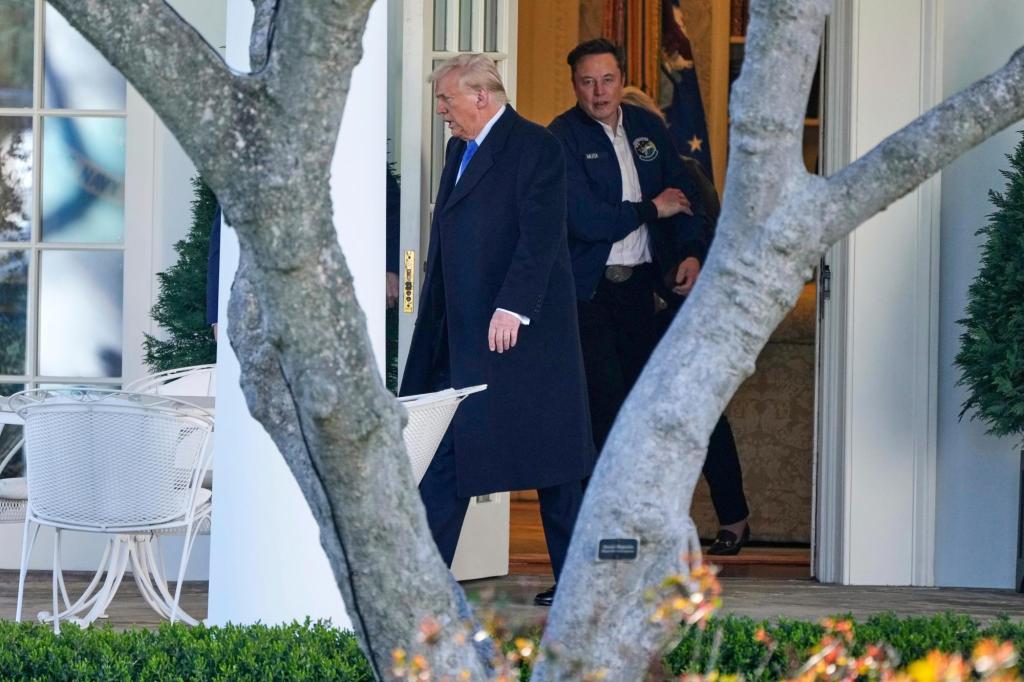
It’s good news only for the two of them that Elon Musk and President Trump are making nice again.
Their détente, engineered by Vice President JD Vance, serves Trump and the Republicans by neutralizing Musk’s threat to establish a third party.
It serves Musk by getting him back in the presidential power orbit that he grossly abused as head of the Department of Governmental Efficiency.
Just how that worked was exposed by a New York Times article that federal spending went up, not down, despite more than 29,000 DOGE cuts small and large. Of the top 40 claimed savings, 28 were wrong or exaggerated.
Trillions for the taking
But the American people gain nothing and could lose much from the reunion of the nation’s most powerful politician and the world’s richest man. Musk protégé Jared Isaacman has been confirmed as NASA’s administrator. There are billions, if not trillions, within Musk’s reach again at NASA, with which he and his SpaceX company are already deeply involved. NASA has essentially bet the future on him.
What’s most troubling about that is Musk’s fixation with colonizing Mars. Not just exploring it with crewed missions, but with making it a refuge from Earth for as many as a million people.
“Because it’s there” has always tantalized human exploration. Mars is the most alluring “there.”
Exploring Mars is at least a saner proposition than living there permanently. It’s far from clear, however, that boots on the surface are worth the enormous expense and the great risk to astronaut lives.
NASA’s unmanned probes have already revealed much about the only known planet that resembles earth to any extent.
That extent is small. Andy Weir’s 2011 science fiction novel “The Martian” and the movie that tracked it showed how fraught it would be to try to live there.
At night, 73 below zero
It was sound science, except the plot premise of a destructive dust storm. As Weir conceded, the atmosphere is too thin for that and is 95% carbon dioxide. To try to breathe it would be to die. The average temperature is 80 degrees below zero Fahrenheit. At the equator in summertime, it may get to 70 during the day, but it will be 73 below at night.
Solar and cosmic radiation and particles ejected by the sun would be a threat to the lives of any astronauts on such a long voyage as it would take to get there, and a permanent danger once they arrived. Mars lost its magnetic field billions of years ago, scientists say, leaving it without the natural shield that Earth’s magnetism affords.
Whoever tried to live there would need to burrow underground and depend for supplies on literally thousands of costly space missions before becoming, if ever, a self-sustaining community. Musk’s SpaceX would doubtlessly be the prime contractor. It’s far from certain that the billions of people who would be left behind on Earth would be willing to subsidize the escape of a tiny fraction of them.
The threshold question: Why?
Mars as Musk’s refuge
Musk says he sees Mars as a refuge if Earth becomes unlivable. That means relying on an unlivable planet rather than doing what we could to preserve the one we live on now. The trillions he proposes to spend would be more wisely invested in saving the only environment where life is known to exist. We know how to do that; what’s lacking is the will.
It may be impossible to get that rational choice into the head of a president who demands that dirty coal generating plants remain open even as he shuts down wind power farms and scorns solar power too. But he won’t be president forever.
It falls to Congress, in the meantime, to quash any proposal that would put the nation on an irrevocable path to Mars. That decision, even if only for exploratory purposes, should be left to a Congress whose majority isn’t addled by either devotion to Trump or fear of him.
For now, the idea of a colonized Mars makes about as much sense as raising and restoring the Titanic, whose crumbling remains lie 2.4 miles below the ocean’s surface. Perhaps it could be done if cost were no object.
But again, the question would be: Why?
The Sun Sentinel Editorial Board consists of Opinion Editor Steve Bousquet, Deputy Opinion Editor Dan Sweeney, editorial writers Pat Beall and Martin Dyckman, and Executive Editor Gretchen Day-Bryant. To contact us, email at letters@sun-sentinel.com.