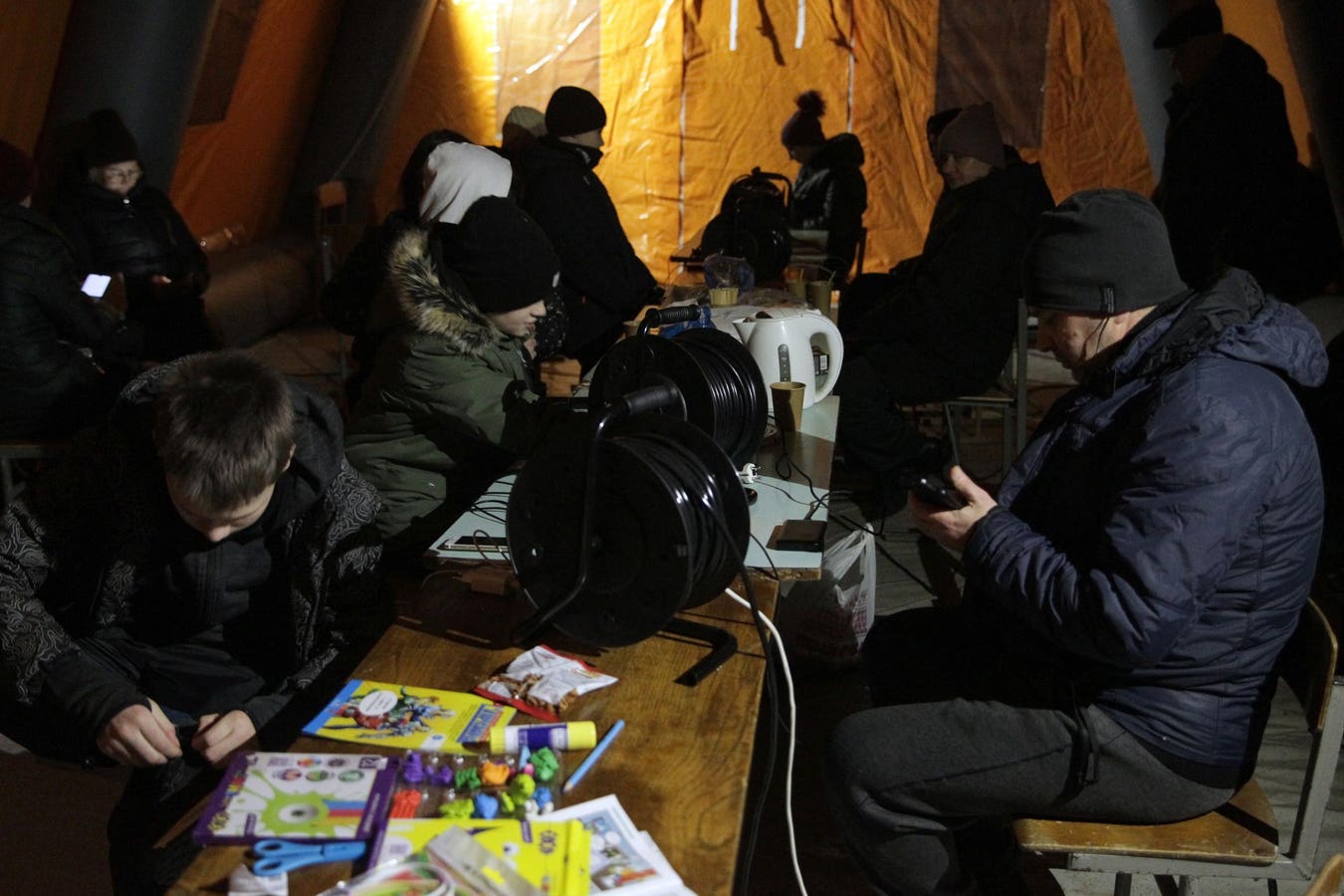
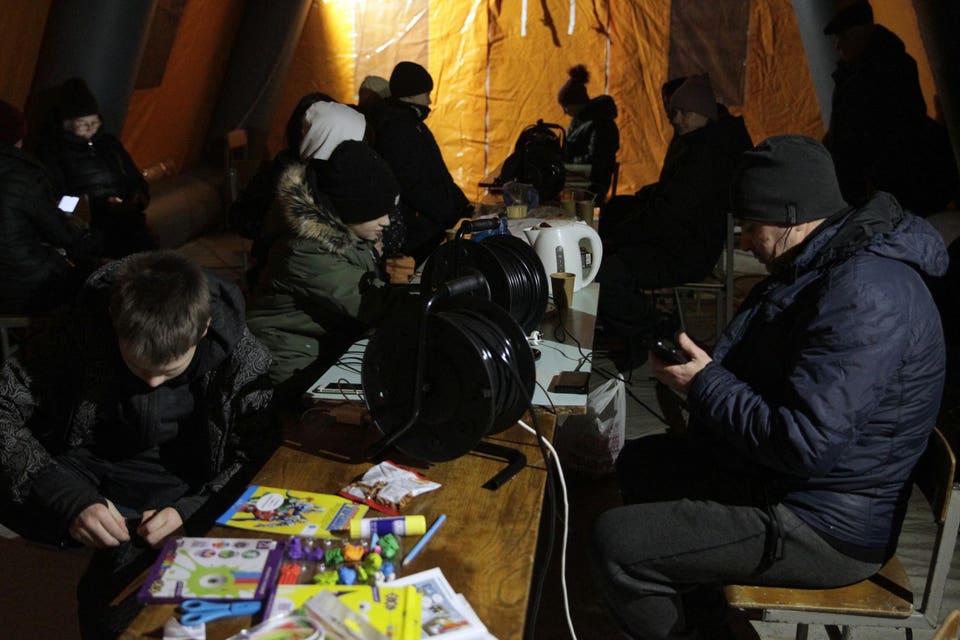
Local residents visit a heating tent set up in the Desnianskyi district of Kyiv, Ukraine, on January 13, 2026. Following missile and drone attacks, the energy situation in the capital deteriorates, prompting a full transition to emergency power outages. (Photo by Hennadii Minchenko/Ukrinform/NurPhoto via Getty Images). NO USE RUSSIA. NO USE BELARUS. (Photo by Ukrinform/NurPhoto via Getty Images)
NurPhoto via Getty Images
Dispatches from Ukraine. Day 1,424
Russian Attacks and Energy Backlash
Russian strikes on January 12-15 in the Kherson, Kharkiv, Zaporizhzhia, Chernihiv, Sumy, Donetsk and Dnipropetrovsk regions killed at least 14 civilians and wounded about 65 others. The attacks also inflicted heavy damage on Kyiv, where they shattered the city’s power plants and substations, leaving entire districts without heat or electricity as temperatures fell below 5°F. It marked the worst power outage suffered by Kyiv during the war, as the resulting destruction has overwhelmed emergency repair efforts. In response, Ukrainian President Volodymyr Zelenskyy has declared an emergency in Ukraine’s energy sector.
Technocrat Takes Ukraine’s Defense Helm
Ukraine’s parliament on January 14 appointed Mykhailo Fedorov, 34, a technocrat credited with innovating digital statecraft and managerial efficiency, as the fourth wartime minister of defense, making him the youngest in the nation’s history. Fedorov succeeded Denys Shmyhal, a former prime minister who, in a parallel vote, was named Ukraine’s next minister of energy.
Speaking to lawmakers before the parliamentary vote, Fedorov pledged to slash red tape and the Soviet-era institutional framework embedded in Ukraine’s armed forces. “Today, it is impossible to wage a modern war with cutting-edge technology while relying on an outdated organizational structure,” he said, adding that Ukraine has emerged as a global leader in unmanned systems during the war.
Fedorov established his reputation as a reform-minded technocrat well before his move to the defense ministry. After serving as Minister of Digital Transformation for a year, he was named to Forbes Ukraine’s 30 Under 30 list in 2020. Over the following five years, he oversaw the creation and expansion of Diia, a mobile platform that grants citizens access to a wide range of government services online and has helped position Ukraine as one of Europe’s most digitally advanced governments. In 2024, Diia landed on TIME magazine’s annual list of the world’s 200 best inventions.
Despite his record in building a digital state, Fedorov says he enters the defense ministry as someone who has been working for the war effort since 2022, citing initiatives ranging from the Army of Drones to Brave1. He argues that those programs have helped Ukraine transition into a phase of electronic and drone warfare, as well as pursue asymmetric ways of resisting Russia’s numerically superior forces.
Ex-Prime Minister Accused of Fracturing Zelenskyy’s Parliamentary Majority
Ukraine’s anti-corruption bodies allege that Yulia Tymoshenko, a former prime minister and one of the country’s most formidable opposition figures, orchestrated a scheme to bribe deputies to divide President Zelenskyy’s ruling majority in Ukraine’s parliament.
According to Ukraine’s National Anti-Corruption Bureau (NABU) and the Specialized Anti-Corruption Prosecutor’s Office (SAPO), the operation allegedly targeted deputies across party lines, including lawmakers affiliated with Zelenskyy’s bloc in parliament, Servant of the People.
Investigators allege that Tymoshenko paid lawmakers thousands of dollars to back her political objectives, including supporting the dismissal of Fedorov and Shmyhal, the new energy and defense ministers, from their former positions, but refusing to vote for their appointments (Ukraine’s parliament secured enough votes for their appointments only on the second day after their removal from previous posts).
One purportedly intercepted conversation released by NABU suggests that instructions were to be delivered secretly via the Signal messaging app. NABU described the operation as a regular mechanism of cooperation that involved advance payments and was intended for a long-term period.
Tymoshenko has forcefully denied the allegations, rejecting the authenticity of the audio recordings and the premise of the investigation. “I officially declare that the published audio recordings have nothing to do with me. I reject all accusations and I will prove they are groundless in court,” she said in a Facebook statement. In a separate post, she called the raids on her office in central Kyiv politically motivated, arguing that “they have nothing to do with law or legality” and are instead linked to speculation that national elections may be approaching. “It seems the elections are much closer than they appeared and someone has decided to start clearing out the competition,” she wrote.
There is also a sharp irony embedded in the affair. Tymoshenko was among the most vocal proponents of a controversial bill last year that would have effectively eliminated NABU and SAPO, institutions now investigating her, before Zelenskyy withdrew the legislation under heavy domestic pressure from the first wartime protests.
Tymoshenko’s political ascent was shaped as much by power as by persecution: after turning a 1990s energy-trading empire, one of the country’s largest private gas trading companies, into a national political platform, she became prime minister twice before being jailed in 2011 by the pro-Kremlin president Viktor Yanukovych. Western governments widely viewed her imprisonment as selective justice, a prison sentence that recast her from oligarchic insider into democratic martyr.
Two decades after she rose to global prominence during the 2004 Orange Revolution, and more than a decade after her imprisonment, Tymoshenko again finds herself at the center of a political storm. This time, however, the question is not whether power is being abused to silence her but whether she herself quietly sought to buy it.
Ukraine House in Davos
Ukraine House Davos will return to the crossroads of global political debates at the World Economic Forum from January 19 to 22. Traditionally, the house addresses the most pressing contemporary political questions through the prism of Ukraine. Last year, the flagship panel focused on Ukraine’s natural resource base, estimated at $12 trillion; this year, the agenda shifts to securing a lasting peace in Europe, reflecting U.S. efforts to end the four-year-old war. President Zelenskyy is expected to address the forum online, joined by senior Ukrainian policymakers, including Economy Minister Oleksii Sobolev and Ukraine’s former ambassador to the U.S., Oksana Makarova.
The 2026 program will also place culture at the heart of Ukraine’s presence in Davos. As part of Ukraine: Future’s Frontline project, the Victor Pinchuk Foundation, together with the Office of the President of Ukraine, will present a curated exhibition featuring works by Ukrainian artists Oleksii Sai, Yarema Malashchuk, and Roman Khimey, alongside Damien Hirst’s The Incomplete Truth.
In 2024, the all-women-run pavilion was named the World Economic Forum’s Best Pavilion by POLITICO; the following year, the house was credited with the best hospitality award for sideline discussions and thoughtful details, from barista coffee to “minefield honey.”
By Danylo Nosov, Alan Sacks