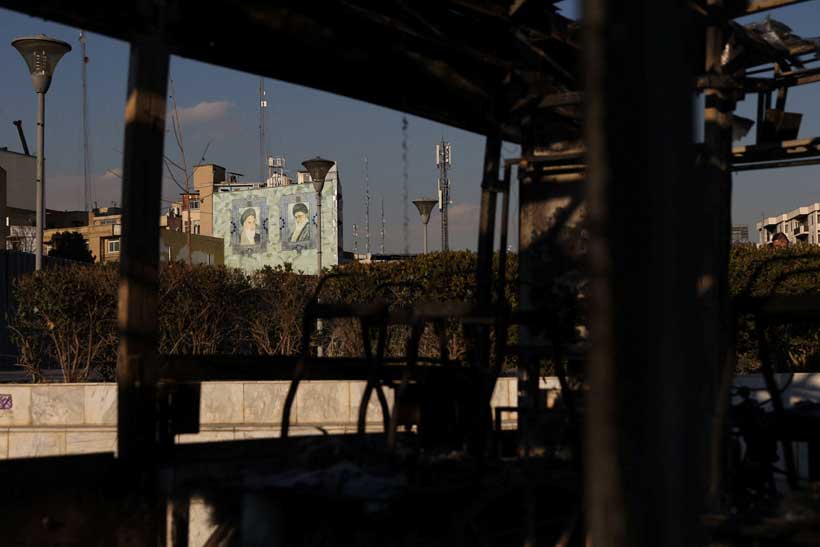
Waves of mass protest in Iran tend to erupt when least expected, though this should hardly surprise us. They typically represent the release of pressures accumulated over years. The current cycle follows this familiar pattern. Its immediate trigger was a sharp currency collapse that pushed the Iranian rial to historic lows, eroding household purchasing power almost overnight and rendering basic goods unaffordable. That economic shock transformed latent discontent into street mobilization—first in commercial centers, then across cities nationwide.
Yet the scale and geographic spread of these protests cannot be explained by currency collapse alone. They reflect the cumulative impact of severe international sanctions since 2012, inflation exceeding 40 percent, and chronic economic mismanagement. They also reflect the erosion of the regime’s prestige following last year’s Israeli and US strikes during what became known as the “twelve-day war.” Demonstrations that initially focused on economic grievances quickly evolved into direct political challenges to the regime itself.
What makes the Iranian crisis geopolitically significant is not the intensity of domestic discontent but the fact that it is unfolding in a pivotal state. Iran sits at the intersection of the Persian Gulf, the Eastern Mediterranean, Central Asia, and the Caucasus. It influences energy flows, maritime chokepoints, and overland corridors. Instability within Iran does not remain internal—it radiates outward, affecting multiple geopolitical subsystems simultaneously.
Timing also matters. Iran is absorbing several shocks at once: prolonged sanctions, post-pandemic economic strain, regional insecurity, and a demographic transition towards younger generations for whom the 1979 revolution that established the theocratic system is distant history. These pressures are amplified by external efforts, particularly by the United States and Israel, to weaken and ultimately overthrow the theocratic regime.
Scenarios and their geopolitical implications
Despite the intensity of the crisis, historical experience offers a clear lesson: social unrest does not automatically translate into revolution. Revolutions require an alternative center of authority, elite fragmentation, and a transfer of control over the instruments of coercion. None of these conditions are visible today. The regime’s core institutions remain intact. Protests are fragmented, leaderless, and programmatically diffuse. No alternative governing center has emerged.
A plausible near-term outcome, therefore, is regime survival under pressure: combining repression with selective economic concessions. From a geopolitical perspective, this would preserve Iran as a regional actor: weakened, but still capable of projecting power through asymmetric means across the Middle East and the Gulf.
A second scenario involves change within the regime rather than regime change. Sustained internal and external pressure could accelerate a shift away from clerical dominance towards a more nationalist, security-driven leadership. Such a recalibration would not liberalize the system. Instead, it would seek to ground legitimacy less in revolutionary ideology and religion and more in sovereignty, order, and resistance to American and Israeli pressure.
A third scenario—revolutionary overthrow—remains theoretically possible but practically unlikely. The opposition lacks organizational coherence, elite backing, and control over coercive instruments. External encouragement from the United States and Israel may intensify unrest, but it cannot substitute for domestic authority or organizational capacity.
Economic warfare and Washington’s logic
Washington’s economic pressure campaign may prove more consequential than military strikes. The announcement of immediate 25 percent tariffs on any country trading with Iran represents a qualitative escalation of economic warfare. The objective is not merely economic suffocation. It is to deter third parties—China, India, Turkey, and the UAE—from engaging with Iran, to sever the country from global economic networks, and to amplify internal centrifugal pressures.
The collapse of the rial in 2025 catalyzed the current unrest. The currency lost more than 80 percent of its value in a single year. The prospect of secondary sanctions threatens to cut off Iran’s remaining commercial links, intensifying domestic strain. For the regime, this signals slow and painful suffocation—even in the absence of immediate political overthrow.
Energy, chokepoints, and the Hormuz dilemma
This is where classical geopolitics comes into sharp focus. Iran controls one of the most sensitive choke points in the global economic system. More than one-fifth of global energy trade passes through the Strait of Hormuz. This geography is not incidental; it is Tehran’s most powerful structural asset. Iran has repeatedly threatened to close or disrupt maritime traffic under conditions of existential threat. Historically, such threats functioned primarily as deterrent signaling. Under prolonged economic warfare, however, Tehran’s strategic calculus may shift.
A full closure of the strait would provoke severe international reaction and is therefore unlikely as a first step. More plausible are selective disruptions: harassment of vessels, tanker seizures, drone operations, and attacks of ambiguous attribution. These actions do not close the strait, but they render it unpredictable, costly, and dangerous.
Energy markets are extremely sensitive to such conditions. Even limited disruptions can have disproportionate global effects. Iranian exports matter not only in volume but also because they flow primarily towards Asia.
For China, the exposure is strategic. Iran is a significant supplier of discounted crude. The loss of Iranian oil—following the loss of Venezuelan supply—would increase costs and reshape China’s entire energy portfolio. Supplier diversification mitigates but does not eliminate vulnerability. Beijing seeks stability, yet its capacity to shield Iran from US sanctions enforcement is limited, perhaps negligible.
Regional implications
For Israel, Iranian destabilization represents more opportunity than threat. Jerusalem’s strategic objective is the weakening of Iran and its network of regional allies, including Hezbollah and the Houthis. A weakened Iran reduces pressure on Israel across multiple theaters. In its most permissive form, this logic extends from regime collapse to state failure. A fragmented Iran—like Libya or Syria—would cease to function as a potent regional challenger.
Turkey faces a different balance of risks and opportunities. Instability along its eastern frontier increases pressure, including through migration flows. At the same time, a weakened or fragmented Iran would elevate Ankara’s geopolitical role as an energy hub and provider of regional stability across the Middle East, the Caucasus, and Central Asia. Iran’s collapse would not merely produce disorder; it would redistribute regional power.
Gulf states welcome pressure on Tehran, but not prolonged instability. Disruption of energy flows and maritime routes would harm them first, whilst creating a high-risk investment environment across the region.
Great powers and the limits of control
Major powers can influence events, but they cannot control outcomes. The United States seeks to undermine the Eurasian continental axis of China, Russia, and Iran. It also seeks regime change in Tehran without assuming responsibility for managing state collapse or regional instability. Its primary tools are economic pressure, political subversion, and information operations. Direct military intervention would likely produce rally-around-the-flag effects, strengthening regime cohesion rather than weakening it. Tehran, in turn, threatens to export instability across the Gulf and the broader Middle East to deter such action.
China’s room for maneuver is constrained, despite its awareness that geopolitical turbulence ultimately cuts against its interests. Beijing sees Washington as weaponizing regional advantages against Chinese interests. It prioritizes stability while avoiding direct confrontation with the US over sanctions enforcement.
Russia’s role should not be overstated. Moscow is strategically absorbed by the war in Ukraine. It offered little tangible support to Iran during last year’s US-Israeli strikes on its nuclear facilities, just as it refrained from decisive intervention in Venezuela despite close ties to the Maduro regime. Rhetorical alignment does not translate into strategic commitment when costs are high. In the event of American military action against Iran, direct Russian intervention is unlikely.
Beyond regime collapse: the risk of state fragmentation
One low-probability but high-impact scenario deserves attention. Should unrest evolve into prolonged chaos and central authority disintegrate, centrifugal forces could surface rapidly. Ethnic and regional identities long contained by the authoritarian state—particularly among Azeris, but also Kurds and Baloch—could become politically mobilized. Secessionist dynamics remain unlikely under normal conditions, but in the absence of a functioning center and under favorable geopolitical circumstances, they cannot be ruled out. Such an outcome would signify not merely the end of the Islamic Republic but the fragmentation of the Iranian state itself.
Iran’s unrest matters not because it signals imminent regime change, but because it may herald a broader geopolitical reconfiguration—with spillovers into energy markets, maritime trade, and regional power balances that no single actor fully controls.