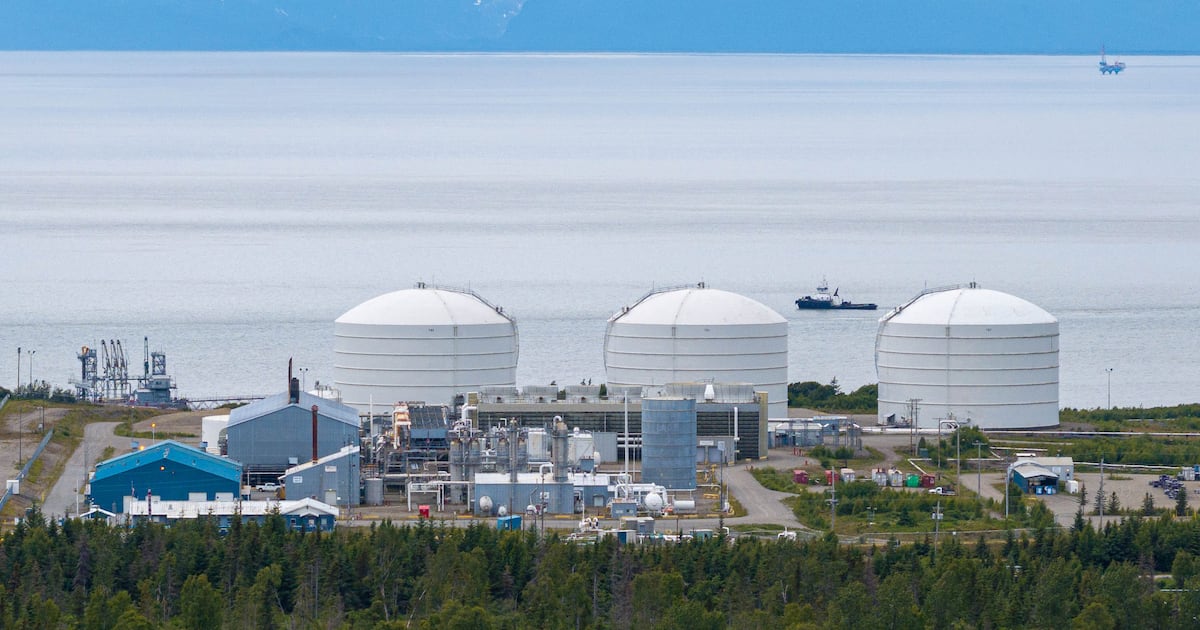
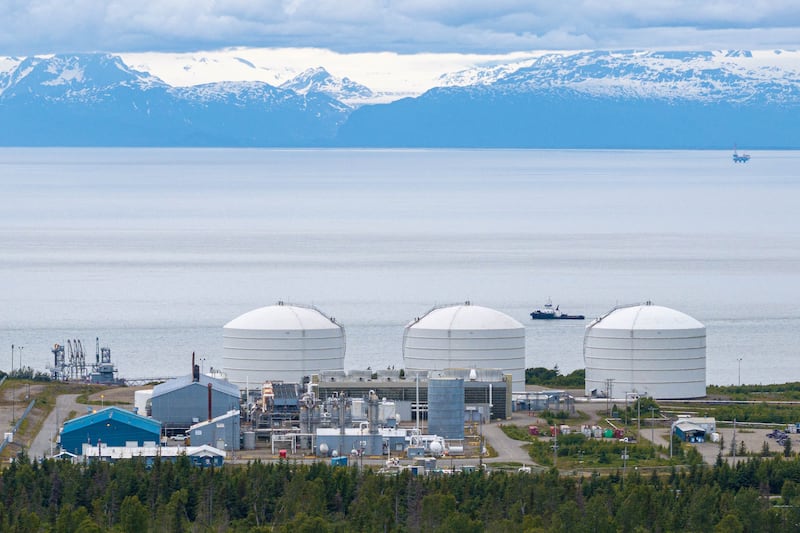
 The shuttered Kenai LNG plant in Nikiski. (Loren Holmes / ADN archive)
A Hilcorp affiliate last week filed paperwork with federal regulators to build what could become the first facility in Alaska to import liquefied natural gas to meet energy needs across much of the state.
Trans-Foreland Pipeline Company seeks to expand plans for a smaller import project that had originally received approval from the Federal Energy Regulatory Commission but had yet not been built, according to the Jan. 9 application.
The project would convert the Kenai LNG Terminal in Nikiski into an import facility to process deliveries of liquefied natural gas, or LNG, that will arrive by tanker.
The facility had long operated as an LNG export facility for decades, starting in 1969, until it was idled in 2015.
The reversal in use highlights the shift in the Cook Inlet basin, where gas production has long dropped.
The basin was once the state’s dominant source of oil and gas, with enough gas to meet local needs and support LNG shipments to Japan.
But Hilcorp, the top gas producer in the region, told utilities in 2022 that it cannot guarantee gas supply after contracts end, including for Chugach Electric in 2028 and Enstar in 2033.
Harvest Midstream, a Hilcorp affiliate, acquired the Kenai LNG facility and Trans-Foreland from its previous owner, Marathon Petroleum, last year. The federal agency had originally authorized Trans-Foreland to build an import facility in 2020. The new filing seeks to expand those plans.
An official with Harvest Midstream declined to provide comment Friday.
Today, production in Cook Inlet still largely meets the demand for gas in the region, the filing says.
Gas from storage reservoirs also supplement produced gas on cold winter days when demand rises.
But declining production is forecast to cause a “supply deficit” starting next year, the filing says.
The application seeks approval by July 31 in order to beat that shortfall.
The project “is narrowly tailored to address the forecasted needs of the southcentral Alaska region” and “will enhance natural gas supply reliability and security for the Southcentral region,” the filing says.
The facility could deliver up to 20 billion cubic feet of gas annually, meeting a chunk of total demand in the region.
But the supply shortfall is expected to keep growing, to a deficit of 40 billion cubic feet by the early 2030s, the filing says.
The application does not say how that deficit may be closed.
Larry Persily, an oil and gas analyst and former Alaska deputy commissioner of revenue, said the Trans-Foreland facility could seek federal approval for expansion after it gets off the ground.
“They certainly could get the authorization for 20 (billion cubic feet) and then go back to FERC in four, five, six years and say, ‘Hey, we need to increase it,’” he said. “It’s not a number that’s hard wired for all eternity. It’s just a function of how much equipment they put there.”
It’s possible another LNG import facility could be built, also in Nikiski.
Enstar, the natural gas company for Southcentral Alaska, has teamed up with Glenfarne to study the construction of what could be a second LNG import facility in Alaska.
That project would not come online until at least 2029.
The project has not yet filed for approval from the Federal Energy Regulatory Commission, Persily said.
Persily said it’s increasingly likely that LNG imports may be a necessary part of the state’s future, though it’s possible more gas could be produced than expected in Cook Inlet, heading off the shortage.
Also, Glenfarne is working with the state and other companies to develop a $44 billion Alaska LNG project that could deliver natural gas to Southcentral Alaska in a first phase, if it can be built.
But the project, which proposed starting up in 2029, remains iffy.
A final investment decision on Alaska LNG has not been made, though it was expected late last year for the project’s first phase. Similar gas projects in Alaska, saddled with a costly 800-mile pipeline like Alaska LNG, have failed for decades.
Tim Fitzpatrick, a spokesperson for Glenfarne, said in an email that front-end engineering and design for phase one of Alaska LNG was completed on schedule.
He said that “we are moving forward toward FID,” or a final investment decision.
If gas imports do begin, Persily said, it’s possible that the increased price of imported gas could be a “manageable” problem.
LNG supply has grown worldwide while Cook Inlet prices for gas are high and have been rising, he said.
Chugach Electric Association, a potential customer for gas from the Trans-Foreland facility, estimated in 2024 that ratepayer bills would rise about 10% when LNG is imported in 2028.
“The fact that the global market seems to be entering an era of plentiful supply, at least through the early 2030s, bodes well for us,” Persily said.
And companies are pursuing additional gas storage, which can also stabilize prices, he said.
“They don’t have to buy LNG for next week’s cold spell,” he said. “You can buy it when the market is cheap and put in storage.”