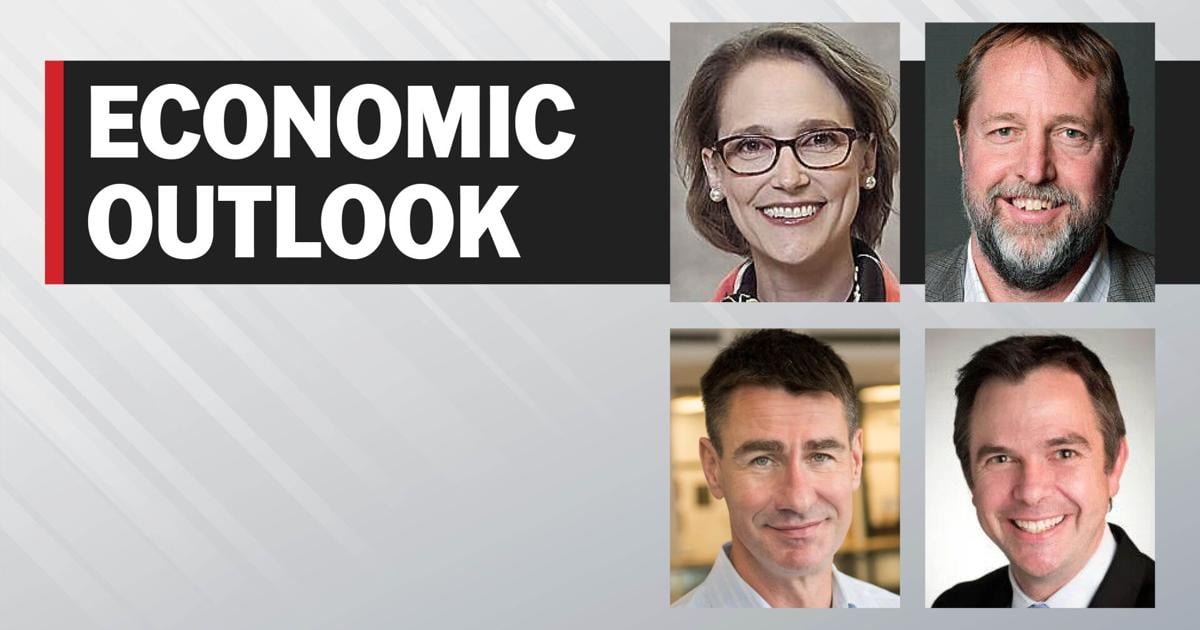
If “Sesame Street” were doing a 2026 economic outlook episode, it would feature the letter K.
That’s because experts are saying a well-developed K-shaped economy will continue this year. To understand the reference, consider the shape of the letter K.
The upward slanted line represents the people who will continue to do well in this economic environment. The downward slanted line depicts how low-income families will struggle even more than they already do.
To put it another way: the rich will prosper and the poor will suffer.
The K-shaped economy is a familiar story that has been the subject of national economists’ comments for months. But the pain some local residents are experiencing feels fresh.
Budget squeeze
Rachel Blakeman, director of the Purdue University Fort Wayne’s Community Research Institute, has the data to back up the forecast. But rather than burying people under a blizzard of numbers, she summarized her findings.
“Higher-income earners are powering the American economy as a whole. They continue to spend and spend generously,” she said during a phone interview. “They are not feeling the crunch of the cost-of-living burden.”
Middle-income families’ budgets are being squeezed, Blakeman said, citing the rising costs of rent, car payments, insurance, groceries and other necessities.
A tight housing market has driven up the cost of buying a home. And even those homeowners who are staying put with their low-interest-rates mortgages are facing higher property tax bills because their properties are being assessed at rates that reflect the current housing market.
Higher property taxes are yet another drain on vulnerable families’ incomes. Middle- and low-income consumers are surviving by either cutting back on spending or going further into debt, Blakeman said.
Higher food and rent costs coupled with lower consumer spending are hitting some locally owned businesses in the bottom line. 816 Pint & Slice, a downtown pizza restaurant, closed permanently on Dec. 31 after the owners said on social media that they were unable to increase prices enough to offset their rising costs.
Blakeman said small-business closures are a ripple effect of current economic conditions. And more shutdowns could be coming.
Some women who typically get their nails done every two weeks will cut back to one salon visit a month, Blakeman forecast. And, she said, some homeowners who have previously paid landscaping firms for lawn care will begin doing the work themselves.
Seeing a trend
Local families aren’t the only ones struggling financially.
“It’s a trend being seen nationally but also playing out at the state and local levels here,” Blakeman said.
A good case study at the state level is contrasting Allen County with Hamilton County, where residents have some of the highest incomes in Indiana, she said.
“(T)hey probably feel comfortable spending in ways lower-income households don’t or, more accurately, they aren’t feeling as squeezed by increased prices on the same scale,” Blakeman said.
Although inflation has cooled, basic necessities’ prices remain at the highs reached in the last couple of years.
“Purdue University Fort Wayne evaluated wages, household income, rent, food costs and home prices for the past decade in both current and inflation-adjusted 2024 dollars to understand conditions going into the new year,” said Blakeman, who conducted research with colleague Heather Tierney, an associate professor of economics.
“The big takeaway here is how inflation-adjusted earnings and income haven’t kept pace with overall inflation,” Blakeman said.
The average Hoosier earned 88% of the average American for an hour of work in August 2025, according to research from the Indiana Business Research Center.
Phil Powell, the center’s executive director, found that Indiana’s gross domestic product growth of 2.6% last year outperformed all four of its neighboring states and bested the national rate of 2.1%.
U.S. Bureau of Economic Analysis data show that a surge in durable goods manufacturing – such as vehicles and major household appliances – fueled the Hoosier State’s GDP increase, he said in a report. The research center is part of Indiana University’s Kelley School of Business.
Chemical manufacturing, which includes pharmaceuticals, also helped power the state’s economy last year, Powell said. Indiana led the nation in pharmaceutical and medicine manufacturing exports at $22.4 billion in 2024 with North Carolina a distant second at $12.7 billion.
Unpredictable policy
The state’s economy is expected to grow more slowly than the national economy this year, Powell said.
Even so, he added, Indiana has some notable strengths, including a focus on regional cooperation and an emphasis on apprenticeship programs that prepare high school graduates not going on to college for careers in the building trades.
Kyle Anderson, assistant professor, and R. Andrew Butters, associate professor, collaborated on the research center’s U.S. outlook. They both teach business economics and public policy courses.
Strong corporate investment in artificial intelligence, resilient consumer spending and robust financial markets suggest economic growth, they said in their report.
Those encouraging signs are offset, however, by a softening labor market, with slower payroll growth. Political and economic uncertainties are making some companies reluctant to hire, they said.
Also, the K-shaped economy indicates consumer spending likely will weaken as middle- and low-income households pull back.
Although artificial intelligence, or AI, is becoming more prevalent in business and social usage, some market watchers have expressed concern that a bubble could be on the way. Anderson and Butters said the rapid investment growth in relatively few AI companies could result in market volatility.
Unpredictable trade policy in the form of threatened and actual tariffs will continue to discourage large-scale business investment, the professors said.
The U.S. economy will continue to reflect that uncertainty. And consumers aren’t immune from tariff fallout.
“Companies have managed to absorb some cost increases, but we expect they will be less likely to do so as tariffs become permanent,” Anderson and Butters said, indicating that the added expense will be passed on to buyers.
High uncertainty
Andreas Hauskrecht, IU clinical professor of business economics, tackled the research center’s international economic forecast by focusing on about 10 countries of significant interest to the U.S.
Like the U.S. forecast, Hauskrecht’s highlighted the likelihood that manufacturers will raise prices to cover the cost of tariffs they are forced to pay when importing raw materials and other goods.
Consumers were largely sheltered from tariff effects in 2025 because importers rerouted some supply gains, stocked up on products before tariffs went into effect and sacrificed profits to keep prices lower, his report said. But those strategies can’t continue for long.
Hauskrecht said the high level of economic uncertainty experienced last year is expected to continue in 2026.
According to the International Monetary Fund, inflation in the U.S. is expected to decrease slightly from 2.7% in 2025 to 2.4% in 2026, he wrote. Emerging and developing countries, which begin at much higher rates, will also see a decrease in inflation.
The U.S. economy is expected to grow by 1.6% this year. In comparison, economic growth in Europe remains subdued and the Chinese economy will see growth rates of about 5%, a cooling off from the Asian country’s rapid economic expansion in recent years.
Canada and Mexico are each expected to post 1.5% economic growth this year, Hauskrecht said. Inflation is expected to remain at 2% in Canada and will decrease to 3.3% in Mexico this year.
Japan’s economic growth forecast is a modest 1.1% with 2.1% inflation for 2026. India, by contrast, is expected to experience strong growth with GDP increasing by 6.2% this year while inflation ticks up to 4%, the report said.
Hauskrecht concluded his global economic forecast by saying that “the world economy suffered less from ongoing trade conflicts than expected” in 2025. “However, the level of uncertainty remains high, making forecasts of future economic activity and inflation difficult.”