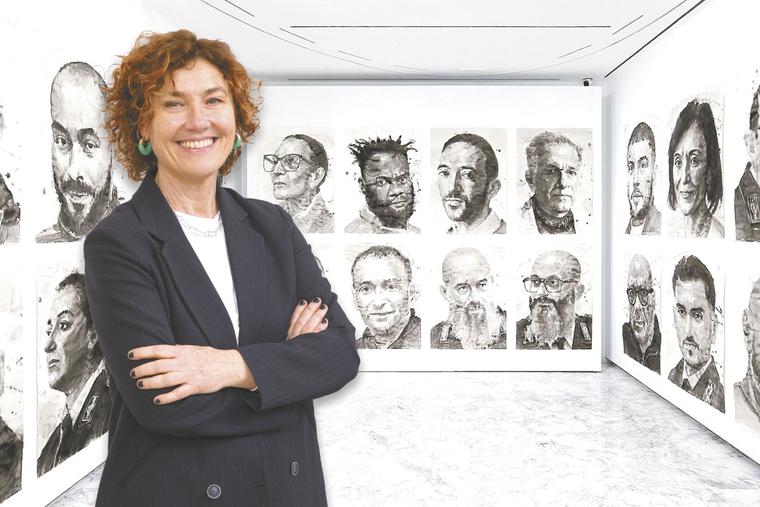
An expert in contemporary art, Cristiana Perrella was inducted into the Vatican’s 500-year-old fine arts academy in a narrow Baroque chapel under the attic of the Pantheon in 2022. Three years later, Pope Leo XIV appointed her the first woman president in the academy’s history.
In three decades as an independent curator and director of art museums, Perella has had little experience with Church institutions and is not herself a practicing Catholic. Her appointment exemplifies the opportunities and challenges in the Vatican’s engagement with secular culture.
The Virtuosi al Pantheon is an international society of experts in art and literature approved by Pope Paul III in 1542. The academy is based at the Pantheon, an ancient Roman temple famous for its large, open rotunda, which was transformed into a Catholic church in the early seventh century. Its members, nominated by the pope, stage art exhibitions and organize lectures and cultural events.
Perrella, from Rome, studied art curation in the early 1990s at Centro Pecci, Italy’s second-oldest contemporary art museum, in Prato, a town outside of Florence. She returned to the museum as its director from 2018 to 2020. The critic, who currently runs the MACRO, Rome’s Museum of Contemporary Art, said in an interview it was clear from the start of her career that she wanted to work with the artists of her time.
Contemporary art is “a frontier of experimentation” and a powerful vehicle for communicating values, challenging reality, and understanding the times we live in, she told the Register.
In 2017, Perrella curated an exhibit on the role of Italy’s public television, RAI, in the 1970s. The exhibit, which combined video images from the RAI archives with abstract paintings, sculptures and installations, explored “the relationship between television and culture, television and feminism,” she said. It was “a very important experience for me.”
“I am always interested in the most innovative expressions” of art, she said. “[Contemporary] art continuously trains us to seek complexity, [and] it teaches us … that things are never black and white.”
In 2022, Pope Francis appointed Perrella to the fine arts academy, her first institutional connection to the Church. Pope Leo XIV named her the president in September 2025.
The curator called it a sign of change that Pope Leo XIV chose to place a woman at the top of the cultural institution.
“The presence of stronger women, also in decision-making roles, can change something,” she said. “Women bring a culture that is not a culture of death, because women are generative by nature.”
Unlike Vatican employees, members of various academies associated with the papacy include people of other faiths and even nonbelievers, as part of the Church’s ongoing dialogue with contemporary scholarship and culture.
Perrella said she herself is not religious, but she appreciates the Church’s outreach to those outside its ranks.
“Even people who do not identify with the Church are strongly influenced by the Church’s message at this moment in time,” she said.
The curator cited Pope Francis’ meeting with artists in the Sistine Chapel in 2023 and the Vatican’s 2024 exhibit mounted in the Venice-Giudecca Women’s Prison for the Venice Biennale, an international artistic and cultural festival held annually in the northern Italian city. The show, which Francis visited, featured paintings, films, a mural, neon light pop-art, and suspended fabric sculptures, set against the backdrop of an active women’s prison.
Perrella later called that exhibition a “truly transformative experience” that made her and other viewers “think about art and prison conditions from a different foundation.”
She hailed the Church as “visionary” for channeling culture and art as tools to convey values such as charity and mercy and to answer questions troubling society today. The Vatican in recent years has had a “renewed confidence in art and its potential … to both elevate humanity and help us understand the times we live in,” Perrella said.
Her most substantive collaboration with the Vatican so far has been as this year’s curator of the exhibit space, Conciliazione 5, an initiative of the Vatican’s culture and education dicastery, which oversees her academy.
Perrella credits the dicastery’s prefect, Portuguese Cardinal José Tolentino de Mendonça with having “an extraordinary vision” for how the Church can relate to contemporary art.
“Because he is a poet, an intellectual, he knows and deeply loves art and artists,” she said.
It was the cardinal’s idea to open up Conciliazione 5 — a small gallery of just under 300 square feet with a large window onto the main pedestrian thoroughfare leading to St. Peter’s Basilica, Via della Conciliazione. Thousands of tourists and pilgrims pass the gallery’s show window every day on their way to the Holy Door of the basilica.
“The idea was to catch their eye and try, through art, to stimulate reflection on themes that were also very important to Pope Francis,” Perrella explained.
Cardinal Mendonça “didn’t ask me to work on religious art, but on art that could interpret this theme of hope … and that was in touch with strong social issues.”
The first exhibit drew attention to the humanity of the incarcerated through 27 large, black-and-white watercolor portraits of inmates, guards and staff at one of Rome’s most notorious prisons.
The same portraits, by Chinese-French artist Yan Pei-Ming, were also projected with light onto the exterior of the Regina Coeli Prison on the night of Feb. 15, with some of the subjects and their families in attendance to view the display.
 The Conciliazione 5 gallery has showcased, l to r, Brazilian Vivien Suter’s abstract paintings and Adrian Paci’s sculpture of a man carrying a roof on his shoulders.
The gallery space has also featured Adrian Paci’s sculpture of a man carrying a roof on his shoulders as a reflection on different kinds of journeys, including forced migration.
Through Dec. 4, the space hosted an exhibit of Brazilian Vivien Suter’s abstract paintings, created outdoors, Perrella said, exposed to elements such as rain, animals and falling leaves and fruit to give the idea “of total communion with the natural environment.”
The Vatican is paying attention to what “art and creativity can do in elevating the human condition, regardless of a strictly confessional or religious approach,” Perrella said. Perrella’s Vatican appointment drew disapproval from some conservative news websites that said exhibitions she had staged, and some posts on her Instagram account, promoted LGBTQ themes.
The most controversial of the shows was a 2020 exhibition of nude photographs by the Chinese photographer Wen Hang (1987-2017). According to the host museum’s description of the exhibit, the nude bodies in the photos are sometimes “provocatively explicit in their exposure of sexual organs and poses, which at times recall sadomasochism and fetishism.”
Objections to Perrella’s new role also cited posts shared on her personal Instagram page, such as a photo of a rainbow-colored rug in Rome’s Termini train station, and another in support of a bill seeking to penalize discrimination on the basis of sexual orientation and gender identity, which was opposed by Italian Catholic bishops and the Vatican. Perrella described the complaints as “strange.”
“In fact, the cardinal [Mendonça] told me not to worry” about it, she said.
Cardinal Mendonça and the Holy See Press Office did not respond to requests for comment. At a presentation for Conciliazione 5 in October, the cardinal thanked Perrella for the ecologically focused exhibition, calling it a “nonconformist and truly jubilant journey.”
Perrella acknowledges that some in the Church would prefer to stick to traditional artistic themes and forms. But she insists that “the experiment, the vision, is now to move outside [historic] boundaries.”