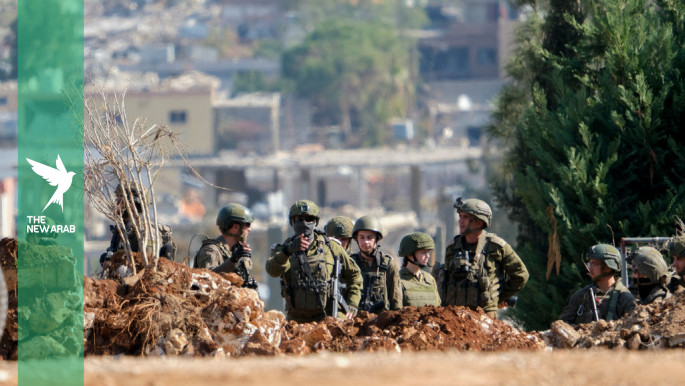
Israeli ground operations in southern Lebanon uncovered extensive, ready to use military infrastructure, according to the report [Getty]
Hezbollah had drawn up a “terrifying” and highly advanced plan to invade northern Israel’s Galilee region, while the Israeli army was unprepared to confront such a scenario, an Israeli newspaper has reported.
According to a report published on Friday by Yedioth Ahronoth, the plan was not “fictional”, but had reflected a real operational scenario developed by Hezbollah and known to Israel’s security establishment well before 7 October 2023.
The newspaper said the plan could have resulted in a catastrophe in northern Israel exceeding the scale of Hamas’ 7 October operation, had it not been for Israel’s large-scale assault on Lebanon that preceded the current ceasefire.
Citing what appeared to be Israeli security sources, the report said Hezbollah had planned to deploy thousands of fighters from around 30 south Lebanon villages along the border.
According to the scenario, an initial wave of some 3,000 fighters from Hezbollah’s elite Radwan Force would have infiltrated tunnels close to Israeli towns and settlements, awaiting orders said to come from Iran, the group’s main backer.
The plan reportedly included a surprise barrage of hundreds of rockets targeting strategic Israeli sites, alongside sniper fire aimed at border surveillance cameras and sensors.
At a later stage, the operation would have involved abducting large numbers of Israelis and using them as human shields, severely restricting the Israeli air force’s ability to strike targets in Lebanon.
The report claimed that thousands of Israelis would have woken to find their towns “occupied,” with a Hezbollah brigade seizing what it called the “lifeline of the north,” a reference to the Acre–Safed highway. Other towns and settlements would have come under Hezbollah control, with possible attempts to strike oil refineries in Haifa Bay, alongside the launch of drones and continuous rocket fire. The newspaper alleged that up to 16,000 rockets could have been fired within the first 48 hours of such an attack.
‘The army was not ready’
According to the report, the Israeli army would have struggled to confront Hezbollah’s forces because it was not adequately prepared. After 48 hours, a second wave of around 5,300 fighters would have joined the offensive, expanding the area under Hezbollah control in the Galilee and intensifying resistance to Israeli forces.
The report claimed that only after several days, and at a very high cost, would the Israeli army have been able to regain control of the Galilee, with casualties in the thousands, and hundreds of Israelis taken captive, including soldiers from military sites that were overrun.
Yedioth Ahronoth said this scenario had long been known to the Israeli army, yet it was unprepared for it on 7 October when Hamas attacked, despite the risk that it could be triggered “by a single phone call from Tehran”. Iran has long denied that it gives direct instructions to its non-state allies, with analysts noting that even senior Hamas officials outside of Gaza were likely kept in the dark about the October 2023 assault.
The newspaper added that more than two years have passed without this scenario materialising, attributing that to what it described as a “hard war” that exacted a heavy toll on Israeli lives and, according to the report, removed the threat hanging over hundreds of thousands of Israelis in the north. It said Hezbollah suffered a severe blow, with senior leaders killed and weapons stockpiles reduced.
However, the report noted that while extensive coverage has focused on Israel’s failures surrounding 7 October, “the failure” on the northern border has largely escaped public scrutiny. According to the newspaper, no one was held accountable for leaving northern Israel exposed, and the Israeli army’s investigations into preparedness in the north were neither presented to the public nor widely published.
No senior officers were summoned to explain why the region remained vulnerable, the report said. While the army claims it has drawn lessons and that its current security doctrine on the northern border has changed, the newspaper quoted an Israeli officer as saying: “It was clear to everyone that if something started here in the north, it would be a mass slaughter. We saw what Hezbollah had prepared for us. A miracle from heaven saved us.”
The term “miracle”, the report said, was repeatedly used by army officers, intelligence researchers, and field security personnel familiar with conditions along the northern border prior to 7 October, who acknowledged that the security services knew what was being prepared but failed to prevent it.
To what extent was Hezbollah prepared?
The report said Israeli ground operations in southern Lebanon in 2024 uncovered extensive, ready to use infrastructure stocked with equipment and weapons intended for thousands of fighters waiting for “zero hour.”
According to the newspaper, the Israeli army seized an estimated 85,170 weapons and pieces of military equipment during those operations, including around 6,840 rocket launchers and RPGs, anti-tank launch platforms, roughly 9,000 explosive devices and detonators, about 2,250 mortars and rockets, nearly 2,700 light weapons, around 60 anti-aircraft missiles, and some 20 vehicles.
It also claimed Hezbollah had gathered extensive intelligence before any operation, including around 60,800 communication devices, computers and documents, as well as some 300 surveillance tools.
While the Israeli army may have been surprised by the sheer volume of equipment found, the report said it was not surprised by plans to use it to attack and seize control of the Galilee. It noted that just one month before 7 October 2023, Israel’s Northern Command held a special study day focused on “preparations for the next war in the north.”
The newspaper added that multiple assessments were conducted before and after that, with Israeli military officials blaming political leaders for preventing pre-emptive action. This included not allowing strikes on Hezbollah tents erected in the border area before Israel’s assault on Lebanon, while the government remained silent at the time.
Despite a November 2024 ceasefire, Israel has continued to occupy five strategic border hilltops inside southern Lebanon. It frequently conducts strikes in parts of the country, which it claims are targeting Hezbollah positions and members, vowing to keep the group weak.
Israel has threatened to launch another offensive on Lebanon if Hezbollah does not disarm, in accordance with the ceasefire agreement. It has also reportedly warned Hezbollah against becoming involved in any future Israel–Iran war, as regional tensions flare.
The Lebanese army recently announced that it had completed the first phase of efforts to disarm Hezbollah, while Beirut has pledged to end military dualism in the country. The Tehran-backed militant group has refused to surrender its weapons elsewhere.