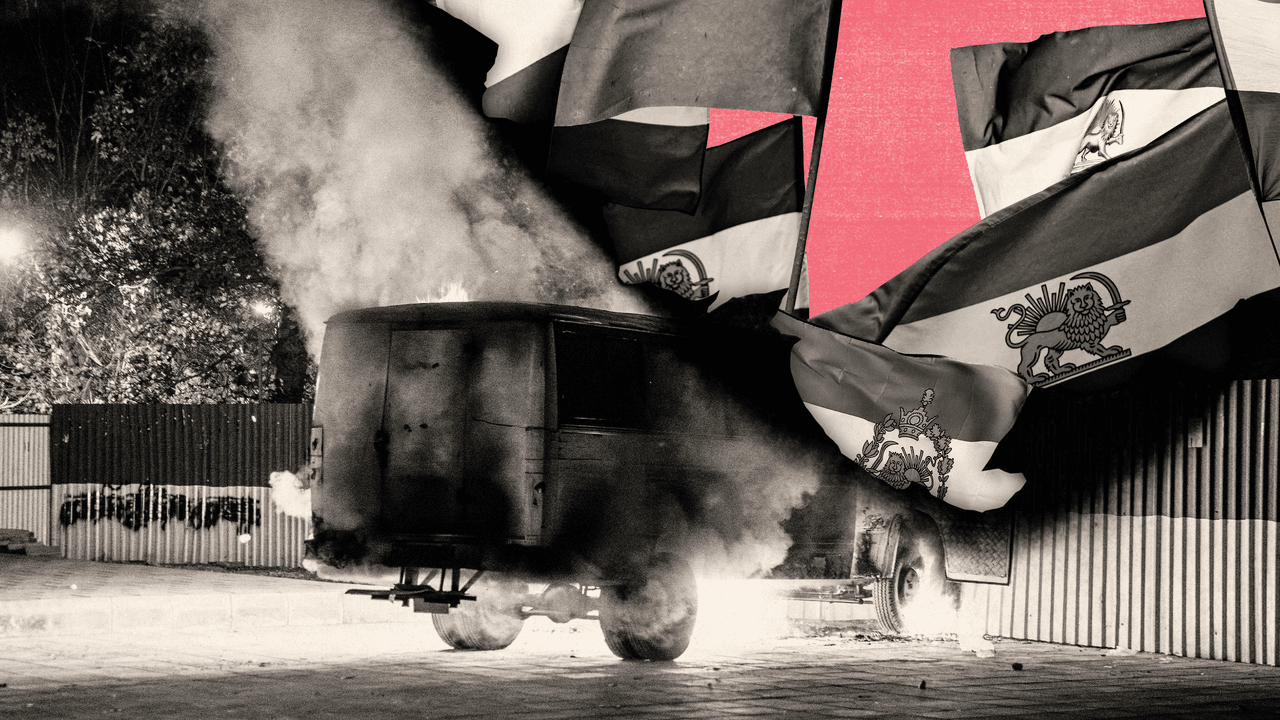
On January 8th, the twelfth day of mass protests in Iran, which began when shopkeepers, responding to runaway inflation, closed Tehran’s Grand Bazaar, the Iranian government shut down public access to the internet, further shrouding an already largely closed society. Nevertheless, isolated images and details have been smuggled out, giving a hint of how brutal and monumental these events are.
Video clips have circulated of people outside a morgue, unzipping body bags as they search for their loved ones. In the western city of Ilam, near the Iraqi border, security officials stormed a hospital to try to seize wounded protesters, while medical staff resisted. An ophthalmologist at a hospital in Tehran reported that it has been overwhelmed by casualties, including many people who were shot in the eye. In the conservative city of Mashhad, a journalist said that the streets were “full of blood.” The Iranian government has acknowledged the deaths of two thousand people, though international observers fear that the total may be much higher. The Chancellor of Germany, Friedrich Merz, insisted on Tuesday that the regime was in “its last days or weeks.” If he proves to be correct, it will be because of hundreds of thousands of brave acts by Iranian citizens—acts of discontent but also of idealism.
The portfolio of this crisis landed across classified Washington, on the desks both of career staff in the intelligence and diplomatic services and of Donald Trump’s recent appointees, among whom idealism is an increasingly shunned philosophy. The norm in American foreign policy has been that all interventions, including blatantly self-serving ones, are pitched in elevated humanitarian terms. During Trump’s second Administration, universal principles such as self-determination and due process are wielded only opportunistically. In Venezuela, Trump followed his ouster of Nicolás Maduro not by supporting the democratic opposition but by sanctioning the ascent of the dictator’s second-in-command, Delcy Rodríguez, seemingly in exchange for oil revenues. (The opposition leader, María Corina Machado, could only offer her Nobel Peace Prize medal.) Just after the New Year, in a conversation that also touched on annexing Greenland, against the will of its people, the White House adviser Stephen Miller gave CNN’s Jake Tapper the emerging party line: “We live in a world, in the real world, Jake, that is governed by strength, that is governed by force, that is governed by power.”
This is an encompassing vision, one that is now playing out in the ICE campaign in Minnesota against undocumented migrants and, more and more, against protesters and ordinary citizens. It also makes plain the hypocrisy in Trump’s embrace of the Iranian opposition. Ayatollah Ali Khamenei’s government has denounced the protesters it has killed, calling them terrorists; the Trump Administration has said that Renee Good, the woman shot dead by an ICE officer in Minneapolis, was engaging in an act of “domestic terrorism.” If the scenes in the Twin Cities look like those from an overseas occupation, the historian Nikhil Pal Singh suggested in the magazine Equator this week, that is because, under this Administration, the foreign and the domestic realms have bled together, as Trump threatens war-time powers “to arrest and remove unauthorised immigrants—and discretionary police powers abroad, to arrest foreign leaders (and seize foreign assets) under US law.” The Administration is asserting, too, an almost colonial kind of impunity: last week, Vice-President J. D. Vance baldly asserted that ICE agents have “absolute immunity” from local prosecution for their activities in Minnesota.
Even so, although the President’s intrinsic sympathies are with strongmen—Putin, Orbán, Kim—his strategic interests in Iran are with the protesters. (As it happens, the Administration’s old allies in Israel and its newer ones in Saudi Arabia and the Gulf states all want the Iranian theocrats gone.) On social media, the President made some gestures of solidarity. “keep protesting,” he urged. “help is on the way.”
Exactly what kind of help remains unclear. Trump’s adviser Steve Witkoff met with Reza Pahlavi, once the crown prince of Iran, but the White House found the deposed royal unconvincing. “He seems very nice, but I don’t know how he’d play within his own country,” Trump told reporters. In posts and appearances, the President returned to more familiar themes: he mused about possible military strikes on strategic sites in Iran, threatened tariffs against countries that trade with it, and announced a little bit of progress—the Iranian government had apparently reversed a plan to execute Erfan Soltani, a twenty-six-year-old shop owner who was arrested in connection with the protests. “We’ve been told the killing is stopping,” Trump said on Wednesday afternoon, and then, somewhat tellingly, struggled with his verb tenses. “It has stopped. It is stopping.”