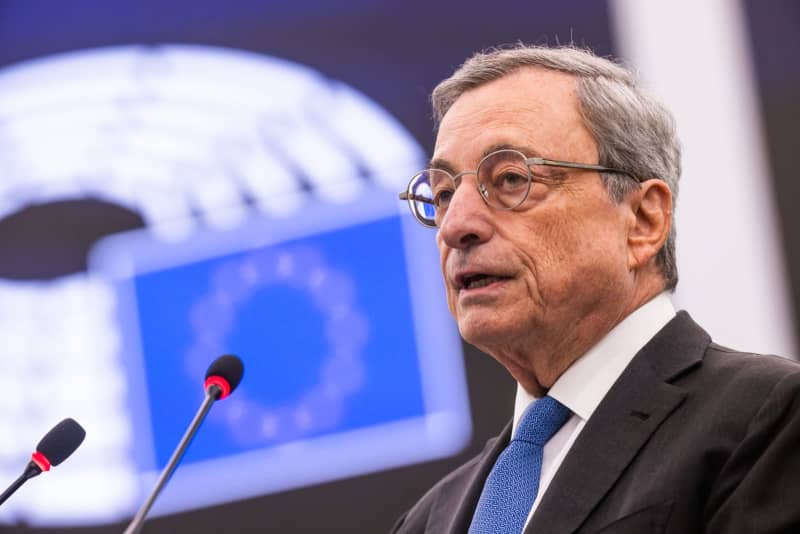
Mario Draghi, the former Italian prime minister and ex-head of the European Central Bank, is to receive the prestigious International Charlemagne Prize for services to European unity, organizers said on Saturday.
The prize’s board of directors praised the 78-year-old for having “achieved great things for Europe with purpose and unwavering determination.”
The board cited Draghi’s report on European competitiveness, which was published in 2024 and named after him.
In it, he warned that the European Union must urgently become more innovative or risk falling behind other economic powers such as the United States and China.
The prize board called the situation “dramatic,” stating: “Europe risks becoming the pawn of other powers. Economic strength is the foundation for everything else.”
Draghi also recently expressed frustration over the slow implementation of his recommendations, warning that weaknesses are increasing.
The organizers said awarding Draghi the prize at this moment is a “deliberate” signal to EU leaders: “We call on the European Commission and Heads of State and Prime Ministers to implement the Draghi Report now.”
Draghi expresses gratitude
Draghi responded with a video message expressing his “extreme gratitude” for the honour.
“This decision comes at a time when Europa has many enemies, perhaps never as many as now, both internal and external enemies,” he said.
In order to preserve the EU, Europeans must stand together more closely than ever, he warned. “First, we have to overcome our self-inflicted weaknesses and we have to become stronger: stronger militarily, stronger economically and stronger politically.”
Only then can we “preserve our values,” he said.
Tributes to Draghi
“As President of the Central Bank, Mario Draghi saved the euro – almost single-handedly, when it was hanging in the balance,” said German lawmaker Armin Laschet, who chairs the Charlemagne Prize board of directors, in comments to dpa.
In 2012, at the height of the euro crisis, Draghi said that the ECB would do “whatever it takes” to shore up the currency. “His words ‘whatever it takes’ are more relevant today than ever,” said Laschet, calling Draghi not only historically significant, but also highly relevant today.
Referring to Draghi’s report on Europe’s competitiveness, Laschet said: “That is why ‘whatever it takes’ should be a guiding principle for the commission today.”
He said the message from the Charlemagne Prize board of directors is: “Overcome the petty squabbles. Implement what Mario Draghi called for in his report.”
Past winners of prize
Previous recipients of the award, handed out by the western German city of Aachen since 1950, include Winston Churchill, pope Francis and Ukrainian President Volodymyr Zelensky.
European Commission President Ursula von der Leyen took home the award in 2025. The last Italian to win the award was Andrea Riccardi, the peace mediator and founder of the Catholic community Sant’Egidio, in 2009.
The Charlemagne Prize was founded by citizens of Aachen shortly after World War II. It is named after Charlemagne (748-814), whose empire extended over a large part of Western Europe.
He often resided in Aachen, which is located near what is now Germany’s border with Belgium and the Netherlands.
The award is widely regarded as the most prestigious prize for services to European unification. The award ceremony traditionally takes place in May in Aachen.