By Lydia Catedral & MICROLAB
At 4.34pm on November 26, Sringatin and Jepy saw a WhatsApp message from a relative of an Indonesian domestic worker who was trapped inside a burning building in Wang Fuk Court, a housing estate in Tai Po.
By 4.41pm, no one had been able to contact the worker. The day after the fire, Sringatin and Jepy went to Tai Po in person, visiting temporary shelters to look for migrant workers who had escaped the blaze.
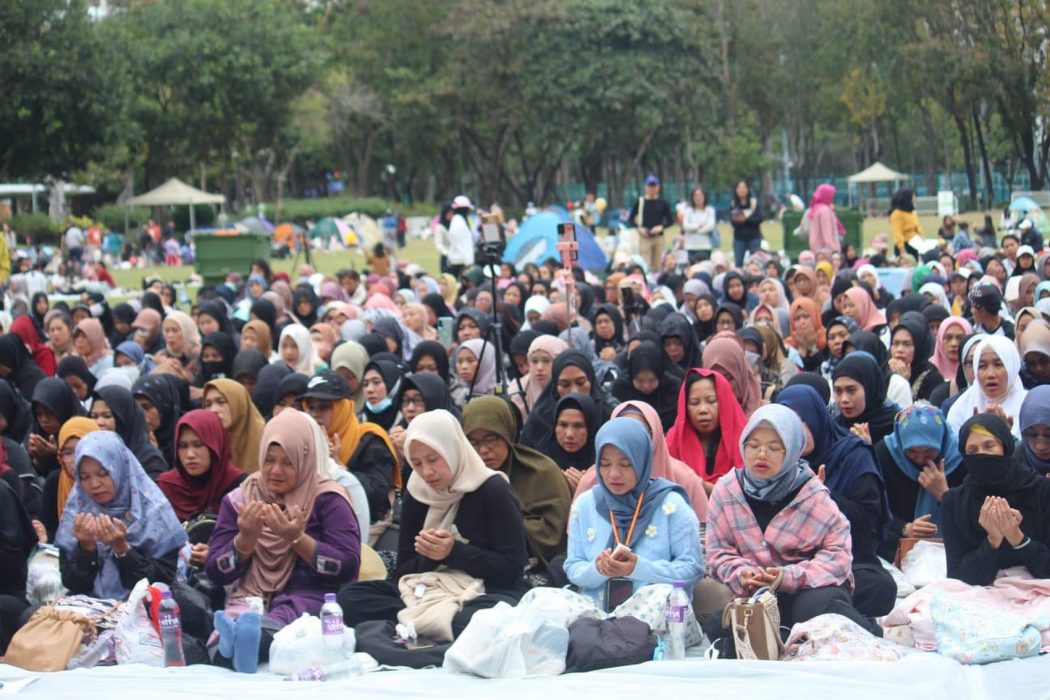 Indonesian nationals in Hong Kong take part in an interfaith prayer for victims of the Tai Po fire at Victoria Park on November 30, 2025. Photo: JBMI, via Facebook.
In the days that followed, they continued to return to the site, providing material and emotional assistance to 73 Indonesian workers who survived the disaster. They also visited hospitals and morgues, and connected with the families of nine Indonesian migrants who had died in the fire.
It is important to note that Sringatin and Jepy are not NGO workers or first responders.
They are Indonesian migrant domestic workers themselves, and their crisis response is part of the larger work of the Network of Indonesian Migrant Workers (JBMI), which has been working for the rights of Indonesian domestic workers for the past 16 years.
The JBMI was able to respond to the Tai Po tragedy at a time when the situation was acute and information chaotic, despite the extreme limitations they face as a domestic worker organisation.
I am writing this piece as a member of MICROLAB, an initiative that is collaboratively run by JBMI leaders Sringatin and Jepy, along with other supporters of Indonesian migrant workers.
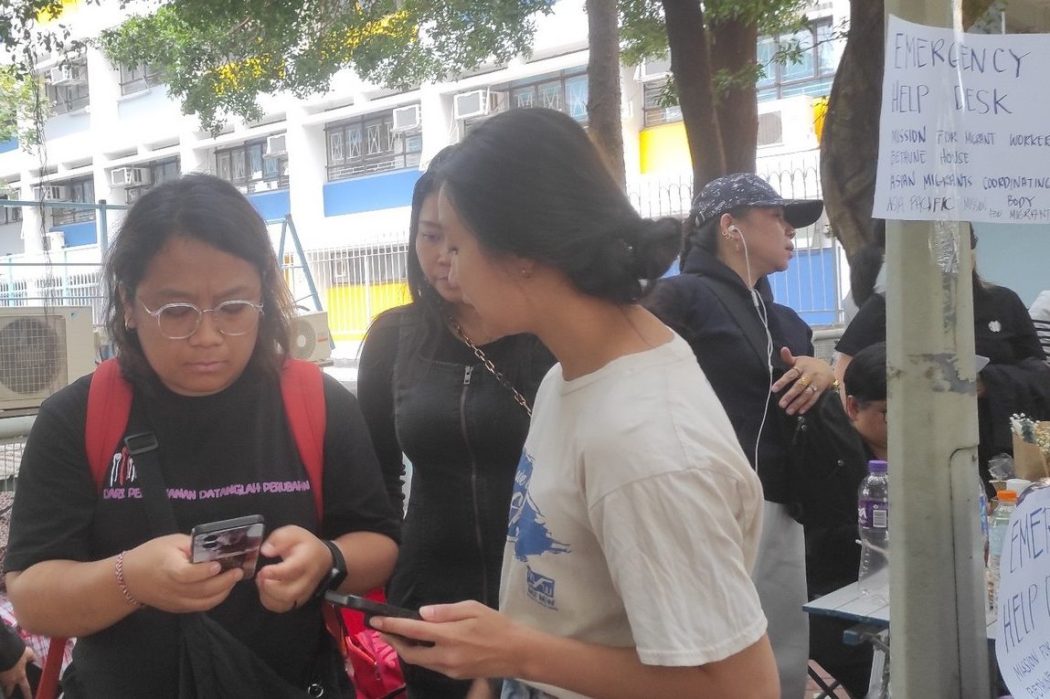 Jepy (first from left), leader of the Network of the Indonesian Migrant Workers (JBMI), is in Tai Po on November 30, 2025, to help Indonesian migrant domestic workers affected by the Wang Fuk Court fire. Photo: JBMI, via Facebook.
It is hosted by the Department of English and Communication at the Hong Kong Polytechnic University, and one of its goals is to tell the overlooked stories of migrant organisers and their contributions to their fellow migrants.
My work as a researcher, who has studied these organisations for the past six years, convinces me of the importance of their stories.
My published research shows, for instance, that the statements and submissions written by organised migrant workers give a more substantive, critical and intersectional account of the problems facing domestic workers than the reports and conventions of the United Nations’ International Labor Organization (ILO).
More broadly, I have found empirical evidence that, despite facing extreme constraints, these organisations outshine governments and even international organisations in their care and advocacy for fellow migrants.
This level of care is also evident in their response to the Tai Po fire. Even though JBMI members have limited time and financial resources because of their low-paid work as live-in domestic workers, they were still able to provide crucial forms of support for the victims.
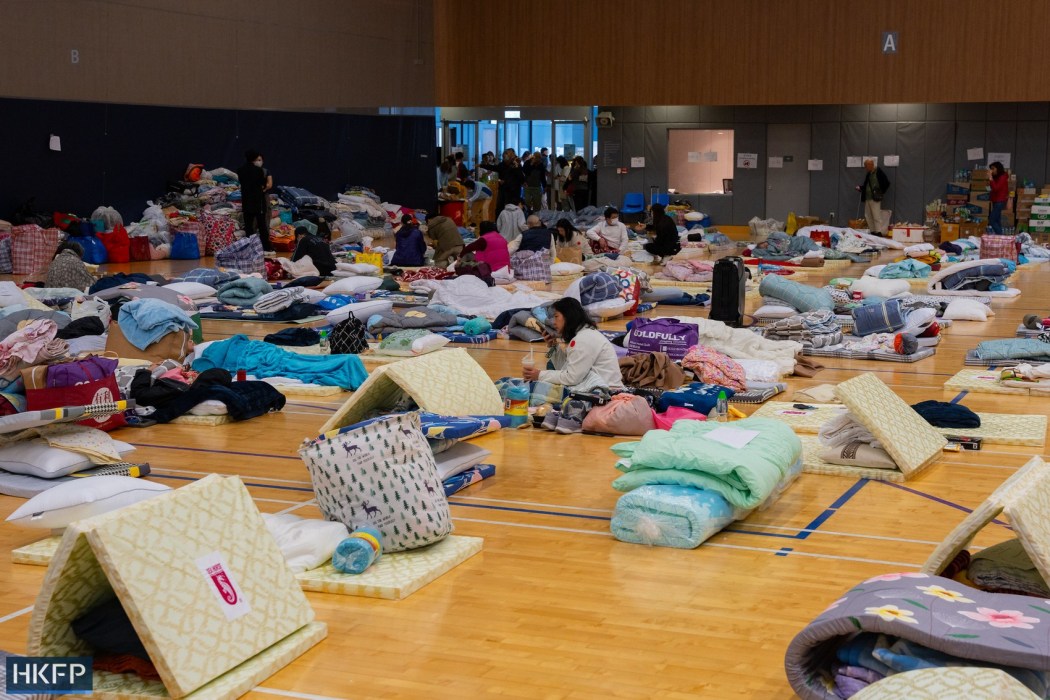 Tung Cheong Street Sports Centre turns into a temporary shelter in Tai Po for residents affected by the Wang Fuk Court fire on November 27, 2025. Photo: Kyle Lam/HKFP.
This is true even in the face of the unprecedented provisions made for migrant workers by the Hong Kong government.
The Hong Kong government has promised the families of deceased migrant workers HK$800,000 – money that will offer them much-needed long-term support. However, the bureaucracy involved means there is a long process before families are able to access these funds.
In contrast, within a week of the fire, the JBMI had mobilised members of its network in Indonesia to visit the families of the deceased.
They were able to do this because, although the JBMI was formed by migrant workers in Hong Kong, it maintains strong connections to civil society in Indonesia – especially to former migrants who have returned home from Hong Kong.
See also: Tai Po fire: Domestic workers pick up the pieces amid emotional trauma, job loss
Those who visited the families provided comfort, updated information, and a small donation coordinated by the JBMI and its Indonesian network. This donation was to ensure the family would be able to carry out the tahlilan, the Indonesian Islamic communal prayer following the death of a loved one.
We know intuitively that no amount of money can compensate for the tragic death of a loved one, and the funds provided for the tahlilan acknowledge this.
These funds are not delayed compensation for loss, but rather a timely provision of the basic resources needed for the families to meaningfully grieve their loss.
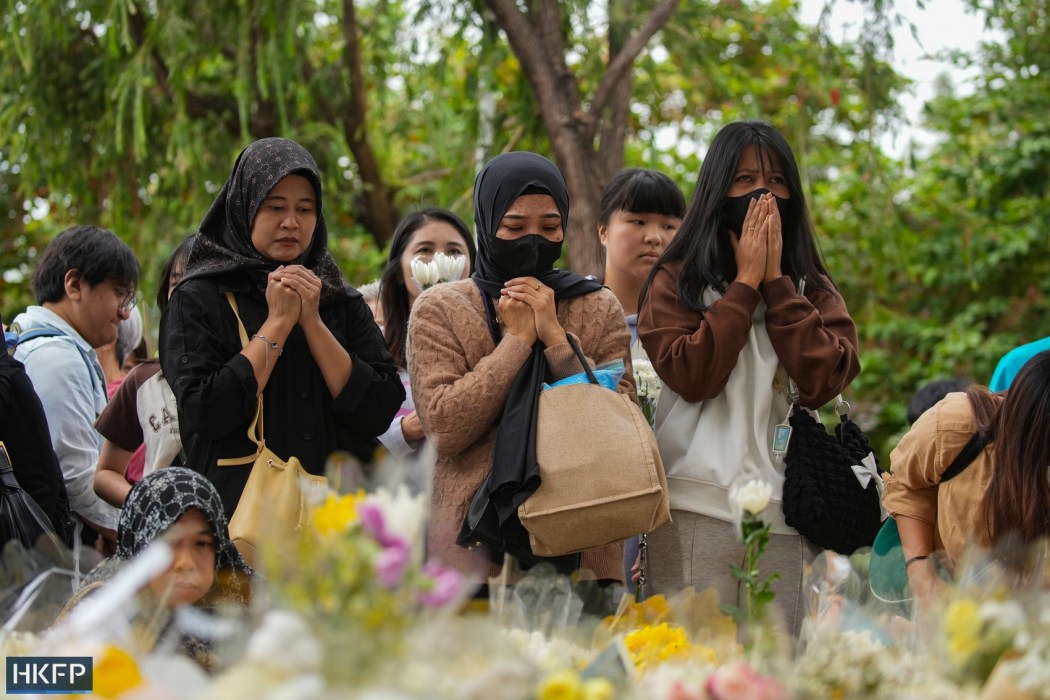 This photo, taken on November 30, 2025, shows people mourning the victims of the massive fire at Tai Po Wang Fuk Court. Photo: Kyle Lam/HKFP.
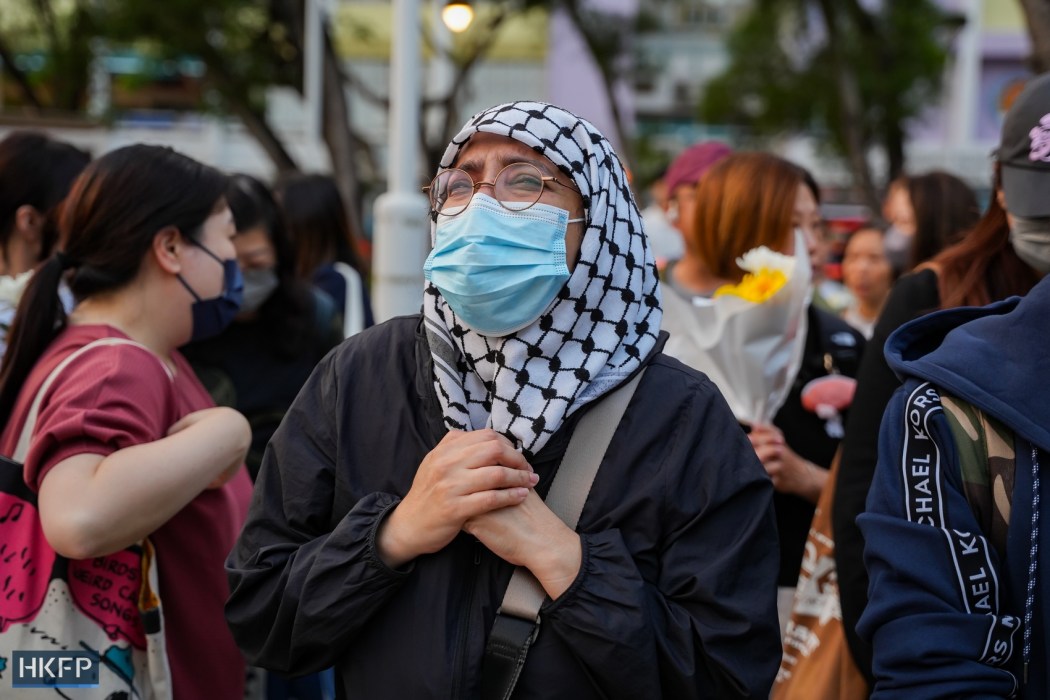 Mourners paid their respects to the dead outside Wang Fuk Court in Tai Po on December 2, 2025. Photo: Kyle Lam/HKFP.
The JBMI also coordinated with NGOs and mental health counsellors who offered services to migrant survivors of the fire.
Such professional services are crucial forms of support for those affected. But in addition to the trauma of surviving the fire, migrant victims also experience a secondary trauma – the trauma of being all alone in Hong Kong during the hardest moments of one’s life.
Alleviating these feelings of loneliness is something that is best accomplished by other migrants who have their own experiences of loneliness in Hong Kong.
To respond to this need, JBMI members were in Tai Po every day for a week after the fire to establish trust with migrants living in Wang Fuk Court through their continual physical presence.
One of our MICROLAB team members, Yvonne Zhu, accompanied JBMI members to a temporary shelter the day after the fire. She noted that the Indonesian migrants staying there looked shaken and terrified.
However, when they saw people from their home country come to check on them, their expressions suddenly softened with relief.
On another occasion, a survivor was hesitant to ask for what she really needed. She said that after receiving so much, she felt embarrassed to admit that what she truly needed was a bra.
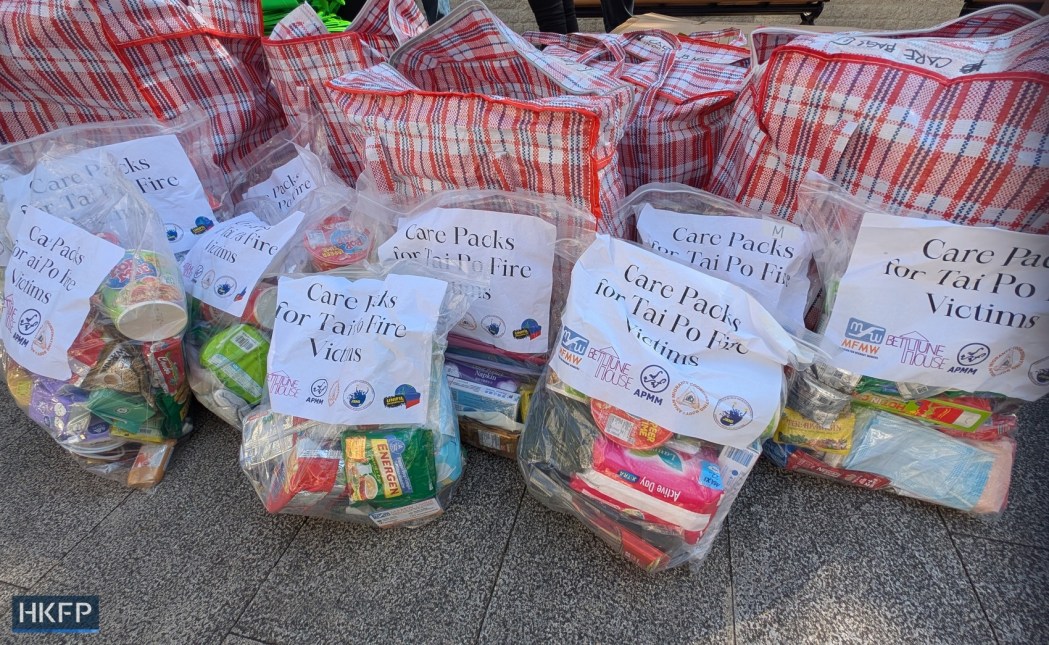 Care packs for Indonesian migrant workers who survived the Wang Fuk Court fire are distributed by the Network for Indonesian Migrant Workers (JBMI) in Tai Po on December 21, 2025. Photo: Yenni Kwok/HKFP.
Sringatin reassured her that she should ask for whatever she needed without feeling indebted. “We are perantau,” Sringatin reminded her, using an Indonesian word for someone who leaves home to seek better fortune. She assured her compatriot that they were both Indonesians living abroad, with no one to turn to except each other.
The financial compensation promised by the Hong Kong government and the professional services offered by NGOs are crucial for affected migrant workers and their families, who were already in a precarious situation to begin with.
However, these provisions should not lead us to disregard or underestimate the support that migrant workers are uniquely positioned to offer one another.
Since the Tai Po fire, the JBMI has mobilised more than 300 Indonesian migrant domestic workers to provide direct services to victims and to communicate with their family members back home.
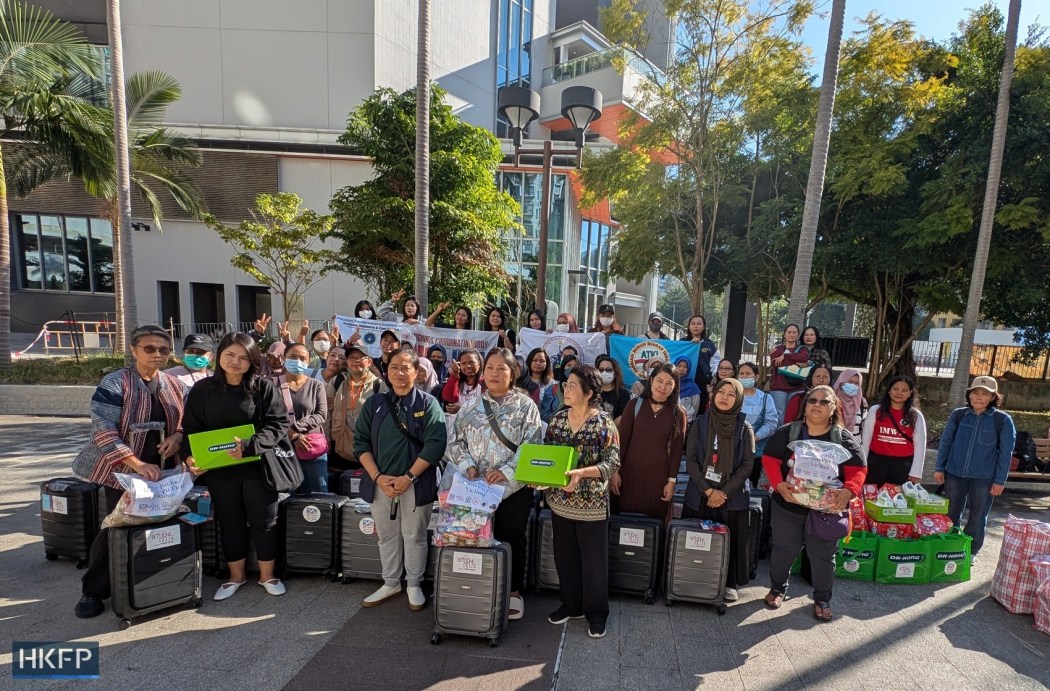 Sringatin (front, third from left), leader of the Network of Indonesian Migrant Workers (JBMI); Edwina Antonio (front, fifth from left), executive director of Bethune House Migrant Women’s Refuge; and Cynthia Abdon-Tellez (front left), general manager of the Mission for Migrant Workers (MFMW) pose with Indonesian migrant workers affected by the Wang Fuk Court fire after distributing suitcases, shoes, and care packs on December 21, 2025, in Tai Po. Photo: Yenni Kwok/HKFP.
In addition, the JBMI has joined forces with migrants of other nationalities through the Asian Migrants Coordinating Body (AMCB), and with supporting NGOs such as the Mission for Migrant Workers (MFMW), Bethune House, the Asia Pacific Mission for Migrants (APMM), and the Association for the Rights of Industrial Accident Victims (ARIAV), to coordinate relief efforts for Indonesian and Filipina fire victims.
The JBMI rallied broad support from over 2,500 Indonesians and others in Hong Kong to make donations and join online and offline interfaith prayer vigils.
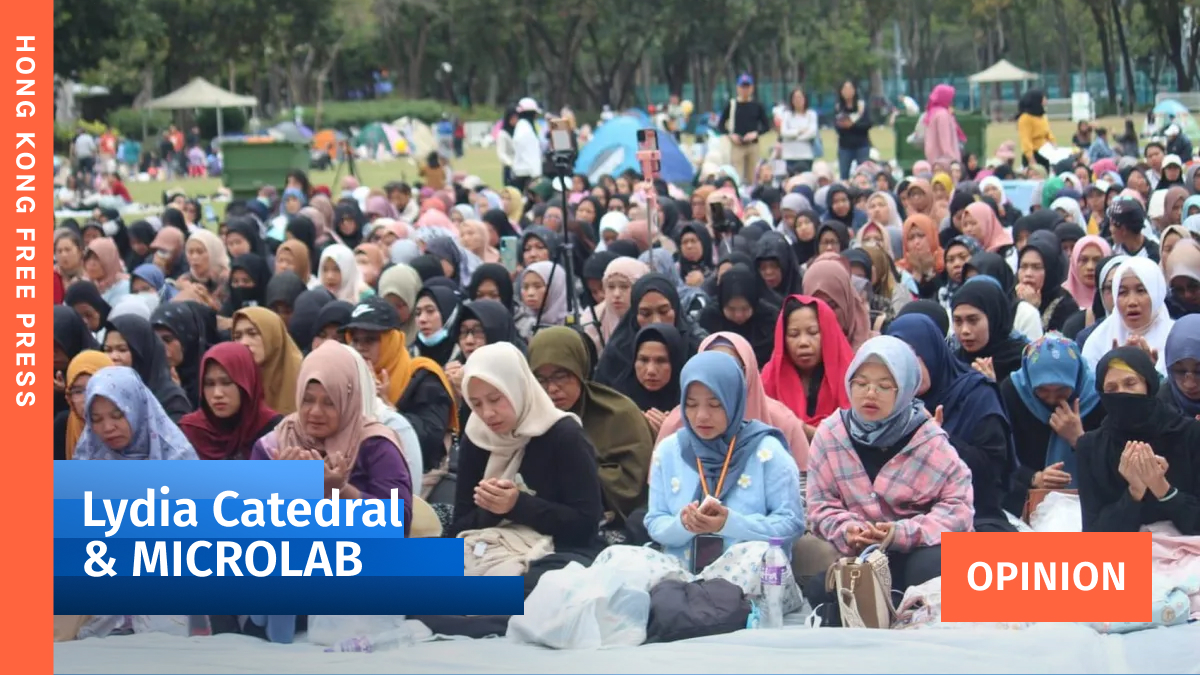
At one of the largest of these vigils, Sringatin stood in front of a crowd of mostly migrant workers in Victoria Park.
As one of the leaders of this grassroots community, someone who has long spoken firmly and resolutely for the rights of the migrants at this exact spot, she was at one point unable to stop crying.
Although there were likely many reasons for her tears in the midst of the tragedy, she later shared that one reason was that, looking out at the crowd, she was deeply touched by the image before her of “poor people helping poor people.”
Sringatin’s vision of the poor helping the poor is not unique to this crisis.
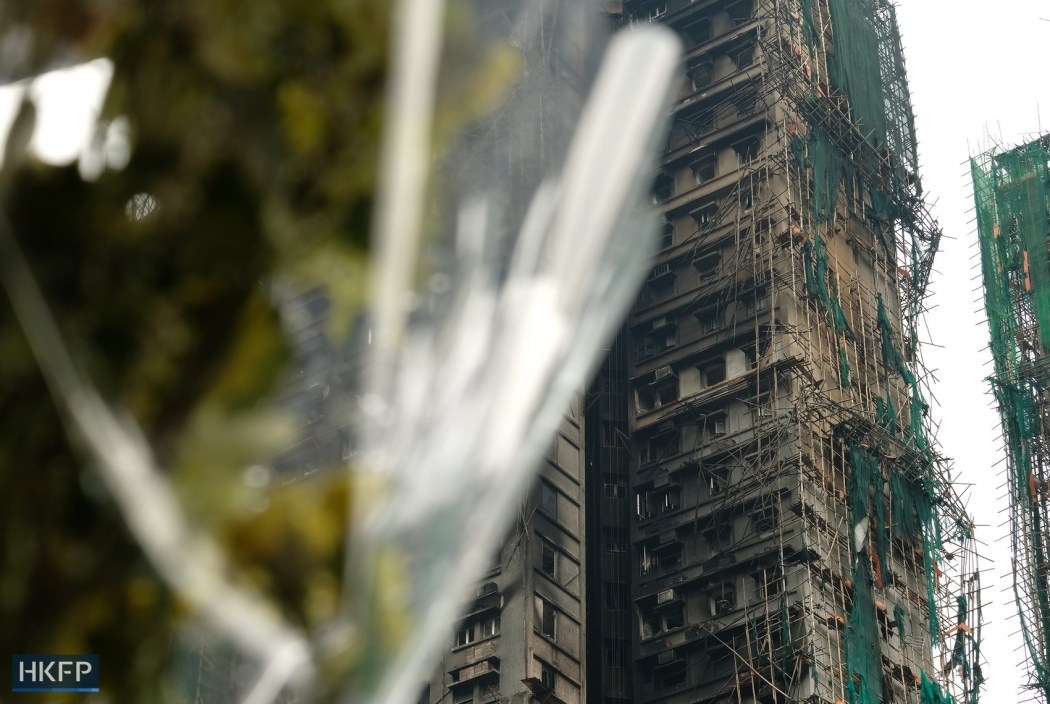 Wang Fuk Court in Tai Po on December 10, 2025. Photo: Kelly Ho/HKFP.
Migrant organisations like the JBMI not only provide support in times of collective tragedy, but also in the mundane moments of Hong Kong life.
In a city that employs nearly 368,000 migrant domestic workers – 42 per cent Indonesians and 55 per cent Filipinos – there is always a worker facing a personal tragedy.
The JBMI’s ongoing work of caring for fellow migrants may be as simple as listening to someone share her struggles with her family back home, advising her on how to calculate her sick leave, riding the MTR with her to immigration to renew her visa, or encouraging her to report an abusive employer who violates the law.
While times of crisis draw out our desire to respond, as we move further from the tragedy of the Tai Po fire, there is much to learn from and support in the day-to-day work of migrant organisations.
Through their acts of care, trust is built, creating a stronger foundation and deeper understanding for those moments when migrants need each other most.
This piece is written collaboratively by academic Lydia Catedral, whose sociolinguistic research focuses on migrant-led organisations, and the rest of the MICROLAB core team. MICROLAB is a shared space to cultivate collaboration between grassroots migrants, academics, artists and service providers hosted in the Department of English and Communication at the Hong Kong Polytechnic University. It is collaboratively run by JBMI leaders Sringatin and Jepy, Professor Lydia Catedral, Francis Catedral, Yvonne Zhu, and Yuyan Liang.
HKFP is an impartial platform & does not necessarily share the views of opinion writers or advertisers. HKFP presents a diversity of views & regularly invites figures across the political spectrum to write for us. Press freedom is guaranteed under the Basic Law, security law, Bill of Rights and Chinese constitution. Opinion pieces aim to constructively point out errors or defects in the government, law or policies, or aim to suggest ideas or alterations via legal means without an intention of hatred, discontent or hostility against the authorities or other communities.
Support HKFP | Policies & Ethics | Error/typo? | Contact Us | Newsletter | Transparency & Annual Report | Apps
Safeguard press freedom; keep HKFP free for all readers by supporting our team
Type of Story: Opinion
Advocates for ideas and draws conclusions based on the interpretation of facts and data.