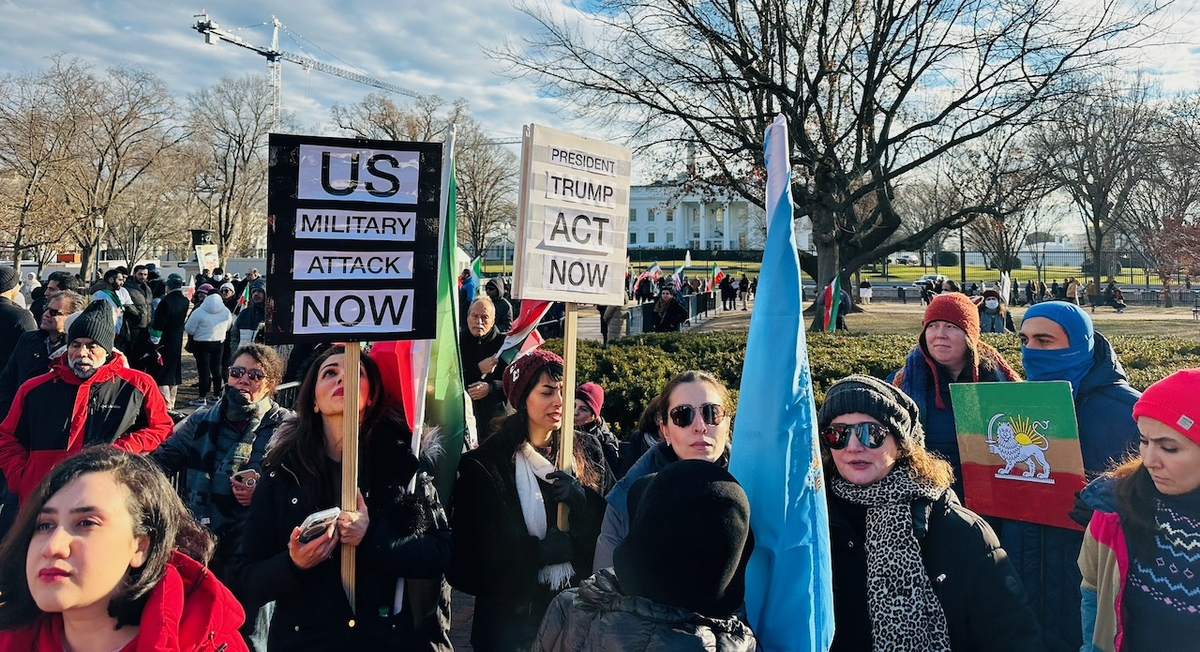
WASHINGTON DC – The warning didn’t come wrapped in diplomatic language. It came blunt, personal, and unmistakably political.
US President Donald Trump on Saturday labeled Iran’s Supreme Leader Ayatollah Ali Khamenei a “sick” man and declared it was time for new leadership in Tehran, escalating a public war of words as thousands of Iranians are reported dead in the streets – and as demonstrators gathered outside the White House demanded the president keep a promise they say helped ignite the uprising.
JOIN US ON TELEGRAM
Follow our coverage of the war on the @Kyivpost_official.
“It’s time to look for new leadership in Iran,” Trump told local media after learning of a series of posts from Khamenei attacking him on X.
“What he is guilty of, as the leader of a country, is the complete destruction of the country and the use of violence at levels never seen before,” Trump told Politico.
War of words turns personal
Khamenei, 86, had gone after Trump earlier Saturday, calling him a “criminal” and blaming him for the deaths of thousands of protesters killed during Iran’s brutal crackdown.
“We consider the US president a criminal for the casualties, damages, and the slander he inflicted on the Iranian nation,” Khamenei said during a religious holiday address.
“The US’s goal is to devour Iran,” he added, claiming Washington incited unrest in Tehran.
Trump responded in kind.
“The man is a sick man who should run his country properly and stop killing people,” Trump shot back, adding, “His country is the worst place to live anywhere in the world because of poor leadership.”

Other Topics of Interest
Zelensky Is Not the Last Word in Ukraine on a Peace Deal
Western leaders may near a Ukraine peace deal, but Ukrainians will decide. Polls show they want peace with security, reject territorial concessions, and distrust Putin to honor any deal.
The exchange continued into Saturday evening in Tehran, with Khamenei doubling down, accusing US and Israeli agents of operating inside Iran and claiming they “murdered several thousand people … including a three-year-old girl.”
Bodies in shrouds – and a blackout inside Iran
Iran’s regime has responded to the protests with overwhelming force.
Images of bodies wrapped in white shrouds have sparked outrage around the world, including among Iranians living in the US.
According to human rights groups, more than 3,000 people have been killed.
Telecommunications inside Iran have been largely cut since January 8, when authorities imposed a nationwide blockade.
While Iranians have regained limited ability to send domestic text messages since Saturday, global internet access remains blocked.
Citizens can only reach state-controlled websites via the national intranet.
The demonstrations, which began December 28 in Tehran’s Grand Bazaar following the catastrophic devaluation of Iran’s currency, spread rapidly across the country.
Millions poured into the streets on Jan. 8 after Trump issued a stark warning on Truth Social: “If Iran shoots and violently kills peaceful protesters, the United States of America will come to their rescue. We are locked and loaded and ready to go.”
Iranians took heart.
‘He used us as cannon fodder’
Then Trump reversed course.
After the Pentagon ordered some non-essential personnel out of its largest Middle East air base – a move widely interpreted as preparation for conflict – Trump announced that Iran’s regime had agreed to stop killing protesters and executions would halt.
Military action, he said, was off the table for now.
Outside the White House on Saturday, the sense of betrayal was immediate among Iranian-Americans.
“Trump said he is not Obama – but he is worse than Obama,” said Saleh Mansari, a Virginia-based Iranian-American dentist who moved to the US 14 years ago.
Speaking to Kyiv Post, Mansari said, he had called friends and relatives to celebrate Trump’s earlier “help is on its way” post.
“He pulled the rug from under our feet,” he added.
Hope, rage – and exile
Kyiv Post spoke with several Iranian demonstrators gathered in front of the White House on Saturday, many of whom identified themselves as both Iranian dissidents and supporters of Ukraine.
At some point, said “Noorzad” – a pseudonym used to protect her identity – “it becomes impossible to remain on the sidelines.”
She fled Iran in the past decade with only a suitcase and a laptop. Now, she helps organize protests in Washington.
“This mullah regime is not legitimate, and it has never been legitimate,” one demonstrator, Ali, told Kyiv Post. They urged Trump to keep his words.
In Iran, poverty, repression, and hopelessness are driving people into the streets, Noorzad said. What sets this uprising apart is despair so deep that fear no longer restrains it. She pointed to a viral video of an Iranian woman crying for help:
“She says, ‘I haven’t really lived for 47 years. I’m already dead. If they shoot me, let them – it makes no difference.’”
Others told Kyiv Post they have been unable to return home for decades.
Khosrov escaped Iran with her five-year-old daughter and three-year-old niece. Malek survived three years in Tehran’s notorious Evin Prison. Shirzad was sentenced to death in absentia after her husband was executed.
For more than 20 years, they have met in a Cologne café to plan protests.
“In the past, we were always hopeful,” Khosrov said. “Now there is only rage at this murderous regime. It has to go.”
‘They emboldened Tehran’
Several of the demonstrators explicitly tied Iran’s domestic violence to its foreign policy – and to Ukraine.
They identified themselves as supporters of Kyiv, arguing that Iran’s impunity for supplying Russia with weapons has emboldened the regime.
“The same government helping Russia kill Ukrainians is now killing its own people,” said “Reza,” an Iranian-American protester outside the White House.
“No one held them accountable. Now they feel untouchable,” he added.
Another demonstrator, “Sara,” said the West’s failure to decisively confront Tehran over Ukraine sent a clear signal.
“When dictators face no consequences abroad, they escalate at home,” she added.
“Look at what they got away with in Ukraine,” said Khosrov.
“They provided drones and missiles, and no one did anything serious. That gave them confidence that they could do the same thing here – with us. That’s why this regime feels it can slaughter its own people without fear,” he emphasized.
‘He is tricking the regime’
Not all hope has faded among exiled Iranians. Some see Trump’s apparent retreat as a deliberate tactic.
“My son believes this is typical Trump strategy – meant to keep them off balance,” said a former Tehran resident. “He thinks Trump will strike – and strike decisively.”
“Trump is outsmarting the regime,” said another demonstrator in Washington.
Others are less convinced. “We’re losing time to bloody regime. After Trump reversed his words, they’ve become even more brazen.”
Familiar strongman, familiar dilemma
Iran’s rulers openly mocked Trump’s reversal.
Tehran’s prosecutor, Ali Salehi, dismissed the president’s statements as “nonsense and gibberish,” vowing swift indictments and executions.
Yet Trump’s comments Saturday – calling explicitly for Khamenei’s removal – reopened uncertainty once again.
“It’s time to look for new leadership in Iran,” Trump said.
Whether that rhetoric translates into action remains the central question – for Iranians risking their lives in the streets, for exiles chanting outside the White House, and for a president whose words, they say, helped set history in motion.
For now, the protests might have gone underground. The rage has not.