
For many family historians in North America, the search for an immigrant ancestor follows a predictable, well-worn path. We start with the family stories passed down through generations, move to the federal census to find the first record of their life in the United States, and then focus on a single, iconic point of entry: Ellis Island.

We imagine our ancestors standing in long, nervous lines, perhaps clutching a suitcase, waiting for a clerk to process their arrival into the “New World.” Consequently, when we look for documentation, we instinctively focus on inbound traffic. We search through Ellis Island New York Passenger Lists, U.S. Customs manifests, and various immigration and naturalization records.
While these records are foundational, they represent only the “arrival” side of a much larger story. Focusing solely on inbound records is like reading the final chapter of a book without ever seeing the beginning. To get the full picture of an ancestor’s journey, we must look at the “flip side” of the Atlantic: the records of their departure.
The limitation of inbound records
Traditional research often hits a “brick wall” because inbound records capture an ancestor at a moment of transition and stress. By the time they reached a port like New York, Boston, or Philadelphia, they were often already being viewed through the lens of a new culture and a foreign language.
One of the most common frustrations for researchers is the discrepancy in names. There is a persistent genealogical legend that names were “changed at Ellis Island” by overzealous clerks. While research shows this is largely a myth — names were typically changed later as families sought to assimilate into American life — clerical errors and phonetic spellings on inbound manifests are very real.
To find the most accurate version of an ancestor’s name, you often need to look at the records created before they even set foot on a ship: records written by clerks who spoke their language and understood their local geography.
A new perspective: the UK and Ireland outgoing passenger lists
With the recent addition of the UK and Ireland outgoing passenger lists collection to MyHeritage, researchers can now more easily explore the departure side of the immigration story alongside arrival records. This collection contains 23.5 million records of individuals departing from ports like Liverpool, London, Southampton, and Queenstown (now Cobh).
Because these records were compiled at the point of departure, they offer a fresh perspective that inbound records often lack. They provide a vital resource for tracing your roots and finding ancestral origins by documenting the passenger’s status before they left their homeland. Together with incoming collections, these records represent the entire surviving set of passenger lists for the British Isles across 8 decades, offering a comprehensive view of global travel.
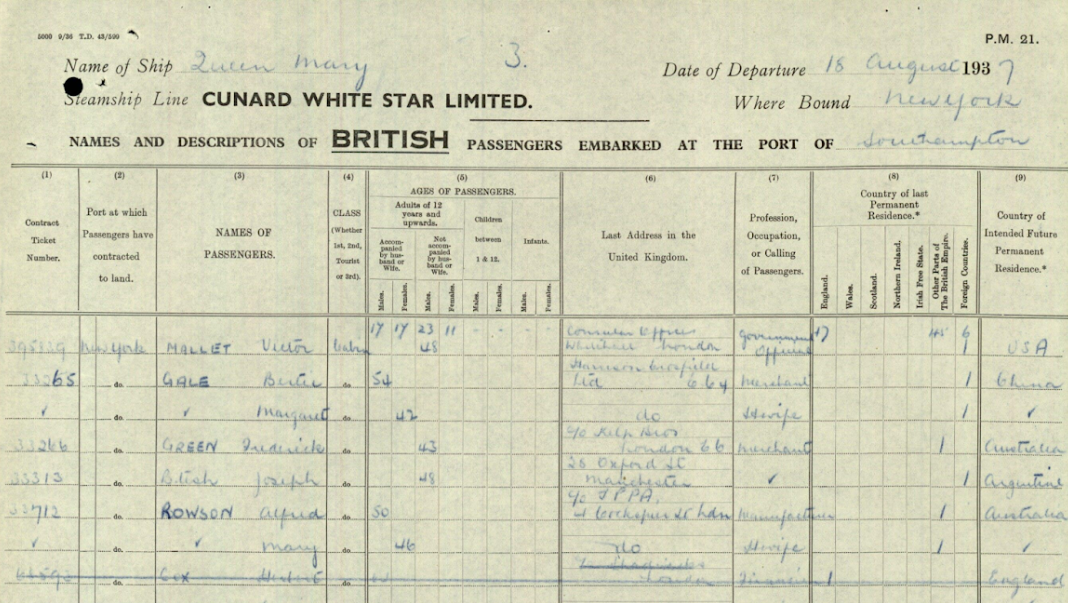
An excerpt from an outgoing passenger list from 1937
New insights: What the outgoing lists reveal
When you shift your focus to the departure, you uncover details that were often lost, mistranslated, or omitted during the Atlantic crossing. Here are the key insights these records provide:
1. Professional and economic reality
Inbound records might list an ancestor’s “intended occupation” in America, which was often aspirational. A farmer might say “laborer” because they knew that’s where the work was. However, the outgoing lists usually record their actual profession in their home country.
Furthermore, the class in which they traveled — First, Second, or Steerage — offers immediate context regarding their financial standing. Seeing that an ancestor traveled in a higher class might suggest they had liquidated assets or were of a higher status than previously thought. Conversely, seeing a family in steerage highlights the sacrifice made to afford the journey.
2. The “original” name and residence
The outgoing lists were often compiled closer to the ancestor’s home, making them more likely to feature the correct spelling of a surname. Perhaps even more importantly, these records typically include the passenger’s last permanent residence.
While a U.S. arrival record might simply say “Ireland” or “Great Britain,” an outgoing list might provide a specific village, parish, or even a street address. This specific detail is the “holy grail” for researchers looking to cross the ocean and begin searching local records in the land of origin.
3. Possessions and status
These records can sometimes offer a glimpse into the physical baggage of the journey. For many families, these lists represent the only surviving documentation of their departure. They capture the moment of maximum risk: when the ancestor had left their home but had not yet secured their future. Details about who they were traveling with (neighbors, cousins, or fellow villagers) are often clearer on departure lists, and the connection between these individuals reveals patterns of “chain migration” — where people from the same family or community emigrated in stages, following one another to the same destination — that can be obscured at the crowded arrival docks of the U.S.
The role of the British Isles as a global transit hub
It is a common misconception that these records are relevant only for those with British or Irish heritage. During the peak years of migration, the ports of the United Kingdom served as a massive transit hub for the entire world.
Thousands of immigrants from Scandinavia, Germany, and Russia would first travel to a port like Hull, cross England by train, and then depart for the United States from Liverpool. If you have hit a dead end searching for an Eastern European ancestor’s arrival, they may appear in the U.K. Outgoing Passenger Lists as they transited through Britain. Understanding the ships that brought immigrants to North America is key to tracking these complex, multi-stage journeys across the Atlantic.
Completing the circle: A bidirectional approach
To truly understand your family’s history, you need to view the immigration experience as a bridge between two worlds. By combining the data from the MyHeritage Wiki on Immigration to the U.S. with these newly available outgoing lists, you can reconstruct the entire journey.
Comparing the two records (inbound vs. outbound) allows you to spot:
Changes in intentions: Did they change their destination mid-voyage?
Name variations: How did the spelling evolve between the two ports?
Hidden companions: Did they leave with a group but arrive alone due to illness or different processing speeds?
Research the migration route of your ancestors
When researching your ancestors’ immigration, arrival records are only part of the story. While the inbound records at Ellis Island represent the beginning of their American story, the outgoing records from the U.K. and Ireland represent the life they were brave enough to leave behind.
Departure manifests can add important detail to what you already know about an ancestor, including their last place of residence, occupation, and family situation before emigrating. This perspective helps place immigration events in context and can clarify why and how an ancestor made the journey. If you have been searching for your ancestors’ arrival for years without success, it may be worth turning your focus back across the ocean to the ports where their journey began.
FAQs about migration from the UK to the US
Why should I look for outgoing records if I already have the arrival record?
Arrival records often contain phonetic errors or vague origins like “Germany.” Outgoing records were created in a familiar cultural context, making them more likely to feature accurate name spellings and specific last addresses. This detail is essential for identifying the exact village or parish where your ancestors lived.
My ancestors weren’t British; why would they be in U.K. Outgoing Passenger Lists?
The U.K. was a massive global transit hub. Thousands of immigrants from Scandinavia and Eastern Europe traveled to British ports like Liverpool to catch transatlantic ships. These passengers were recorded upon departure, meaning these lists are vital for anyone with European heritage, not just those with British roots.
Is it true that names were changed by officials at Ellis Island?
This is largely a myth. Names were usually changed later by the immigrants themselves to assimilate. Since arrival records were based on departure manifests, any “changes” were usually clerical errors. Outgoing lists provide a more authentic look at the name used before the influence of a new language.
What unique details do outgoing passenger lists reveal about an ancestor’s life?
These lists often record a passenger’s actual profession in their home country rather than their “intended” job in America. They also specify their travel class and last permanent residence. These details offer a clearer picture of their economic status and social identity before they began their new life.
How can U.K. emigration records help me understand “chain migration”?
On crowded arrival docks, groups were often split up during processing. Departure lists show who your ancestor was actually traveling with, such as cousins or neighbors. Identifying these companions can help you bypass “brick walls” by providing alternative names to research when your own family’s trail goes cold.