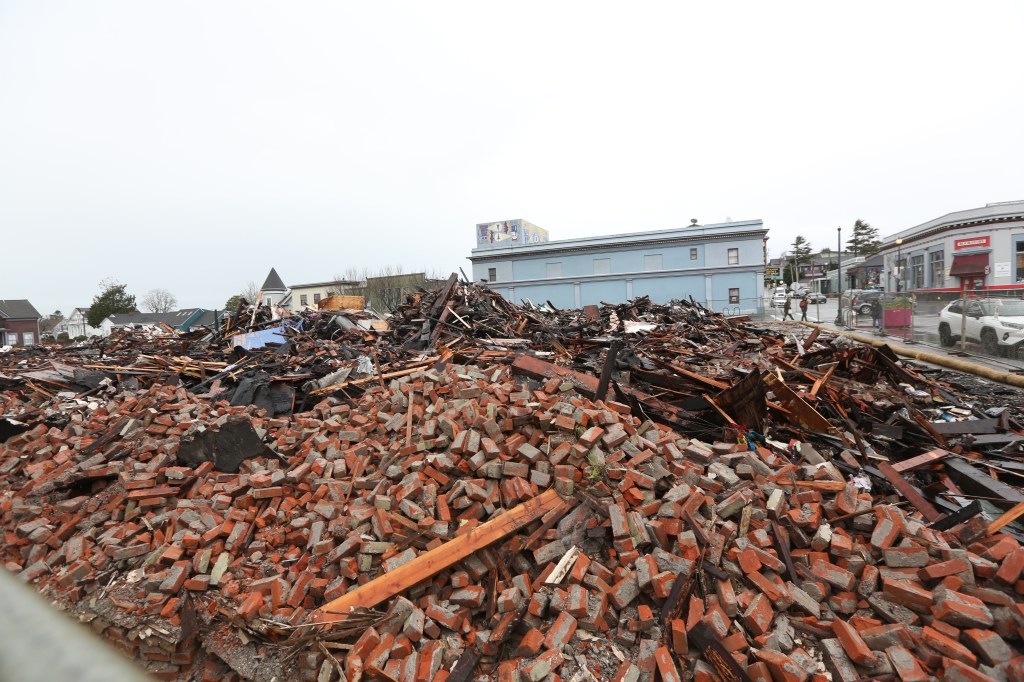
The fire that ravaged nearly a city block of downtown Arcata just north of Arcata Plaza early this month continues to challenge local authorities. The city, in conjunction with local and state partners, is continuing its ongoing efforts to investigate the cause of the fire, support displaced people and organizations, and assess and mitigate environmental impacts of the fire — which poured over two million gallons of runoff into storm drains that filter into Arcata’s surrounding sensitive estuarine environment.
The city is currently working in cooperation with state and local agencies, nonprofits and community members to recover from what is an ongoing emergency situation.
Arcata Mayor Kimberley White, who was appointed Mayor in December, having served on city council since 2022, described the fire as a “devastating event for our community.”
“I want to begin by acknowledging the extraordinary response that prevented an even greater loss,” White told the Times-Standard on Friday. “Thanks to the coordinated efforts of Arcata Fire District, Arcata Police, city staff, Cal Poly Humboldt and mutual aid partners, the fire was contained to a single block and did not spread to additional historic buildings or neighborhoods.
“Once the immediate threat to life and safety was controlled, the city’s focus shifted to what comes next: site safety, environmental protection and long-term recovery. The scale of the damage, the volume of debris and the potential for environmental contamination made it clear very quickly that this incident exceeded what our local resources alone could manage.”
White noted that the environmental impact of the fire was “a primary concern from the outset.”
“Approximately 2 million gallons of water were used to suppress a fire involving a paint store and older buildings,” White said. “Discolored runoff entering the storm system and nearby waterways raised legitimate concerns about off-site contamination. In response, the city immediately deployed best management practices such as straw wattles and other controls to contain runoff, secured the site with fencing and … coordinated closely with county Environmental Health.”
White said that a state of emergency was declared because the city and county lack the resources to “independently conduct the necessary environmental sampling, analysis and potential cleanup.” Humboldt County Sheriff William Honsal, whose office oversees the county’s Office of Emergency Services, declared an emergency on Jan. 3, the day after the fire, and Arcata City Council and the Humboldt County Board of Supervisors ratified that emergency the following week.
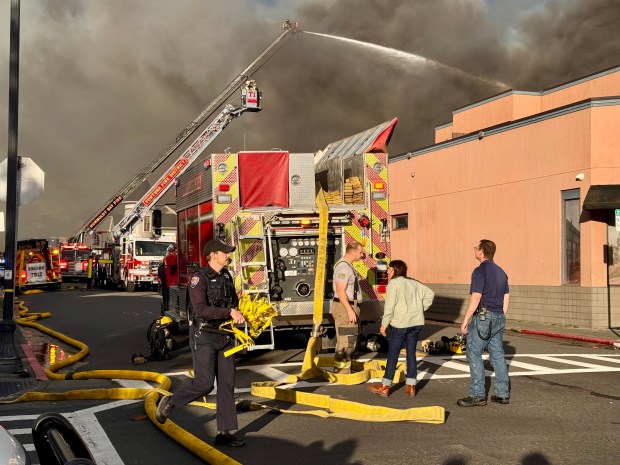 The Arcata Police Department works to establish a perimeter as Rio Dell Fire Department personnel arrive at the scene and begin to attempt to connect fire hoses. The Fortuna Fire Department’s ladder truck had arrived moments earlier, and was coming online to support Humboldt Bay Fire on the west side of the blaze. (Robert Schaulis/The Times-Standard)
“The purpose is to preserve our ability to access state resources,” White explained. “At this stage, the resources provided by the state have been primarily technical. Through Cal OES, we are receiving guidance from multiple agencies, including CalEPA, DTSC and CalRecycle. These agencies are advising on environmental sampling of nearby creeks and sloughs, as well as on appropriate approaches to debris handling and hazardous materials disposal. While direct cleanup funding has not yet been committed, this technical support is an essential first step in determining next actions.”
White said that it’s important for the community to realize that the site of the fire cannot be disturbed until the Arcata Fire District, allied agencies and insurance companies can complete their investigation of the cause of the fire.
Cal OES spokesperson Chris Dargan told the Times-Standard by mail this Wednesday that the agency “has been in close communication with Humboldt County and the city of Arcata since the onset of this fire and is committed to supporting communities impacted by disasters.”
Going forward, Dargan said, “any local government requests for assistance will be evaluated on their own merits.”
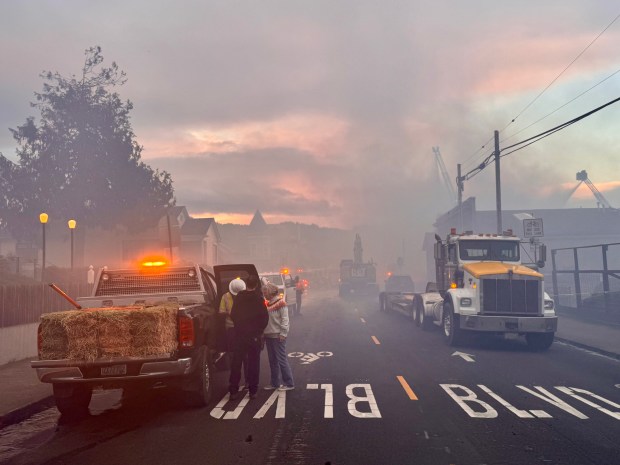 Crews worked to stage straw wattles and position excavators on the west side of the fire on the evening of Friday, Jan. 2. (Robert Schaulis/The Times-Standard)
Elected officials
At a special meeting of Arcata City Council last week, City Manager Merritt Perry noted that a number of elected officials, including Sen. Mike McGuire, had made several calls to offer support.
Assemblymember Chris Rogers was one of those elected officials. He said that, because of the high threshold for mobilizing federal emergency funds — which sits at around $70 million — it’s likely that those state funds will be critically important for Arcata as it works to clean up the site and surrounding environs.
“The state emergency is important, oftentimes, because that then means that the local jurisdiction has access to additional funds, and it also gets Cal OES involved in it,” Rogers told the Times-Standard last weekend. “And in this kind of a disaster, that’s particularly key when you talk about the debris removal process, the actual cleanup from a wildfire, or from a fire of this nature.”
Rogers noted that his office is currently working to ensure the smooth processing of Arcata’s requests to the state. He said that his office will likely be participating in local fundraising efforts as well.
“My role in this is one reaching out to make sure that if there are any roadblocks with the governor’s declaration, or if there’s any confusion about the partnership with CalOES or other agencies that we can just help clear it up,” Rogers said. “So, we have liaisons with each of these departments that we’re able to quickly help to mobilize.”
Rogers said that with aging infrastructure and the effects of climate change and sea level rise, the North Coast — already prone to a number of different disasters such as flooding, roadway slides and slippages, wildfires and earthquakes — could see more frequent need for emergency support from the state and federal government. He’s working on ways to get resources to communities impacted by local disasters that fail to meet the federal government’s fairly high threshold for an emergency declaration.
“… One of the things that I actually co-authored last year was a bill to increase the assistance for local jurisdictions that don’t meet that FEMA threshold,” Rogers said. “We weren’t able to get that one through, and we’re looking at whether or not to take another run at it this year. But our district in particular, whether it’s from road closures, whether it’s from salt water intrusion — we’re also dealing with right now, an area where we have sewage spillage into waterways from a waste treatment plant — there are a number of different types of disasters that we’re unfortunately getting more common.”
Rogers said that community members can always contact him and other local elected officials in times of crisis, and they will do what they can to mobilize support from state agencies.
“Whether it’s the Office of Emergency Services, whether it’s the Department of Motor Vehicles (or) the Franchise Tax Board, each of these California agencies, your local representatives, your state assembly members and your state senators, have direct liaisons to them,” Rogers said. “So whether it’s a disaster that we have to help engage with on Cal OES and decide on these emergency declarations — or even something as simple as somebody’s new registration stickers didn’t come in time from the DMV — we actually have direct contact with liaisons that can help assist in those programs and in those issues.”
Robert Schaulis can be reached at 707-441-0585.