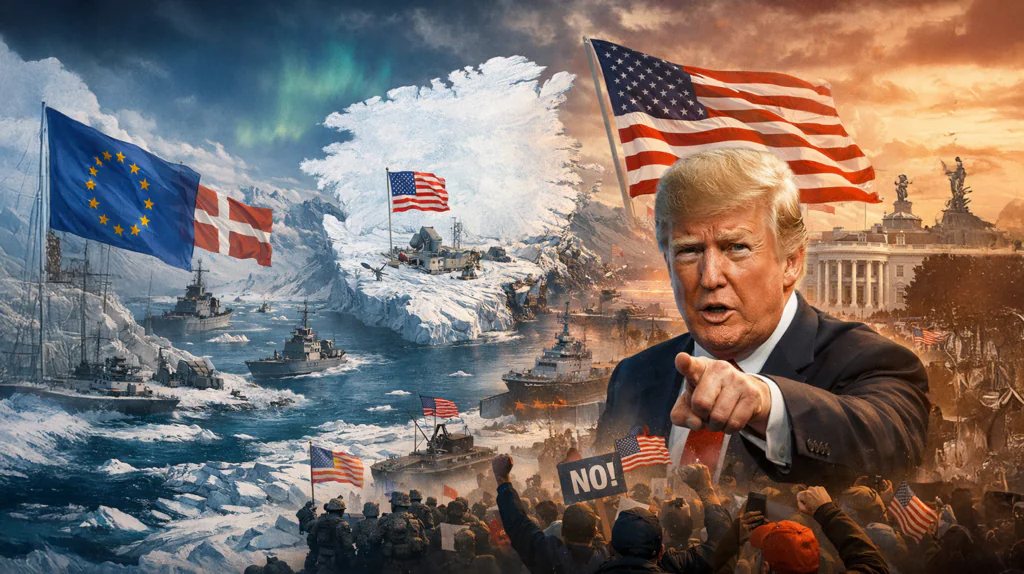
Europe’s response: between unity and uncertainty
The European Union reacted with a mixture of diplomatic restraint and the preparation of concrete countermeasures. On January 18, 2026, the EU Council Presidency convened an emergency meeting of the ambassadors of all 27 member states to develop a coordinated response. Ursula von der Leyen, President of the European Commission, warned of a dangerous downward spiral in transatlantic relations. She emphasized that tariffs would undermine transatlantic relations and create the risk of a dangerous downward spiral. Europe would remain united, coordinated, and determined to defend its sovereignty.
French President Emmanuel Macron described the tariff threats as unacceptable and declared that Europe would respond in a united and coordinated manner if the measures were confirmed. He announced that France would participate in the military exercise in Greenland organized by Denmark to demonstrate European solidarity. British Prime Minister Keir Starmer criticized the imposition of tariffs on allies in pursuit of the collective security of NATO partners as completely misguided. Swedish Prime Minister Ulf Kristersson stated that Sweden would not be intimidated and that only Denmark and Greenland could decide their future.
The EU is considering several options for countermeasures. The anti-coercion instrument, which entered into force in December 2023, offers the EU a wide range of response options to economic coercion by third countries. This instrument was originally designed as a response to Chinese trade restrictions against Lithuania and to earlier tariff threats from the first Trump administration. It allows the EU to impose retaliatory tariffs, restrict access to public procurement for US companies, limit financial services, or levy taxes on American technology companies, without requiring unanimity in the Council, but rather by qualified majority.
Bernd Lange, chairman of the European Parliament’s Committee on International Trade, called for the immediate activation of the Alternative Trade Incentive (ACI) and described Trump’s actions as crossing a new red line. He accused Trump of misusing trade as a tool of political pressure and demanded the suspension of the implementation of the EU-US trade agreement until the US withdraws its threats. Manfred Weber, chairman of the European People’s Party, stated that approval of the trade agreement was not possible at this time and that the 10 percent tariffs on US products should be suspended.
The EU faces a strategic dilemma. Retaliatory tariffs would not mitigate or eliminate any of the negative consequences of the US tariffs. On the contrary, they would exacerbate the economic damage to the European economy. Studies by the Kiel Institute for the World Economy show that if the EU were to fully retaliate, GDP losses for Europe would increase from 0.2 to between 0.3 and 0.4 percent, while simultaneously severely impacting global trade as a whole. The real danger lies not in the direct effects of individual tariffs, but in the escalation of a tariff spiral that, in the worst-case scenario, could lead to a global economic crisis similar to that of the 1930s.
For this reason, the EU is initially focusing on dialogue and a phased approach. EU Trade Commissioner Maroš Šefčovič is shuttling between Brussels and Washington to achieve as much as possible through negotiations without resorting to retaliatory tariffs. The European Commission generally does not react to mere announcements of tariffs, but only when they are actually implemented. This approach aims to test Trump’s willingness to withdraw the threats without provoking an escalation.
Suitable for:
The danger to NATO and the transatlantic security order
The most serious consequences of Trump’s Greenland policy do not concern trade policy, but rather the West’s security architecture. NATO Secretary General Mark Rutte stated that all alliance partners agree that security in the Arctic is a priority. The Arctic is a strategic region that opens up new routes, but also carries the risk of increased Russian and Chinese activity. However, the threat of tariffs against allies participating in a joint NATO exercise in Greenland fundamentally undermines confidence in the American guarantee of mutual defense.
Article 5 of the NATO Treaty states that an attack on one member is considered an attack on all. Greenland, as part of Denmark, is protected by this article. Should the US attempt to bring Greenland under its control by military or economic means, this would completely destroy the credibility of Article 5. If the most powerful NATO partner is prepared to annex the territory of another member against its will, how can the alliance’s defense guarantee still be considered credible? The Danish chairman of the Defence Committee, Rasmus Jarlov, stated that Denmark would defend its territory and invoke Article 5 in the event of a US attack.
The implications for Europe are far-reaching. Trump’s argument that he can only defend what he owns calls into question the entire American security guarantee for Europe. Guntram Wolff of the Bruegel think tank emphasized that this logic means Article 5, the US president’s support for European security, can no longer be taken for granted. Former US Ambassador to NATO Julianne Smith warned that the Greenland dilemma could break the EU and pose an existential challenge to NATO. She urged European leaders to take Trump’s statements seriously and consider proactive measures, including new defense agreements.
Camille Grande, a leading French security expert, emphasized that the tensions surrounding Greenland highlight the urgent need for Europe to reduce its security dependence on the US and present a united front. Europe remains heavily reliant on the US in many critical areas, including intelligence and airspace capabilities. Discussions within NATO reveal that even in private conversations, European member states struggle to fully grasp the implications of a potential US military intervention in Greenland.
Long-term consequences for the international order
The economic and security disruptions caused by Trump’s tariff policies extend beyond immediate trade effects. They represent a fundamental attack on the rules-based international order established after World War II. The World Trade Organization system is based on the principle that trade disputes are resolved through multilateral negotiations and legal processes, not through unilateral coercive measures. Trump’s repeated disregard for WTO rules and his willingness to use trade instruments for non-trade-related political objectives undermine the foundations of this system.
The use of economic sanctions to coerce territorial concessions sets a dangerous precedent. If the US, as the most powerful actor in the international system, demonstrates that territorial integrity and sovereignty can be violated through economic coercion, it encourages other powers to pursue similar strategies. China could argue that its claims in the South China Sea or on Taiwan can be enforced through similar methods. Russia could justify its aggression against Ukraine with comparable arguments.
The irony lies in the fact that Trump justifies his Greenland ambitions with the threat posed by Russia and China, while his actions actually strengthen those very actors. Kaja Kallas, Vice-President of the European Commission and EU High Representative for Foreign Affairs, emphasized that Trump’s announcement would likely be welcomed by China and Russia, as both benefit from divisions among their allies. The Chinese and Russian leadership are closely watching how the West reacts to this crisis. A successful US attempt to blackmail Denmark would signal that might makes right and that territorial claims can be enforced through economic and military pressure.
This creates a precarious situation for Germany and the German economy. Germany’s high export dependence on the US, particularly in strategically important sectors such as pharmaceuticals, automotive, and mechanical engineering, makes it vulnerable to American trade pressure. At the same time, the Greenland crisis demonstrates that Germany can no longer rely on American security guarantees. The consequence is a dual dependence coupled with a diminishing reliability of its partner. In the coming years, Germany must make substantial investments in its own defense capabilities while simultaneously attempting to diversify its export markets to reduce its reliance on individual partners.
The Danish and Greenlandic positions demonstrate that small states and territories can only withstand the pressure of a major power with the support of their allies. The majority of the Greenlandic population strives for independence from Denmark but clearly rejects a takeover by the United States. A survey showed that Greenlanders want to determine their own future, not through external powers. The economic reality of Greenland, which is two-thirds dependent on Danish subsidies, makes complete independence unrealistic in the short term. However, the alternative of subjugation to the United States is considered even less acceptable by the population.
Europe’s wake-up call: The post-war order is crumbling – what must follow now?
Further developments depend on several factors. First, it is unclear whether Trump will actually implement the announced tariffs. His presidency has been characterized by repeated threats that have not always been translated into concrete action. Massive opposition at home, including from within his own party, could lead Trump to refrain from implementation. The US Supreme Court is currently examining the legality of Trump’s authority to impose tariffs under the guise of economic emergency powers. A ruling against Trump could significantly restrict his ability to act.
Secondly, the question arises as to how the EU will react if the tariffs actually come into force. A phased response seems likely, beginning with WTO complaints and political pressure, followed by selective retaliatory tariffs if negotiations fail. Activating the anti-coercion instrument would allow the EU to take measures that go far beyond traditional trade tariffs and also encompass services, investment, and access to public procurement. However, political resolve within the EU is not uniform. Some member states, particularly those with strong transatlantic ties, may shy away from escalation.
Third, the Greenland crisis could lead to a fundamental reorientation of European security and defense policy. The realization that Europe can no longer rely on American security guarantees strengthens the arguments for a European defense union and increased defense spending. France and Germany have already undertaken initiatives in this direction, but the Greenland crisis could be the catalyst for accelerated integration. The challenge lies in the fact that Europe is still years away from genuine autonomy in many key military areas, from strategic airlift and satellite reconnaissance to precision munitions.
Fourth, the question of Arctic governance is crucial. The Arctic will become increasingly important for global trade, resource extraction, and military positioning in the coming decades. A multilateral framework that considers the interests of all Arctic and near-Arctic states would be in the interest of global stability. However, Trump’s unilateral approach undermines efforts toward cooperative governance and threatens to turn the Arctic into an arena for great power rivalry. Russia has already invested heavily in Arctic military bases and infrastructure and responded to Trump’s Greenland threats by announcing its intention to further expand its defense capabilities and infrastructure in the Arctic.
Economic analysis shows that all parties involved would lose from an escalation. The US would suffer the most, followed by the directly affected European economies. Germany, as an export-dependent economy, is particularly vulnerable, but also has options for mitigating risk through market diversification and strengthening intra-European trade relations. However, the long-term costs of destroying the transatlantic partnership would be immense for all sides, not only economically, but also in terms of security policy and the West’s ability to respond to challenges from authoritarian regimes.
The Greenland crisis reveals fundamental fault lines in the transatlantic relationship that extend far beyond the term of a single president. It demonstrates that, under certain political constellations, the US is prepared to sacrifice fundamental principles of the international order in order to enforce national interests as defined by the respective administration. For Europe, this means that the post-war order, in which European security and prosperity seemed guaranteed under American protection, is irrevocably over. The question is no longer whether Europe must become more independent, but how quickly and how radically this process can be carried out.