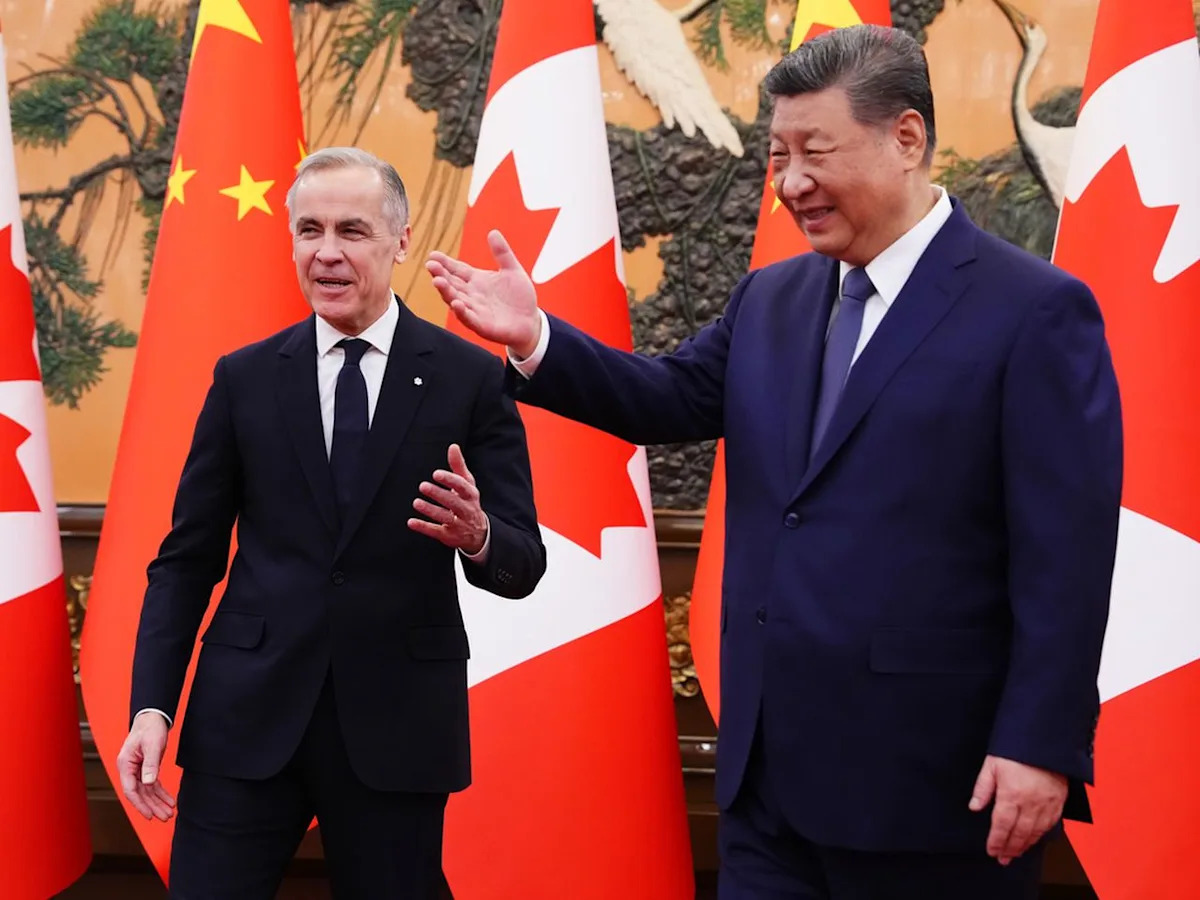
As Prime Minister Mark Carney wraps up his first official trip to Beijing, the focus for Canadian citizens may fall on the deal involving Chinese electric vehicles and Canadian canola. But there are strategic implications for Canada to ponder: The People’s Republic of China has been increasing its influence in not only the global south, but also the Arctic and Indo-Pacific including Taiwan.
Carrying a name that has the opposite meaning of the real action, ”Justice Mission 2025,” the People’s Liberation Army once and again conducted another military exercise surrounding Taiwan at the end of last year. Probably the exercise itself was not as tragic or dramatic as the war in Ukraine, the Venezuela episode, the anti-government protests in Iran, or the anxiety for Greenland to defend its sovereignty. International news outlets always compare the situation in the Taiwan Strait to those crises because of China’s expansionist approach to these regions and its implication for peace in the world.
As China has allied with Russia on the frontlines of the Ukrainian war and significantly increased its “Polar Silk Road” initiative investments in the Arctic Circle, it also conducts intensive grey-zone tactics toward Taiwan, including media infiltration, economic coercion, transnational repression as well as sabotaging undersea cables that are key to communications across the Western Pacific Rim. It attempts to weaken Taiwan’s democracy and undermine the peace and stability of the Taiwan Strait. While over half of the global container traffic passes through this international waterway each year, the magnitude of any fallout should not be underestimated. Any conflict which arises from the Taiwan Strait will impact the world, including Canada.
We appreciate every statement that Canada and G7 nations issued after the “un-justice mission” by the PRC. But it would be more effective if the free world — including Canada — stands firm to engage with Taiwan and continue to send warships to conduct routine patrol in the Taiwan Strait for deterrence purposes while it talks to China on trade, energy and agriculture.
The issue of Taiwan is not an isolated bilateral talking point, but an overwhelming concern on international security for stakeholders in the region. Besides, China has weaponized trade with Canada in the past and may very well do so again if Canada undertakes actions in the future to safeguard Canadian citizen’s human rights from China’s transnational repression, to find ways to deal with overcapacity and non-market behaviours from China, or defend rules-based international order that does not suit the PRC’s purported “core interests.”
Taiwan has experienced this firsthand; when our government stood firm in defending Taiwan’s national sovereignty, authorities in Beijing started to issue vexatious warrants against our politicians, and prohibited Chinese companies from importing a wide range of Taiwanese agricultural products such as pineapples, sugar apples, and groupers for a while. Much like how they targeted Conservative MP Michael Chong’s family, the Chinese Communists publicly doxxed Taiwanese parliamentarian Puma Shen by publishing satellite photos of his home and workplace.
As geopolitics have changed how countries interact and global supply chain is now tied more to national strategy than globalization, many transnational companies have re-shored or friend-shored to invest in democratic countries where regulations are rather transparent and predictable.
However, Canada seems to seek a new economic equilibrium with China when free markets and multilateralism give way to new tariffs and protectionism.
As Prime Minister Carney has met his PRC counterpart on trade and re-engagement, we hoped he had firm guardrails and expressed Canada’s support for a peaceful status quo in the Taiwan Strait.
Taiwan, like so many other stakeholders in the region, is ready to deepen its partnership with Canada to establish reliable, resilient, and predictable supply chains defined by strong protections on intellectual property and rigorous protocols on fair trade. From critical minerals to liquified natural gas and carbon capture to artificial intelligence, we can advance the frontiers of innovation and open new pathways to prosperity.
— Angel Li-hsin Liu is the Director General of the Taipei Economic and Cultural Office in Vancouver, Taiwan’s de facto consul general in Vancouver.