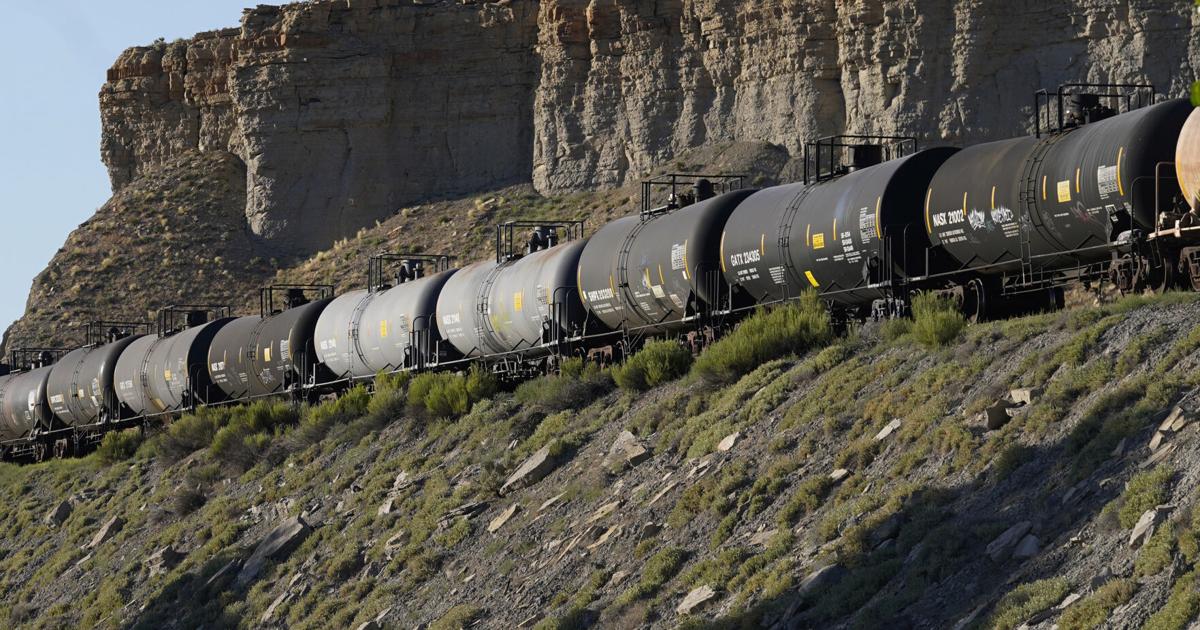
A Utah coalition is asking a federal agency to do little additional environmental review and reaffirm a decision approving an oil train project decision, while others are pushing for a deeper dive in order to adequately address impacts including environmental threats along the Union Pacific railroad in Colorado.
Advocates for taking that closer look are pointing in part to a train wreck along the Gunnison River in December as an example of the kind of environmental impact that could result if the Utah project goes forward.
The Seven County Infrastructure Coalition in Utah has asked the Surface Transportation Board to reaffirm its prior approval once lingering environmental legal issues have been settled. The coalition has indicated in a motion to the board that some of that can be accomplished by the board simply better explaining the rationale behind parts of its previous decision rather than doing more environmental analysis.
The coalition argues that the board should promptly respond to issues in a federal appeals court decision that weren’t addressed by the U.S. Supreme Court in a ruling last year and reaffirm its decision authorizing the construction and operation of the Uinta Basin Railway.
The federal board previously approved an 88-mile railway in northeastern Utah that would facilitate shipments of potentially as much as 350,000 barrels of oil a day through Colorado and to the Gulf Coast. Last May, the high court unanimously reversed aspects of a federal appeals court ruling overturning the board’s approval.
The high court ruled that the District of Columbia Court of Appeals incorrectly interpreted the National Environmental Policy Act to require the board “to consider the environmental effects of upstream and downstream projects that are separate in time or place from the Uinta Basin Railway.” Those projects include oil and gas development in Utah that would provide the product carried by the trains and the refineries that would process it along the Gulf Coast.
The high court didn’t review some findings by the lower court that went against the Utah rail proponents, including its finding that the Surface Transportation Board violated the Endangered Species Act by failing to account for spill impacts. After the high court decision, the appeals court remanded the case to the Surface Transportation Board for further action without vacating the board’s original decision.
According to the coalition’s filing, the board only needs to make clear why the Endangered Species Act “action area” covered in its approval decision “properly excluded parts of the Colorado River hundreds of miles downline.” The coalition argues that “the causal chain between the new railway and any harm to listed fish in the Colorado River is far too attenuated to meet the ESA’s ‘reasonably certain to occur’ standard,” and the candle-like waxy crude oil produced from the Uinta Basin “is so easy to clean up, it poses no threat.”
The Colorado River in Colorado is home to several fished federally listed as endangered or threatened.
In a letter to the Surface Transportation Board, Dan Gibbs, executive director of the Colorado Department of Natural Resources, noted that the federal appeals court vacated a U.S. Fish and Wildlife Service biological opinion related to the project approval, and that agency must issue a new one before the board can complete the remand. The Fish and Wildlife Service opinion adopted an action area including the area of the Upper Colorado River Basin affected by water depletions but not the area affected by train accidents that release crude oil, Gibbs wrote.
“We strongly urge the board to conduct additional environmental analysis to avoid, mitigate, and minimize impacts to the Colorado River and resident aquatic wildlife species,” Gibbs wrote.
He said that the recent train derailment and release of pollutants along the Gunnison River illustrate the sensitive ecosystems at risk.
A rockslide on Dec. 2 resulted in two locomotives derailing into the river along with three additional rail cars south of Whitewater. Two engineers were rescued from the flooded train. The Environmental Protection Agency estimates that more than 8,000 gallons of fuel were likely released to the river and its shoreline.
Eagle County and conservation groups are parties to the oil train legal case. Eagle County argued in a filing with the Surface Transportation Board that the appeals court found the board violated NEPA by failing to consider reasonably foreseeable impacts to downline Colorado communities, “violations which the Supreme Court did not address in its review … and which remain binding on the Board.” Communities are concerned about potential impacts such as trains sparking wildfires or spilling oil into the Colorado River.
The Utah coalition argues that the Supreme Court ruling absolves the Surface Transportation Board of the need to consider such indirect, downline impacts. But if the board still wants to address them, “it can do so without much work,” as the appeals court’s discussion of downline effects “focuses on the need for more explanation, not more analysis,” it said in its filing.
Eagle County argues that the appeals court ruling requires the board to conduct a supplemental environmental impact statement to consider the risk of accidents, increased wildfire risks and impacts along the Colorado River. It is arguing for the board to reverse its original decision approving the rail project and require the coalition to submit an application for the railway.
Environmental groups involved in the case, Colorado Attorney General Phil Weiser, U.S. Rep. Joe Neguse, D-Lafayette, and U.S. Sen. Michael Bennet, D-Colo., also are calling for measures including robust additional environmental review of the project by the board.
Bennet and Neguse wrote to the board, “Train accidents and spills are not rare, as the recent derailment of a coal train into the Gunnison River underscores. … A wide range of local governments, water districts, and other stakeholders along the Union Pacific rail line continue to have grave concerns about the risks of the project. We urge the Board to carefully consider those concerns before rendering a decision that could jeopardize the water supplies, environment, and livelihoods of hundreds of thousands of Coloradans. Without a robust analysis and full public review, the errors identified in the D.C. Circuit Court’s original decision would remain unaddressed, and the legitimacy of the Board’s action would be undermined.”
On Thursday, E&E News reported that Roger Stone, a longtime advisor to President Trump, is lobbying for Uinta Basin Railway Holdings, the company trying to develop the Utah rail line. Stone’s Drake Ventures disclosed the lobbying agreement in a congressional filing saying the company is working on railroad construction in Utah. Stone is a convicted felon pardoned by Trump.