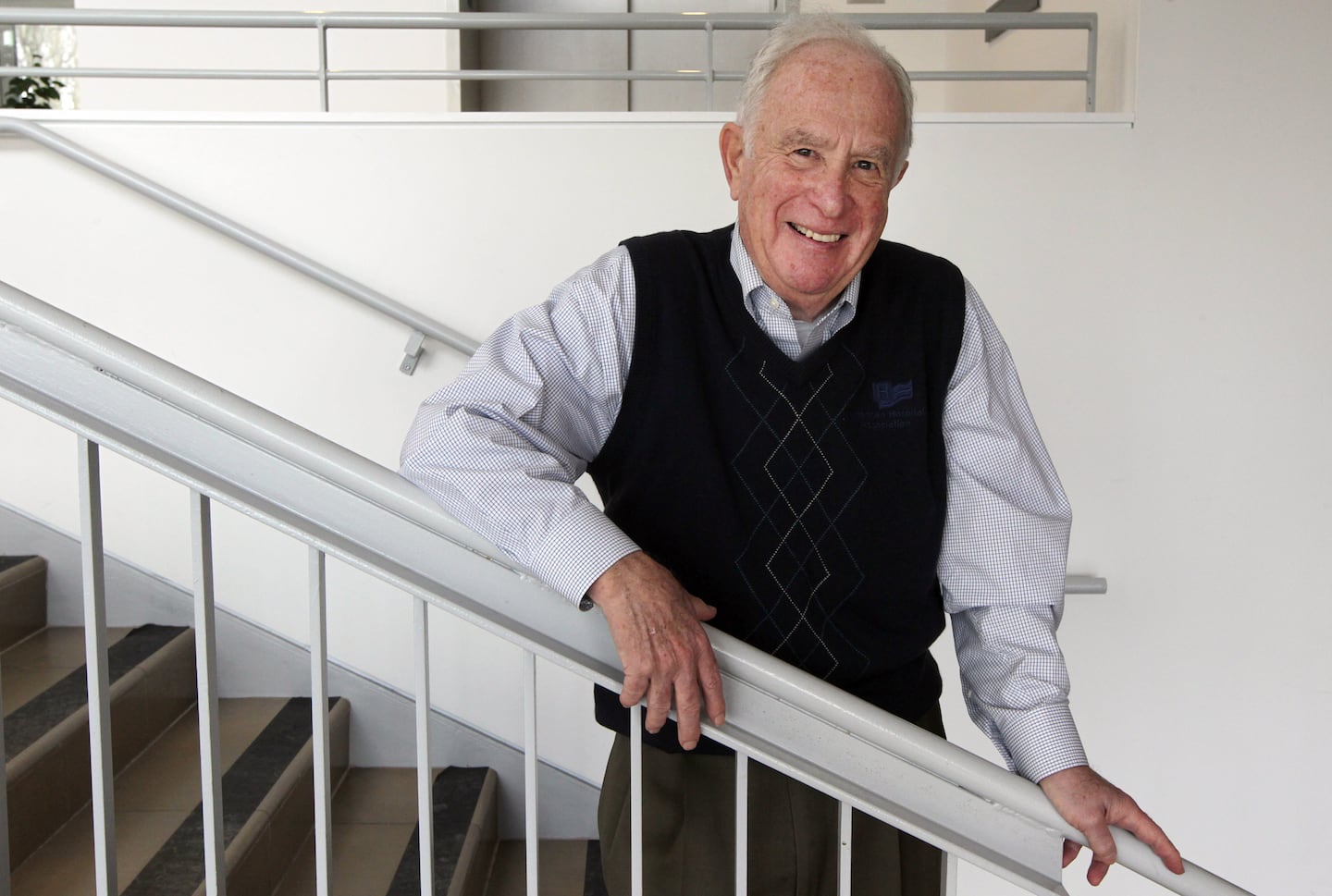
In Massachusetts, he had served as interim president of Brandeis University, his longtime home as a professor, and he was appointed by governors Deval Patrick and Charlie Baker to lead the Massachusetts Health Policy Commission.
With humor and self-effacing nonchalance, Dr. Altman was never grandiose about his contributions. “I’m not political; I’m an analyst,” he told the Jewish Healthcare Foundation in 2025. “I just want to understand the problem and help solve it.”
Dr. Altman died Jan. 1 in North Carolina, where he had lived in Chapel Hill after many years in Massachusetts. He was 88, had been diagnosed with pancreatic cancer last fall, and subsequently delivered a guest lecture to a final class of students by Zoom a month before he died.
While discussing the complexities of health care policy, he often invoked the women in his life — his mother, his wife, his three daughters, and his five granddaughters.
To the chagrin of some of his male academic superiors in the early 1960s, Dr. Altman championed the idea — in that era often unwelcome and unpopular — that women would permanently change and improve the workplace, and that they were there to stay.
“That’s my role in life, to be an expert on women in the labor force,” he said in a 2007 oral history interview with the University of Virginia’s Miller Center. “I had written my dissertation on unemployed married women, and I wrote a book on nurses, and that’s what got me into health care.”
In Brandeis’s tribute, Constance Horgan, professor and codirector of the Schneider Institutes for Health Policy and Research, recalled that Dr. Altman “frequently mentioned his mother’s understanding of some of the implications of Medicare issues. It was always very funny when he paraphrased her, saying something like, ‘Now Stuart, do you know what Medicare is now trying to do to me? What are you going to do about it?’”
Dr. Altman never stopped trying to do something, including while leading the Massachusetts commission that was formed to “to improve health care delivery, lower costs, and reduce health disparities.”
“As long as I can keep at it, I’m going to keep at it,” he said, at 85, in an interview with his daughter Heather Altman of Chapel Hill, N.C.
Dr. Altman “brought to every interaction not only brilliance and rigor, but kindness and care, and was an exceptional colleague and mentor,” said Sara Shostak, dean of the School of Social Sciences and Social Policy at Brandeis.
He was the Sol C. Chaikin professor of national health policy, emeritus, at the university’s Heller School for Social Policy and Management, and was interim president of Brandeis in 1990 and ’91. In his career, he also taught at Brown University, the University of California, Berkeley, and the University of North Carolina.
David Seltz, executive director of the Massachusetts Health Policy Commission, said in a statement that “our country has lost a legend.”
Dr. Altman, the commission’s inaugural board chairman, “dedicated his life to public service and was committed to realizing the vision of a health care system that is affordable and accessible for all,” Seltz said. “The world is a better place for his having lived in it.”
Born on Aug. 8, 1937, Stuart Harold Altman grew up in the Bronx borough of New York City, the oldest of three siblings.
His father, Sidney Altman, was a draftsman, and his mother, Florence Brown Altman, became a bookkeeper when her youngest was a teenager — an example that helped prompt Stuart’s eventual scholarly research on employment challenges for married women in that era.
Dr. Altman met Diane Kleinberg at a dance when they were teenagers, and they married in 1959. Diane, who died in 2020, had worked in the probation department of the Quincy District Court.
After Dr. Altman graduated from City College of New York, he received an economic doctorate from the University of California, Los Angeles.
He subsequently worked at the Federal Reserve in Washington, D.C., and then for the US Defense Department, which was then trying to figure out the economics of creating an all-volunteer military.
In 1971, he joined what was then the US Department of Health, Education, and Welfare as deputy assistant secretary when Nixon, a Republican, was in the White House.
At the time, US Senator Edward M. Kennedy, a Massachusetts Democrat, and labor officials were trying to create “a nationalized health insurance system for everybody,” Dr. Altman told the University of Virginia.
When Caspar Weinberger was HEW secretary, Dr. Altman was directed to create what became known as the Comprehensive Health Insurance Plan, which “would cover every American; it would expand employer-based insurance; it would mandate that every employer had to provide it,” Dr. Altman said.
This was “not a nickel-and-dime plan,” he recalled in the oral history interview.
The ambitious proposal was supported by Kennedy in the Senate and by Wilbur Mills, an Arkansas Democrat who chaired the powerful House Ways and Means Committee.
But it faltered as an affair between Mills and the then-popular stripper known as Fanne Foxe became public, including news coverage of a night when an intoxicated Mills joined her on stage during her performance in Boston’s Combat Zone neighborhood.
The resulting publicity prompted Mills to step down as Ways and Means chairman, and the national health care proposal essentially vanished with him.
“I have told this story a hundred times, that if it wasn’t for Fanne Foxe, we might have had national health insurance in 1974,” Dr. Altman told the University of Virginia.
His books include 2011’s “Power, Politics, and Universal Health Care: The Inside Story of a Century-Long Battle,” which he cowrote with David Shactman.
Dr. Altman worked successfully with Democratic and Republican presidents “because he was genuine and authentic; because he listened to and respected those with different opinions; skills so wanting in today’s environment, that they seem to come from a bygone era,” Shactman emailed in a remembrance.
In addition to his daughter Heather and five granddaughters, Dr. Altman leaves two other daughters, Beth Altman Marcus of Westwood and Renee Altman Nefussy of Natick; his brother, Edward of New York City; and his sister, Ellen Stein of Walnut Creek, Calif.
A celebration of Dr. Altman’s life and work will be announced.
“The same things that people saw professionally, we saw personally: his warmth and humor, and his love and pride of all of us,” Heather said.
Dr. Altman accompanied his granddaughters on college tours, wore sweatshirts from their colleges, and “always wanted to see us, to hang out with us, and support all of us in every way,” Rene said.
And while he never ceased advocating for an ambitious, comprehensive form of national health coverage, he drew from the wisdom of his experience and his ready humor when the University of Virginia interviewer asked in 2007 if he thought that would ever happen.
Dr. Altman laughed while saying that someone once “asked God, ‘Will America ever have national health insurance?’”
God’s reply? “Absolutely, just not in my lifetime.”
Bryan Marquard can be reached at bryan.marquard@globe.com.