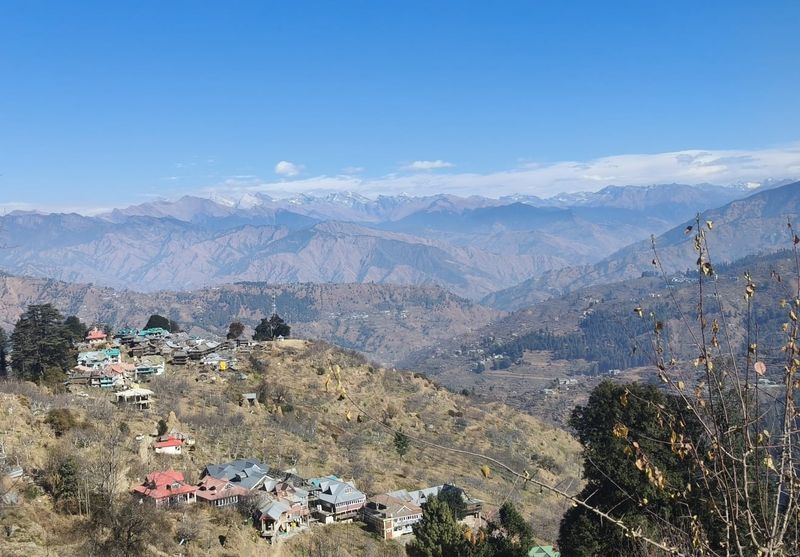
Despite peak winter, mountains such as Chanshal in Shimla district and Churdhar in Sirmaur remain bereft of snowfall. Kinnaur’s Kinnar Kailash has only traces of snow, while Chamba’s higher reaches are covered with light layers. At this time of year, these mountains are usually buried under several feet of snow. Locals are shocked to see the ranges bare in mid-winter.
“I’ve grown up watching the Chanshal range and have never seen it without snowfall in winter. These mountains remain snow-covered even in summer, let alone winter,” said Harish Chauhan, an apple grower from Jubbal. “The only time it is without snow is during the monsoon. From October onwards, snow usually starts piling up,” he added.
For Lalit Mohan, a mountaineer from Kotgarh in Shimla district, waking up to the snow-clad Kinnar Kailash range has been a childhood routine. “From my place, a large portion of the range is clearly visible. The snow cover has been thinning over the last few years, but what we are seeing this time is unprecedented. There is hardly any snow, just traces,” he said. “It’s not just snow that is dwindling. While mountaineering, when we revisit places we were at two or three years ago, we find glaciers have shrunk significantly. The situation is alarming,” added Lalit, a member of the Indian Mountaineering Foundation and its Glacier Preservation Committee.
Why are mountains rising above 12,000 feet not receiving snowfall even during peak winter? The weather department attributes this to weak western disturbances. “The Western Himalayan region did not receive strong western disturbances this winter. That appears to be the immediate reason for the lack of snowfall,” said a weather official.
Environmentalists, however, link the trend to rising greenhouse gas emissions, unsustainable development and mushrooming of high-energy consuming industries. “Average temperatures in the Himalayas are rising faster than the global average. Over-tourism, high vehicular emissions and large construction projects are major contributing factors,” said Kulbhushan Upmanyu, a Chamba-based environmentalist. “Large-scale deforestation for wider roads, hydel projects and mining is also causing irreparable environmental damage,” he added.