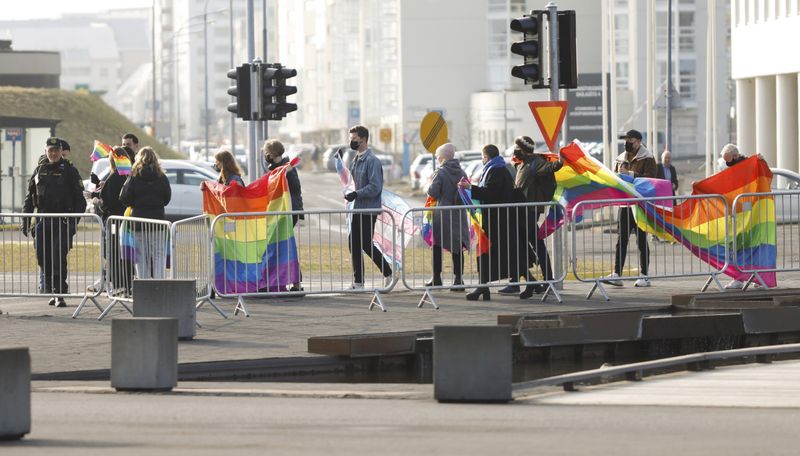
US President Donald Trump’s rhetoric has heightened Iceland’s security concerns as great power rivalry has surged in the Arctic region in recent years, raising the stakes and risks for small states.
When Donald Trump openly spoke about acquiring Greenland and later saw his envoy joke about Iceland becoming the United State of America’s “52nd state”, many in the Arctic stopped laughing. What sounded like bravado in Washington appeared very differently in Reykjavík. For Icelanders, these remarks revived old fears about how great powers treat small states when strategic interests matter. They know that the Arctic has become a terrain of power – routes, cables, minerals and military calculations. The US President’s posture, combined with growing rivalry in the High North, has forced Iceland to rethink its security, its alliances and even its future place in the world.
A small state with a long memory
Iceland’s political culture has been shaped by both independence and vulnerability. Settled in the ninth century, it created one of the world’s earliest parliaments, the Alþingi, in 930. But its long history was also one of subordination, first to Norway and then to Denmark. Full independence came only in 1944, during the Second World War, when Denmark was under Nazi occupation. That experience left a lasting impact.
Icelanders value sovereignty deeply and remain alert to signs of external pressure. The country has no army, a population of under 4,00,000 and depends heavily on diplomacy, international law and alliances for survival. Its economy rests on fisheries, renewable energy, tourism and a highly connected digital infrastructure. Its location between North America and Europe gives it importance far beyond its size.
During the Cold War, Iceland became a central North Atlantic Treaty Organisation (NATO) outpost. The US military presence at Keflavík was justified as protection against Soviet submarines crossing the Greenland-Iceland-United Kingdom (GIUK) gap. After the Cold War, that presence receded. In 2006, US forces left the base and many Icelanders believed geopolitics had softened for good. That assumption no longer holds.
Why Iceland is uneasy today
The unease in Iceland began with Trump’s repeated statements about buying Greenland, followed by remarks by US officials hinting that military options were not off the table. This altered how Iceland viewed American intentions. When Billy Long, Trump’s pick for ambassador, joked about Iceland becoming the 52nd state, it struck a nerve because it marked a shift in tone and posture.
The public response was swift. A petition demanding rejection of Long’s appointment gathered thousands of signatures. Icelandic leaders from across the political spectrum warned that such remarks showed a lack of respect for small states. The Foreign Ministry formally sought clarification from the US embassy.
Also read: Fact Focus: Trump Repeats False Claims When Discussing Greenland’s Security in the Arctic
The concern extends beyond rhetoric. Icelanders view Washington’s behaviour with alarm. Greenland is discussed as a strategic asset, security is framed in terms of control and allies appear increasingly treated as instruments rather than partners. Polls now show that nearly three quarters of Icelanders view Trump’s Arctic posture as a threat. The fear is real – that Iceland’s voice could matter less as larger powers redraw Arctic priorities.
Why the Arctic matters now
The Arctic has become central to global power for three reasons. First, climate change is opening new sea routes. The Northern Sea Route along Russia’s coast is already being used for commercial shipping. Control of these routes shortens travel between Asia, Europe and North America. Second, the Arctic holds vast reserves of minerals, energy and rare earths. Greenland is the most visible example, but Iceland sits on key transit lines connecting Arctic waters to the Atlantic. Third, the region has returned to military importance: Russian submarines operate from the Kola Peninsula, China has declared itself a “near-Arctic state” and invested heavily in Arctic infrastructure, NATO now treats the region as a frontline zone.
Iceland lies at the heart of this geography. The GIUK gap remains essential for monitoring naval movement. Undersea cables carrying internet traffic between Europe and North America pass close to Iceland’s shores. Any disruption would have global consequences. This is why the US has returned to Keflavík, rotating aircraft and increasing surveillance since 2016. It is also why the country’s policy documents describe Iceland as a “critical node” in Arctic security.
Security, influence and control
From Washington’s perspective, Iceland is geopolitically indispensable. US strategy treats the Arctic as a zone where Russian military power must be contained and Chinese influence limited. The 1951 defence agreement gives the US responsibility for Iceland’s defence, even though the country has no army of its own. Recent US documents emphasise surveillance of Arctic shipping routes, protection of undersea cables, monitoring Russian naval activity, limiting Chinese economic presence and maintaining NATO dominance in the North Atlantic.
The Heritage Foundation and US defence planners argue that Iceland should host expanded air patrols and deeper military coordination.
At the same time, Washington seeks stronger economic influence. China has become one of Iceland’s largest export markets and the US sees this as a strategic risk. Energy cooperation, technology investment and public diplomacy now form part of US policy towards Reykjavík.
However, this approach obviously creates tension. Iceland depends on the United States for security but fears becoming trapped in a rivalry it did not choose. Currently, it does not face invasion, but the threats are subtler. From the US, the risk lies in overreach. Trump’s statements have led Icelanders to question whether alliance still means consent. The fear centres on pressure, leverage and loss of agency.
Also read: Trump’s Greenland Obsession Takes Centre Stage as the Vances Visit US Base
From Russia, the concern is military activity and hybrid tactics. Submarine movements, cyber operations and threats to undersea cables worry Icelandic planners. Russia’s war in Ukraine has undermined much of the trust that once underpinned Arctic cooperation. From China, the risk is economic dependence. Investment in ports, data infrastructure and energy projects raises concerns about long-term leverage, even in the absence of a military threat.
Internally, Iceland faces structural vulnerability. It relies on imports for fuel and medicine, has limited emergency stockpiles and depends on four undersea cables for digital connectivity. Any disruption could have severe consequences.
How Icelanders see the moment
Public opinion in Iceland is shifting. For decades, NATO membership was accepted with little debate. Now, questions are being asked about whether reliance on a single power is wise. European Union (EU) membership, once rejected mainly over fisheries, is being reconsidered for security reasons. Support for closer European defence cooperation is growing, as is interest in Nordic frameworks such as Nordic Defence Cooperation (NORDEFCO).
There is also renewed emphasis on civil defence, infrastructure protection and digital security. Iceland’s updated security strategy reflects this understanding of risk, focusing on preparedness rather than force. Importantly, Icelanders do not want to choose between powers. They want predictability, respect and autonomy.
The larger Arctic stakes
What is unfolding around Iceland is a delicate Arctic transformation. The region is becoming a space where military power, climate change, commerce and technology matter. At the same time, competition is replacing cooperation as rules are weakening. Strategic uncertainty is on the rise. If the Arctic becomes another theatre of rivalry, small states will bear the greatest cost. They sit at crossroads they did not create, but must manage their consequences.
Trump’s rhetoric has accelerated this change. By treating territory as negotiable and alliances as transactional, he has forced Arctic states to rethink long-held assumptions. Even if the tone changes, the damage to trust may persist.
Iceland’s dilemma shows the larger picture of the emerging global power dispensation. In it, small states are rediscovering that geography can become destiny, and that security is no longer guaranteed by distance or goodwill. Power has returned to the centre of international relations with different manifestations.
Presumably, Iceland will not seek confrontation. It will instead pursue stability, respect and space to determine its own future. Whether that space endures will depend not only on US policy, but on whether the Arctic becomes a zone of mutual cooperation or sustained geopolitical rivalry. The island’s anxiety may well be a warning. When jokes about annexation no longer sound absurd, the world has already changed.
The author is Director, Inter University Centre for Social Science Research and Extension and Academic Advisor to the International Centre for Polar Studies, Mahatma Gandhi University, Kerala. He has served as ICSSR Senior Fellow, Senior Professor of International Relations and Dean of Social Sciences at the university.
This article went live on January eighteenth, two thousand twenty six, at fifteen minutes past six in the evening.
The Wire is now on WhatsApp. Follow our channel for sharp analysis and opinions on the latest developments.